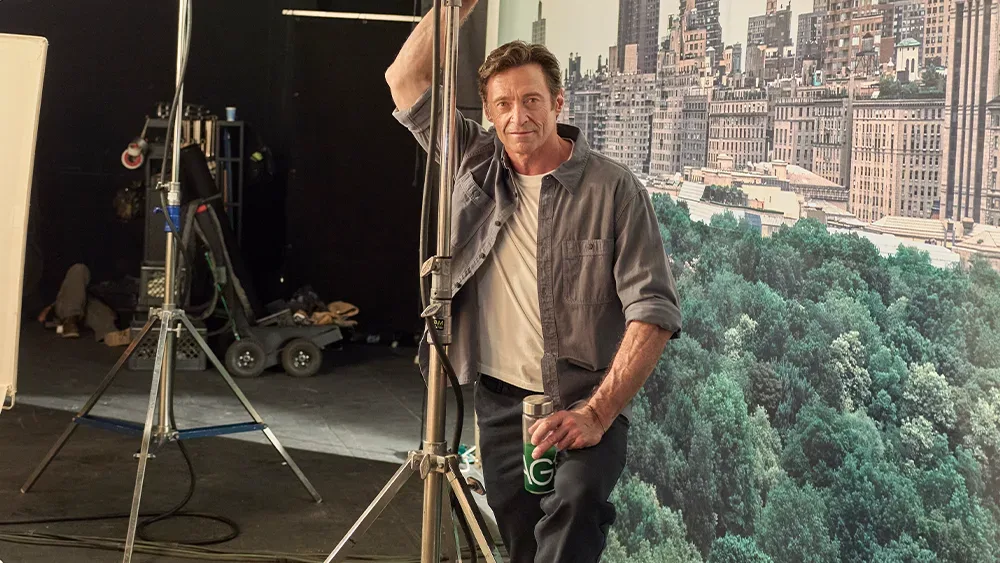
Hugh Jackman may have fronted a new AG1 campaign built around singing through a workout, but the most revealing part of his current public conversation is less the greens powder than the discipline behind the gag. The actor describes a routine constructed for a career that has repeatedly demanded strength, dance, singing, travel and intensely scheduled production days: get up early, make time for meditation, stay active, protect sleep, and train the voice under physical stress when a role calls for it.
That framework matters because Jackman’s public image can make extraordinary physical output look casual. Wolverine’s claws, a Broadway performer’s polish and an action star’s conditioning are all finished products. His explanation of song-and-dance preparation instead points to a demanding, specialized overlap of cardiovascular fitness and breath control. Running hard is one problem; holding a sustained vocal phrase while the heart is racing is another.
There is also a significant professional update tucked between the wellness talk and the superhero non-answer. Jackman is set to star in Ridley Scott’s Treasure Island, adapted from the foundational pirate adventure. Jackman says the script, written by Jack Thorne, convinced him, despite the fact that he had not previously read the novel or watched a film version. He was drawn in by a story whose direction he did not anticipate, and says its ending left him both surprised and satisfied.
A campaign built around a real business relationship
The new advertisement has Jackman singing during a workout, leaning into the musical-theater skills that have long been central to his work away from Wolverine. It is an effective concept because it reflects an exercise he says performers genuinely use: rehearsing songs while running, jumping rope or dancing.
The AG1 arrangement is not presented as a one-off celebrity placement. Jackman says he began using the daily nutritional supplement more than five years ago after a doctor recommended it, and he has been a strategic investor in the company since 2021. He was also named the brand’s global ambassador earlier this year.
Those facts provide important context for viewers assessing the commercial. Jackman says he only takes on endorsements that make sense to him, that he believes in and personally uses. At the same time, he has a financial connection to the company, so his positive comments should be understood as statements from an ambassador and investor, not independent medical guidance.
Jackman attributes several changes to taking AG1, including feeling better, waking more quickly and not getting sick as often. These are personal observations rather than a clinical finding established in the material available here. The conversation also includes a broad claim relayed from his doctor about the difficulty of obtaining everything needed through food while maintaining a busy lifestyle. People considering any supplement should treat celebrity testimony as anecdotal, and seek individualized advice from a qualified health professional—particularly where diet, medication or a health condition is involved.
Why singing during cardio is different from cardio alone
Jackman’s explanation of performance conditioning is more concrete. For a dance-heavy musical number, he says the goal is not simply to hit a high heart rate. A singer needs to remain composed enough to control breath and finish longer phrases without grabbing another breath every few seconds. In his example, that can mean retaining lung capacity and steadiness while a heart rate sits around 160 beats per minute; he also describes ordinary hard running reaching around 170.
Related coverage includes Hugh Jackman Details His Fitness, Meditation and AG1 Routine.
Breath control, in this context, is the ability to manage inhalation and exhalation so that a vocal line remains supported, intelligible and musically shaped. It is not merely the capacity to hold one’s breath. A demanding stage number asks a performer to coordinate movement, timing and voice while recovering from exertion. That is why Jackman considers singing while running, dancing or skipping rope a necessary rehearsal tool for productions with major movement components.
He says he is at his fittest during song-and-dance work, and notices a striking aftereffect once a show has finished: going for a run can feel as if he can continue indefinitely. That is a personal description of his own conditioning, not a universal prescription. But it explains why the campaign’s combination of treadmill work and vocals is more than a theatrical bit. For an entertainer with Jackman’s background, it resembles job-specific preparation.
Jackman recalls hearing about Mick Jagger running 10 to 15 miles daily in preparation for a world tour. Whether or not another performer would use precisely that volume, the underlying point is straightforward: a live show asks the body to repeatedly deliver energy under pressure, often while travelling. Jackman puts sleep at the top of the list of factors that make that sustainable.
The routine is designed to survive call times
Jackman says he was not naturally a morning person. That changed when he held a job opening a gym at 6 a.m. After sleeping in twice, he got a sharp lesson in the expectations of people who have made the effort to attend an early workout. His response was practical rather than glamorous: three alarms. From there, early mornings became habitual.
His current approach during shoots is to protect the routine by shifting the wake-up time earlier. If a call time is especially early, meditation may move to lunch rather than happen immediately after he gets up, but he tries not to drop it altogether. This is a useful distinction between a rigid routine and a resilient one. The exact clock time can change; the core practices remain.
He does not frame the schedule as an argument for minimal sleep. Jackman says he likes seven or eight hours, and sometimes more when possible. That detail is worth emphasizing, especially because high-profile fitness talk can too easily turn punishing schedules into a badge of honor. His message is not that four hours is plenty; it is that, when production demands an earlier start, he adjusts so he can still protect the habits he values.
Place changes the workout, not the intention
Where he is also affects how Jackman begins the day. In Australia, where he says he lives close to the beach, he likes to wake before sunrise and get into the water as the sun comes up. In New York, he says he walks or rides a bike more often, despite the city’s density. The specific activities are different, but the preference is consistent: he likes to be active in the morning.
For anyone looking for a practical lesson without copying a celebrity timetable, this may be the most transferable part. A routine can use what a location makes easy—walking and cycling in one place, swimming in another—rather than requiring identical equipment or a perfect schedule everywhere.
Meditation as a non-negotiable reset
Jackman says he has meditated for 30 years, beginning in his early 20s after a friend introduced him to transcendental meditation through the School of Practical Philosophy. He describes noticing something settled about the friend, asking what was behind it, and then trying the practice himself.
Transcendental meditation is the name Jackman uses for the form of meditation he learned. In his own account, its value is a dependable return point amid busy or difficult circumstances. He describes it as “coming home” to himself twice daily and uses an ocean image: surface conditions can be turbulent, but deeper water remains calm.
That is a personal philosophy rather than a measurable claim about performance. Still, it helps explain why he attempts to preserve meditation on a shoot day even if it must move from morning to lunchtime. The routine does not appear to be about ticking off wellness tasks. For Jackman, it is a way of creating a pause in a life built around public work, travel and high-demand roles.
‘Treasure Island’ is the next firm screen marker
In entertainment terms, the clearest forward-looking detail is Jackman’s role in Ridley Scott’s Treasure Island. The story’s cultural footprint surprised him. He says he knew broad pieces of pirate iconography—treasure maps, pirates and parrots—but did not realize how much of that familiar language traced back to this particular work.
His reason for joining was direct: Scott sent him Thorne’s script, and Jackman found it undeniable. He says he did not know where the adaptation was headed as he read, but felt satisfied by the conclusion. That is deliberately light on plot, role and adaptation details, so it should not be mistaken for a description of what the film will add or change. It does, however, establish that the screenplay was the deciding factor for him, rather than simple recognition of the title.
The project gives Jackman a new literary-adventure role to watch alongside the familiar superhero speculation. It also makes sense that a performer who values physical storytelling would be interested in a tale so strongly associated with maps, voyages, danger and enduring genre imagery—even if the precise shape of this version remains under wraps.
On Wolverine, Jackman keeps the answer locked down
Jackman was asked about possible appearances connected to Doomsday and Secret Wars. He had previously said he would not be in Doomsday, but offered no clarification about the latter. Instead, he responded that he did not know what the question referred to, then joked that he has a literal internal chip that shuts him down if he says the wrong thing.
It is a deliberately playful non-answer, not confirmation, denial or a tease of a specific project. The only responsible reading is that Jackman did not provide new MCU casting information. The joke does demonstrate that he understands exactly how closely any Wolverine comment will be inspected.
That scrutiny reaches beyond film speculation. Wolverine remains a major character across games, comics and physical media, and interest in the character’s broader footprint is evident in discussions around Marvel’s Wolverine and PlayStation’s physical-release questions. But Jackman’s latest comments do not establish a connection to any future game, film or release plan. For now, the concrete story is simpler: he is promoting a campaign, maintaining the habits he says let him meet demanding performance schedules, and moving toward Ridley Scott’s next take on Treasure Island.
Shop the products
Check current price, model and availability at the retailer.