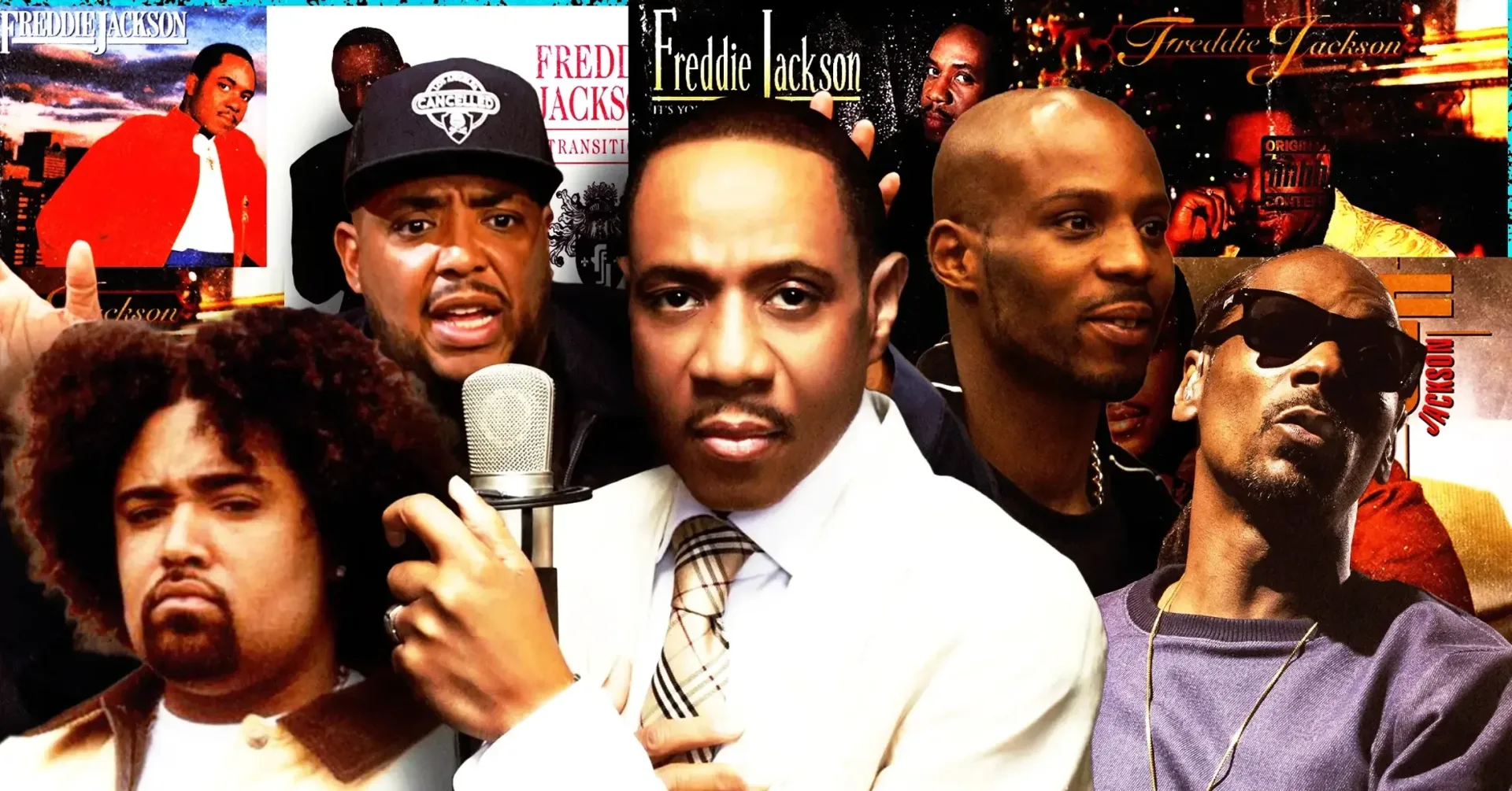
Freddie Jackson’s songs did not remain locked in the decade that introduced them. Two records in particular—1985’s “Love Is Just a Touch Away” and 1986’s “Have You Ever Loved Somebody”—moved from romantic R&B into rap records with vastly different voices, regions and ambitions.
Jackson died on October 5 at age 70, but the ongoing sampling history around those songs offers a useful measure of his reach. Producers and artists did not treat his music as a one-note shortcut to nostalgia. They found basslines, melodic phrases and emotional tones that could withstand major changes in setting. A song first framed around intimacy could become a platform for street reportage, celebration, ambition or hard-earned reflection.
That is one of sampling’s most compelling functions. It preserves a recognizable trace of an earlier recording while placing it in a new argument. The sampled music can carry its original feeling into the room, but the rapper, vocalist and producer may redirect that feeling entirely.
In this case, Jackson’s polished R&B did not have to be made rougher to work in hip-hop. Its smoothness was often exactly the point. The contrast between refined melody and heavier rap subject matter became part of the drama.
What sampling changes—and what it keeps
A sample is a portion of an existing recording incorporated into a new work. It can be a vocal line, a bass pattern, a short instrumental phrase or a broader musical passage. The artists using Jackson’s music did not all approach it in the same way. Some tracks lean on an identifiable melodic connection; others make his groove or bassline part of a new production framework.
That distinction matters. A recognizable hook can function like a piece of shared memory, immediately carrying listeners toward the original song. A bassline or rhythmic figure can be less obvious while still supplying the track’s foundation. Both approaches can retain the character of the source, even if the new song’s subject is nowhere close to its predecessor’s romantic premise.
Jackson’s work was especially suited to that kind of reuse. The records discussed here have lavish, melodic surfaces, but also enough space in their arrangements for producers to hear a different shape underneath. His catalog gave rap artists both atmosphere and structure: warmth for the listener, and a firm musical component around which a new record could be built.
“Love Is Just a Touch Away” traveled widely
Originally included on Jackson’s 1985 debut Rock Me Tonight, “Love Is Just a Touch Away” proved unusually adaptable. Its path through hip-hop crosses New York, Cleveland, Long Beach, the Bay Area and later West Coast R&B-rap collaborations. What connects those uses is not a uniform rap sound; it is the value artists found in Jackson’s groove.
Related coverage includes How Freddie Jackson’s R&B Songs Kept Moving Through Hip Hop.
AZ and Erick Sermon: a smoother foundation
Erick Sermon’s remix of AZ’s “Gimme Yours” uses “Love Is Just a Touch Away,” steering the song toward a warmer and softer feel than the original Pete Rock production. It is a particularly natural match for AZ’s composed delivery. The sample does not erase the darkness that can exist in his writing, but it gives the track an unhurried sense of poise.
This is an example of sampling as tonal framing. Jackson’s music helps establish the record’s atmosphere before every verse has completed its work. The borrowed R&B element makes luxury and tension feel capable of existing side by side.
Foesum: a Long Beach G-funk setting
Foesum’s “Whowouldofeveathought?” from the group’s 1996 debut Perfection takes “Love Is Just a Touch Away” somewhere else. Producers DJ Glaze and Tony G reworked Jackson’s bassline through the track, moving the source into a G-funk context without abandoning the elegance that made it attractive in the first place.
G-funk is a West Coast rap style closely associated with spacious grooves, prominent low end and a relaxed, rolling feel. Here, Jackson’s bass-driven smoothness becomes a natural fit rather than an unexpected contrast. The source retains its polish while the drums and low end give it a distinctly Long Beach direction.
Bone Thugs-N-Harmony: melody as a shared language
“Ain’t Nothin Changed (Everyday Thang Part 2),” from Bone Thugs-N-Harmony’s 1997 album The Art of War, contains hints of “Love Is Just a Touch Away.” The relationship is less about an overtly announced sample flip than a meeting point between musical instincts.
Bone Thugs-N-Harmony’s approach has long made room for melody alongside grief, paranoia, prayer and street-centered storytelling. Jackson came from a different lane, but both sides understood the emotional force of a melodic line. In this pairing, genre boundaries are less important than the expressive role of melody itself.
Mack 10 and Gerald Levert: the title says it plainly
Mack 10’s 1998 The Recipe track “Money’s Just A Touch Away,” featuring Gerald Levert, turns Jackson’s romantic title into an explicit statement about hustle and nearness to success. Freddie Jackson and Barry Eastmond are credited among the song’s writers, while Levert’s hook maintains an R&B connection to the record’s musical ancestry.
The transformation is direct: love’s promise becomes money’s promise. Yet the song does not discard Jackson’s melodic identity. It relies on that familiarity, making the altered destination clear precisely because the listener can still sense the original point of departure.
J. Stalin and The Jacka: atmosphere, then continuity
J. Stalin and The Jacka’s 2006 “Party Jumpin’” samples “Love Is Just a Touch Away” within a looser Bay Area rap setting. Jackson’s music becomes part of the record’s atmosphere rather than an element demanding all of the listener’s attention.
The more revealing detail is that J. Stalin did not leave Jackson’s catalog behind after one use. “Party Jumpin’ 2” later returned to Jackson through a different song, “Have You Ever Loved Somebody.” That makes the R&B singer’s music connective tissue between the two records rather than a single isolated sample credit. The Jacka’s posthumous presence on the sequel gives that continuity additional resonance.
Snoop Dogg and October London: another handoff
On 2022’s “Touch Away,” Snoop Dogg and October London draw from “Love Is Just a Touch Away” nearly four decades after Jackson’s original appeared. By that point, the song had already supplied material to rap records from multiple regions and eras.
That accumulated history changes how the later use can be heard. October London handles the soulful side of the record while Snoop Dogg brings his familiar West Coast ease. The result is less a simple rediscovery than another exchange in a continuing musical lineage. Jackson’s song had already demonstrated that it could move across rap’s regional and stylistic borders without losing its identity.
“Have You Ever Loved Somebody” carried a different kind of weight
If “Love Is Just a Touch Away” frequently offered a durable groove, “Have You Ever Loved Somebody” supplied a question. Released in 1986, the original was rooted in romance and emotional openness. Rap artists repeatedly found ways to keep the yearning while giving it a different object: money, survival, a difficult past or the pressure to become someone.
Glasses Malone, Rick Ross, T-Pain and Birdman: romance redirected
Glasses Malone’s 2009 “Sun Come Up,” featuring Rick Ross, T-Pain and Birdman, samples “Have You Ever Loved Somebody.” The result places Jackson’s romantic foundation beneath a larger-than-life rap record centered on money talk and status.
T-Pain’s melodic hook helps retain a bridge to the song’s R&B origins. Meanwhile, the other performers occupy a dramatically different thematic space. The sample remains recognizable, but its original candlelit mood is replaced by a much louder scale. That tension is the creative point: the new track does not pretend it is still a love song.
DMX: familiarity used to unsettle
DMX’s “Have You Eva,” from 2012’s Undisputed, converts the “have you ever” construction into a series of questions informed by the hard lessons that shaped his rap persona. The tenderness of Jackson’s original falls away quickly.
Its effectiveness rests on contrast. Jackson’s melody evokes warmth and vulnerability, then DMX employs the familiar phrase to prepare the listener for a more severe inventory. A sample can offer comfort through recognition; it can also make the removal of that comfort sharper. “Have You Eva” works in the space between those two effects.
E-40 and Ricco Barrino: yearning for a future
On “Somebody,” E-40 and Ricco Barrino use “Have You Ever Loved Somebody” as an homage while redirecting its yearning toward ambition. The emotional question is no longer solely whether someone has loved you. It becomes whether a person can make something of their life—whether they can become somebody.
That reframing shows why Jackson’s songs could travel so well. Their emotional content was not limited to the exact story of the original lyric. The melodic ache could support another kind of longing, including the drive to build a future and be recognized for it.
A legacy that extends beyond familiar hits
The long afterlife of these two songs also underscores the value of digging past the most obvious catalog selections. Jackson’s music was not simply invoked as a shorthand for an era. Artists found material flexible enough to anchor songs with different tempos, approaches and emotional stakes.
It is a reminder that musical influence is often more complicated than a straight line from one genre to another. The original recording stays intact. The later record neither replaces it nor has to reproduce its meaning faithfully. Instead, sampling creates a conversation across time: a bassline heads to Long Beach, a melodic question lands in a DMX track, and a romantic theme becomes a meditation on ambition for E-40.
That ongoing exchange is also part of how fans keep a catalog active. Conversations about shared culture and the ways people carry art into new settings remain central to fandom, a theme visible in the broader case for IRL fandom. Jackson’s sampling legacy offers a musical version of that participation: artists revisited the work, interpreted it and gave new listeners a route back to the original songs.
Freddie Jackson’s recordings never stopped belonging to Freddie Jackson. Hip-hop simply demonstrated, record after record, that they still had more to say.