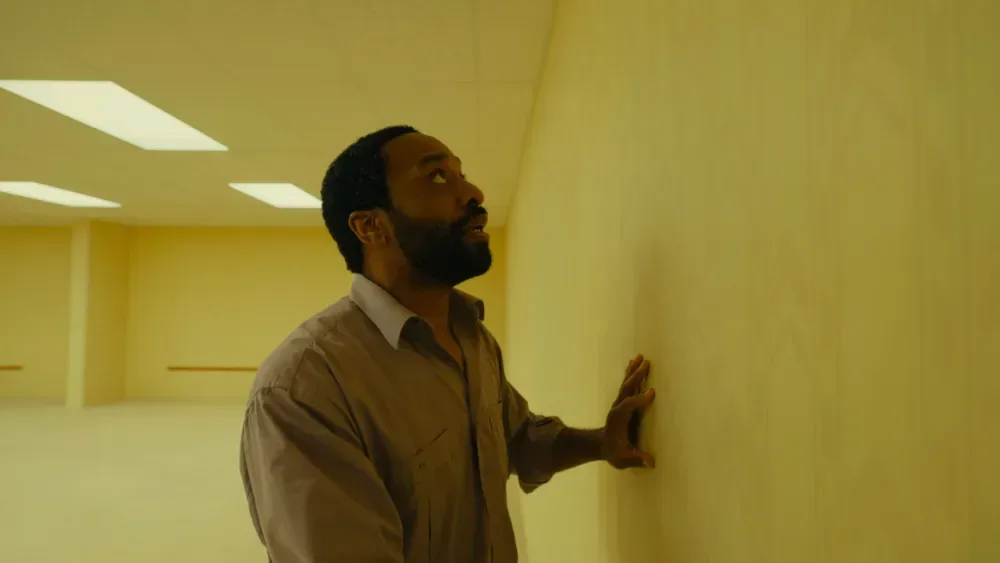
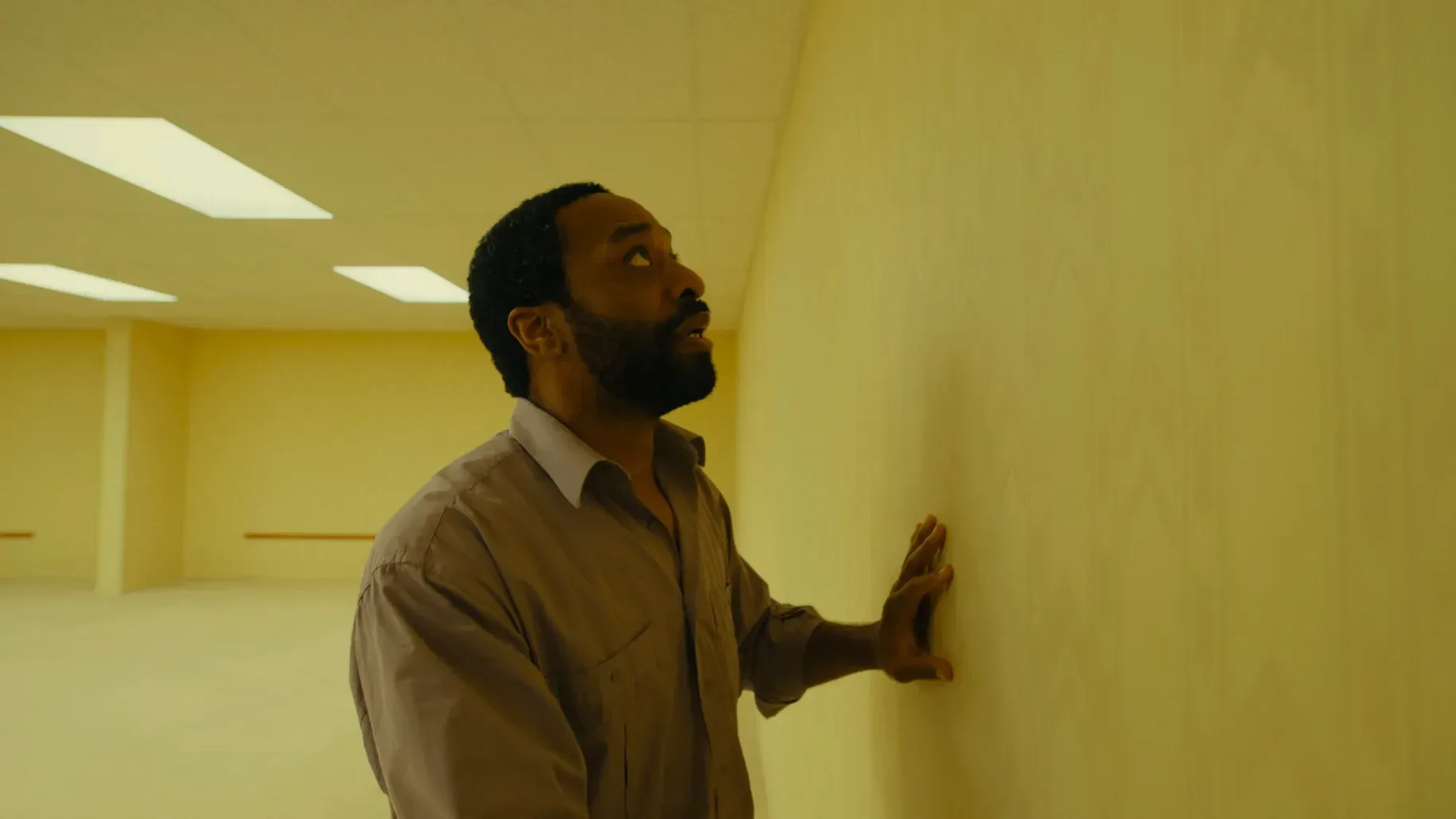
‘Backrooms’ turned an internet-born maze of yellow wallpaper, carpet and impossible architecture into a reported $400 million global box-office success by refusing to make its unreality feel decorative. The film’s central spaces had to be convincingly physical enough for performers and camera crews to inhabit, while visual effects took over precisely where walls, ceilings and spatial logic had to fail.
That balance is the key production story behind the film. The movie grew out of Kane Parsons’ 22-episode YouTube series, whose installments range from two to 45 minutes and explore the mythology of the Backrooms. Yet production designer Danny Vermette and visual effects supervisor Ed Douglas were not initially familiar with the series. Once producer Chris Ferguson brought them aboard, both had to rapidly acquaint themselves with Parsons’ expansive rules, imagery and theories about this strange alternate world.
The result was neither a wholly computer-generated nightmare nor a conventional set-bound production with occasional effects work. It was a hybrid: large practical environments first, then carefully matched digital additions that could make two spaces appear to occupy the same impossible coordinates.
That approach matters because Backrooms horror depends less on spectacle than on certainty. A hallway, ceiling grid or patch of wallpaper has to look ordinary and materially present before the film can persuade viewers that a person or shadow is crossing through it in a way that should be impossible.
From a Blender-built series to a film production pipeline
Parsons built the original Backrooms world in Blender, a 3D creation program used for modeling, animation, computer-generated imagery, rendering, visual effects and simulation. That background created an early technical question for Douglas: should the feature use a standard film visual-effects process, or should it preserve elements of Parsons’ established Blender-based workflow?
The eventual answer was a combined process. Rather than treating the online series as merely a story premise to be translated into an unrelated production language, the film team incorporated Parsons’ way of building the world into its own work. That is a meaningful distinction for an adaptation of a creator-led digital project. The Backrooms’ visual identity was already inseparable from the methods used to make it, so the film had to find a way to scale the imagery without sanding away its particular unsettling texture.
Blender, in simple terms, is software for constructing and rendering 3D scenes. It can be used to create the geometry of a room, determine where lights sit, simulate how a camera moves and produce a finished image. A feature-film visual-effects pipeline, meanwhile, often divides those tasks among numerous specialist stages. The hybrid solution gave the production a bridge between Parsons’ digital foundation and the logistical requirements of a full-scale movie.
Vermette’s work began with a more literal problem: translating lore and imagery into rooms that could actually be built. He spoke with people familiar with the series as well as Parsons, recognizing that he needed to understand the universe’s internal ideas before designing it collaboratively. Familiarity with a fan-driven fictional setting is not automatically the same as understanding how it functions as production design. For this film, the pattern of the wallpaper, construction of the ceilings and behavior of the lighting were all part of the illusion’s grammar.
Why the production built the Backrooms for real
The crew chose to create practical sets wherever actors needed to occupy and interact with the environment. A practical set is a physical construction on a stage or location rather than an element created entirely in post-production. The decision gave performers tangible floors, doors, stairs and walls, but it also gave the visual-effects team something equally useful: a concrete reference for how every material should look on camera.
That reference is especially valuable in a setting defined by repetition. The Backrooms are presented as an endless chain of liminal spaces, including carpeted rooms with yellow wallpaper. Liminal describes an in-between quality: a space that feels like a threshold, passage or place of transition rather than a stable destination. In this case, the unnerving effect comes from ordinary commercial or domestic-looking design repeated and rearranged until it becomes alien.
A real build establishes the small visual details that make digital work believable: how light falls across a wall, where a ceiling panel meets its frame, what scale a hallway has beside an actor and how shadows behave in the space. Vermette’s guiding idea was to carry the physical world as far as budget and available floor space would allow, then extend and enhance it through VFX.
The production ultimately used four stages and more than 30,000 square feet of sets. That scale indicates that the practical component was not a token foreground built solely for close-ups. The film made substantial room for actors to move through its world, while reserving digital intervention for the point where an ordinary construction could become spatially impossible.
The furniture-store threshold and the craft of “clipping”
Set in 1991, the film follows Chiwetel Ejiofor’s Clark, an owner of a furniture emporium. Clark finds a portal in his store’s basement and becomes consumed by the alternate world beyond it. The layout of that first transition was designed to support a particularly clean camera illusion: the basement sat next to the first Backrooms space, allowing actors to walk from one environment to the other and the camera to travel with them.
During filming, blue screens were positioned on both sides of the transition. In post-production, the visual-effects team added the walls back into the image. Blue screen is a method in which a colored surface is used as a replaceable background or area; in post-production, artists isolate that color and composite, or layer, another image into the shot. Here, it gave the production a way to begin from a physical set and selectively erase or rebuild boundaries after photography.
The desired effect was not a glowing portal or a magical ripple. Douglas described a visual language without the usual fantasy cues: no sparkles, distortion or rippling surface to signal a breach between worlds. Instead, the film treats the moment as two computerized objects passing directly through each other.
“Clipping” is the useful technical term here. In 3D graphics, clipping is commonly used when objects improperly intersect or pass through one another because the system does not recognize a solid collision between them. It can look like a visual error in a game or digital scene. ‘Backrooms’ turns that normally unwanted behavior into the terrifying rule of its universe. A wall is still visibly there; the shadow or body crossing it simply does not obey the physical boundary.
That restraint makes the effect more demanding, not less. If an image is obscured by a vortex, glare or obvious energy effect, minor mismatches can disappear into the spectacle. A clean, unadorned intersection leaves nowhere to conceal an inaccurate edge, shadow or alignment. The physical and virtual elements must match with exceptional precision.
The Vertigo Room’s vertical illusion
One of the feature’s most ambitious spaces is the Vertigo Room, discovered by Mary, played by Renate Reinsve, as she runs from Pirate Clark. The filmmakers found a downtown Vancouver building owned by a bank and hollowed out a skyscraper for the construction. The emphasis in this sequence was vertical liminal space: rather than simply extending hallways outward, the design had to make elevation and architecture feel disorienting.
The sequence again depended on dividing the physical set from the digital continuation at practical points. The portions Mary physically touches and climbs were built. The hallway leading into the space was a separate set with a separate door, while an L-shaped arrangement allowed the production to transition into the next part of the action. The ceiling continued far enough for the practical portion to hold up in the shot, and the stairs, small trap door and tiles Mary climbs were real.
Those choices served performance and safety as well as imagery. Reinsve had enough physical structure beyond the doorway to hoist herself upward. This is an important practical lesson in how effects-heavy scenes are constructed: the final image may suggest an enormous, unstable environment, but the actor needs a reliable and safe piece of architecture to perform against. The digital extension can make that real construction seem much larger or stranger, but it cannot replace the need for a workable set at the point of contact.
In that sense, the Backrooms were built with a deceptively disciplined method. The movie’s spaces derive their force from ordinary surfaces and exact geometry, then use effects to break the contracts viewers assume those surfaces obey. It is an adaptation strategy that respects the source material’s internet-native construction while recognizing that cinema benefits from a performer being able to stand in the room, touch the wall and climb the stairs before the room reveals that it is not really a room at all.
For more on another filmmaker-led story rooted in a specific local perspective, see ‘Gugu’s World’ and its focus on a young star and a local Brazilian story.