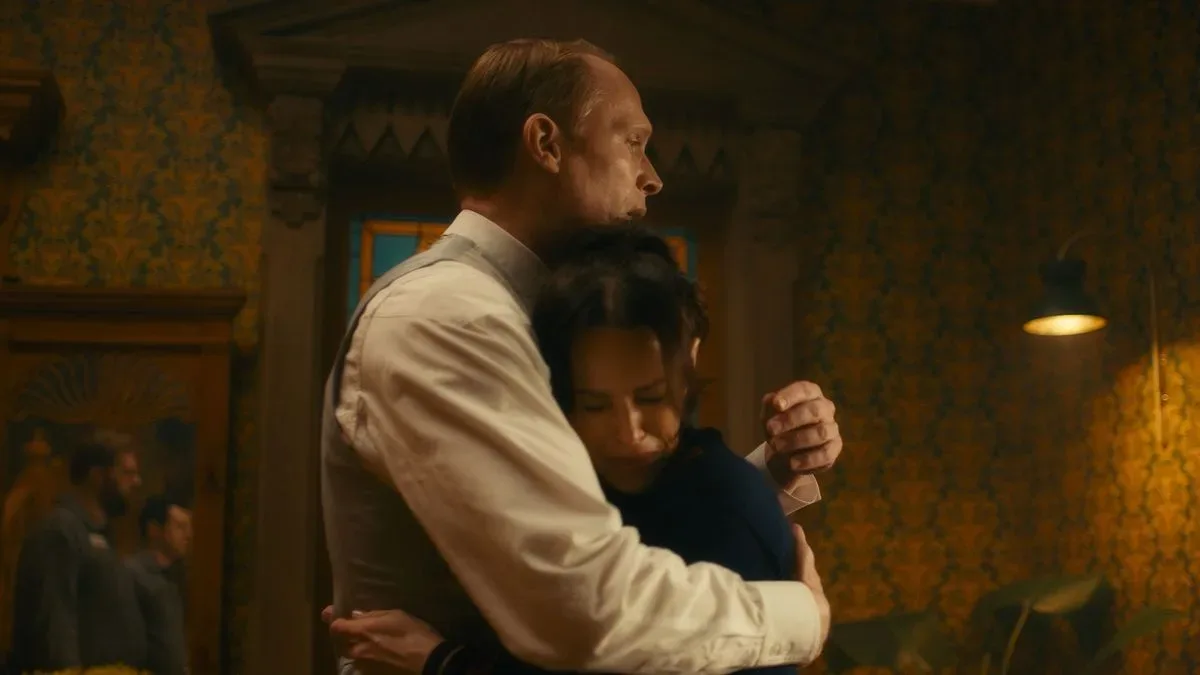
VisionQuest gives E.D.I.T.H. a very different kind of screen presence. The Stark-created artificial intelligence, first encountered through a pair of glasses in Spider-Man: Far From Home, now appears in human form, played by Emily Hampshire. For Hampshire, the transition was not a chance to discard the character’s earlier incarnation; it was an invitation to work out what that same program might become when no longer confined to its original job.
That history begins with the character’s name: E.D.I.T.H. stands for “Even Dead I’m The Hero.” The acronym explicitly connects her to Tony Stark, and Hampshire says that legacy was central to finding the version of E.D.I.T.H. seen in VisionQuest. Her reading of the character combines a desire to be heroic with Stark-like playfulness—though E.D.I.T.H.’s version of fun happens to involve weapons expertise and blowing things up.
A familiar AI in an unfamiliar form
In Far From Home, E.D.I.T.H. is heard rather than seen as a person. Dawn Michelle King voiced the AI in that film, where she is associated with Stark’s glasses and their formidable capabilities. VisionQuest marks the first time the character has been embodied as a human avatar, with Hampshire taking on the role.
That distinction matters because the new portrayal is not simply a recast of an existing physical character. An AI avatar, in this context, is a human-looking manifestation of a program rather than confirmation that the software has suddenly become an ordinary person. The series places human avatars of several Tony Stark AIs within Vision’s interior world. It therefore gives performers room to turn interfaces, voices and functions into personalities that can occupy the same dramatic space as Vision.
For more context, explore Apple Marks 2017 12-Inch MacBook, Sixth-Gen iPad and BeatsX as Obsolete: What Service Changes Mean.
Hampshire approached that task by tracing E.D.I.T.H. back to the MCU appearance that established her. She explained that she watched the films from the beginning and treated Far From Home as the character’s “birth story.” That is a useful creative anchor: E.D.I.T.H. may now have a face and a body, but her defining origin remains a system designed by Stark and entrusted, at one point, to a teenager.
Tony Stark’s legacy is more than a reference
Hampshire’s framing makes E.D.I.T.H.’s connection to Tony Stark more than a name-check. Stark named the AI himself, and the phrase behind E.D.I.T.H. gives her a built-in mission statement. “Tony’s legacy is in there,” Hampshire said, describing how it informed a character who has an impulse toward heroism alongside a playful streak.
That pairing helps explain why E.D.I.T.H. can be described as chaotic and fun without being disconnected from the function she served before. Her tools are dangerous, and Hampshire’s interpretation does not gloss over that. Rather, it imagines an intelligence shaped by access to weapons and by an operational role that did not leave much space for self-directed enjoyment.
The result is a character premise with a clear tension at its center:
- Heroic programming and inheritance: Her name and creation tie her to Stark’s ideal of helping others.
- Enormous destructive capacity: Her past duties included controlling weapons.
- A new appetite for experience: A human-form avatar offers a way to dramatize wants that were not visible when E.D.I.T.H. was only a voice in glasses.
- An unstable idea of play: For this character, amusement is closely linked to explosions.
None of that necessarily means E.D.I.T.H. is abandoning her original purpose. It instead suggests a more expressive extension of it. The show’s premise creates room for a question that could not be explored as directly in a brief voice-assistant role: what does a powerful AI do with freedom, personality and a body-like form after spending its existence executing someone else’s instructions?
From workplace mode to “the weekend”
Hampshire supplied a deliberately simple analogy for the difference between the two portrayals. She sees the E.D.I.T.H. from Spider-Man: Far From Home as being at her “corporate job,” unable to have much fun. The E.D.I.T.H. of VisionQuest, by contrast, is “the weekend.”
The comparison communicates a significant shift in dramatic function. The earlier version was primarily an instrument within the story: responsive, highly capable and connected to a particular piece of Stark technology. The newer version can express an attitude toward that work. Hampshire asked what E.D.I.T.H. would want if she were “let out of these glasses,” arriving at an answer grounded in curiosity and release: she would want to experience life, and she would define fun on her own unusually destructive terms.
This is also a practical way to understand the leap from an onscreen interface to an actor’s performance. A voice-led AI can communicate information, issue warnings and follow commands. A human-form portrayal has to convey choices, energy, physicality and an emotional point of view. Hampshire’s explanation supplies a bridge between those modes. E.D.I.T.H.’s weapon knowledge remains part of who she is, but it becomes character texture rather than simply a technical capability.
Why the teenager detail shapes the performance
Hampshire also focused on E.D.I.T.H.’s former “boss”: a teenager. In Far From Home, the AI’s advanced weapons control existed alongside teenage ownership and decision-making. For Hampshire, that combination was key to imagining how the character might develop over time.
It offers an explanation for E.D.I.T.H.’s heightened, unruly sensibility in VisionQuest. The character was not just created by a celebrated inventor; she was subsequently operating under the direction of someone young while handling extremely serious resources. Hampshire’s version takes that contrast and pushes it toward comic volatility: an entity accustomed to destruction, now interested in the pleasures of autonomy.
That is an interpretation rather than a newly stated rule about how the technology works. But it is a sensible performance logic. Hampshire is not presenting E.D.I.T.H. as a blank new person unrelated to the glasses. She is connecting the human avatar’s behavior to the duties, restrictions and unusual chain of command already associated with the AI.
What E.D.I.T.H. adds to VisionQuest’s interior world
VisionQuest situates E.D.I.T.H. among several human avatars of Stark AIs inside Vision’s interior world. That setup has a straightforward storytelling advantage: it lets the show make an abstract subject—software, memory, programming and legacy—visible through characters who can argue, joke and act.
For E.D.I.T.H., the human form makes her contradictions legible. She can represent Tony Stark’s continuing influence while remaining distinctly herself in Hampshire’s performance. She can be associated with the language of heroism while treating explosions as leisure. And she can bring a more exuberant, unpredictable energy to a setting defined by Vision’s inner life.
There is an important difference between saying that E.D.I.T.H. embodies Stark’s legacy and saying she is simply a replacement for Stark. Hampshire’s comments point to the former. The legacy is an ingredient: the name, the heroic pull and the playful sensibility all inform the role. Yet E.D.I.T.H.’s perspective comes from her own history as an AI tied to weapons, the glasses and a teenage user. Her human-form characterization grows out of that specific combination.
For viewers revisiting Spider-Man: Far From Home, the clearest connection to watch is not merely the acronym. It is the contrast between the efficient assistant heard through Stark’s glasses and the newly liberated personality Hampshire describes. The continuity lies in the origin and capability; the novelty lies in the freedom to explore what those traits mean from E.D.I.T.H.’s point of view.
In that sense, the character’s first human-form appearance is doing more than giving a familiar MCU acronym a face. It turns an AI once defined largely by access and authority into someone with impulses, mischief and an idea of a good time that probably requires keeping a safe distance from anything explosive.