Warning: This article discusses major spoilers for episode 8 of Carrie.
The last episode of Mike Flanagan’s eight-part Carrie adaptation does not treat the Ewen High catastrophe as a simple scorecard of who deserved what. That is a crucial distinction for Matthew Lillard’s Principal Henry Grayle and Amber Midthunder’s gym teacher Rita Desjardin, two adults positioned much closer to Carrie White than most of the people around her—and still unable to stop the disaster.
Lillard and Midthunder have addressed their characters’ grim, and in one case deliberately unresolved, outcomes by stressing the tragedy embedded in the story rather than looking for tidy moral arithmetic. Their comments point to one of this version’s defining choices: it gives viewers more time with a wider group of characters, then makes the final destruction harder to process as a clean divide between villains, victims, heroes and bystanders.
All eight episodes are streaming on Prime Video.
Henry Grayle’s fate makes the catastrophe feel bigger than one room
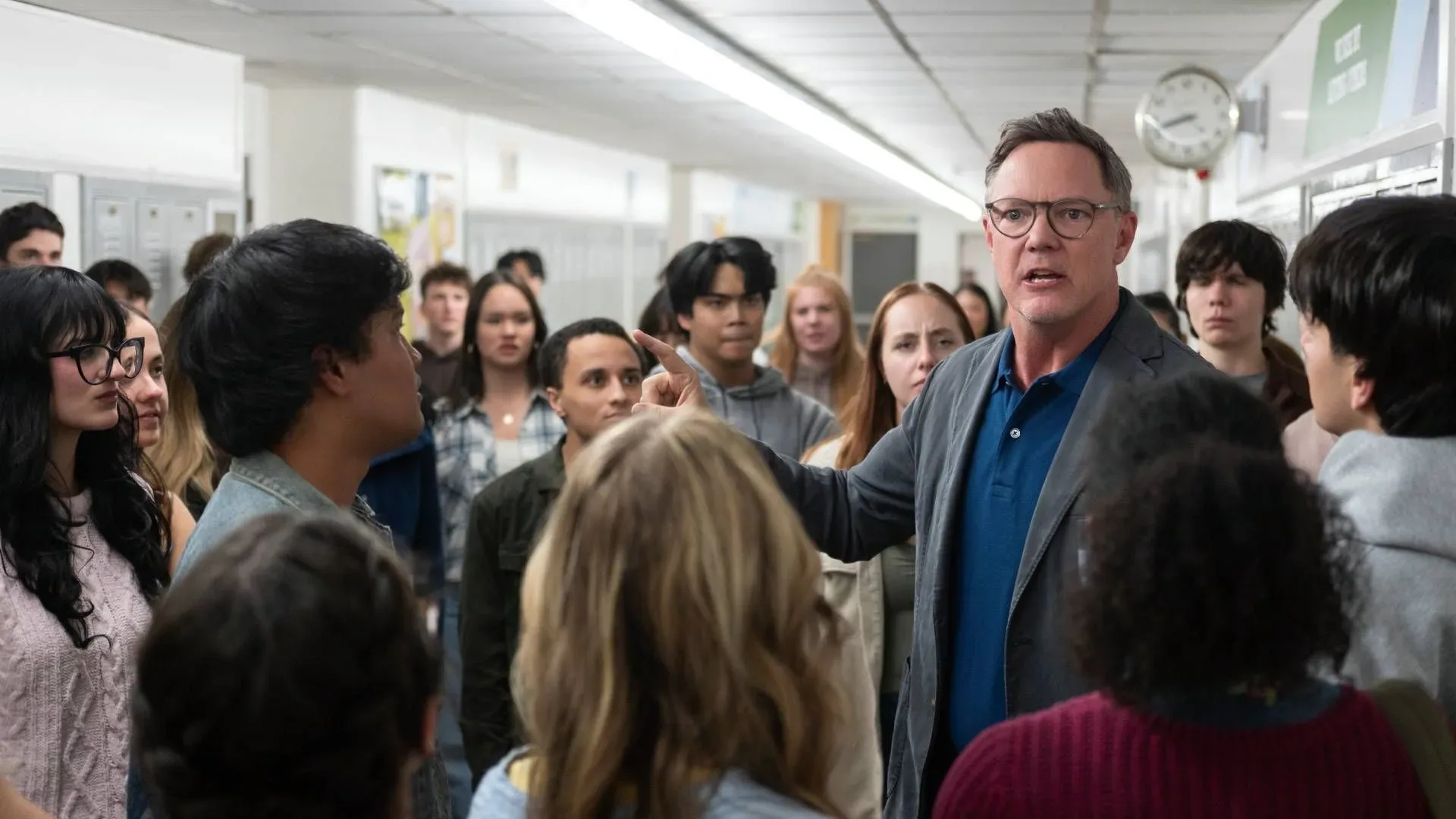
Lillard plays Henry Grayle, Ewen High’s principal. Grayle is well-intentioned, but he is plainly outmatched by the situation around Carrie: her mother Margaret White is not an ordinary parent, and Chris Hargensen’s cruelty is not ordinary school conflict. The character’s position matters because a principal represents institutional authority. Grayle has responsibility, but neither enough understanding nor enough control to prevent events spiraling outward.
In episode 8, Grayle is electrocuted during the prom chaos. Lillard said he places his faith in Flanagan’s reasoning for the character’s end, while framing it as part of the story’s central tragic movement: Carrie is overwhelmed, loses control, and the destruction ultimately extends across the town.
“First and foremost, in Mike Flanagan, we trust,” Lillard said. “Like, if you ask him, he will have a reason.”
That trust is not an argument that Grayle’s death is fair. It is an acknowledgment that Carrie is built around consequences that exceed any single character’s intentions. Grayle is not presented as the person responsible for everything inflicted on Carrie, but good intentions do not create a safe exit once the violence begins. His death underscores how quickly the prom turns from an event with social rules and adult supervision into something no one present can manage.
Lillard described the story as a “tipping point,” rather than a straightforward morality tale. That phrase is useful in this context. A morality tale usually promises a relatively direct lesson: behave badly and be punished; behave well and be protected. A tipping-point tragedy is more uncomfortable. It focuses on accumulated pressure, failures of intervention, and the moment at which events move beyond recovery.
He also connected the material to contemporary fears around violence involving young people, saying it can work as an allegory for what happens when kids can no longer endure what is being done to them. That is an interpretation voiced by Lillard, not a claim that the series reduces its supernatural horror to a real-world incident. The point is that the story’s emotional machinery—humiliation, isolation, adults failing to recognize danger soon enough, and an explosive breaking point—can evoke anxieties viewers bring to it.
An adaptation history that makes Grayle’s scene especially pointed
Grayle’s presence at prom, and his death there, are not inevitable features of every Carrie version. In Stephen King’s 1974 novel, the principal does not attend the prom and is presumed to leave education after the massacre. The 1976 film changes that setup: the character is renamed Principal Morton and is electrocuted onstage. The 2002 remake also gives the principal an electrocution death.
Flanagan’s series therefore works within a recognizable adaptation pattern while putting its own emphasis on the moment. The sequence is prolonged, turning an established plot outcome into an extended confrontation with the horror rather than a brisk reference to an earlier version.
This is one of the ways adaptations can remain connected to a source’s legacy without simply repeating it. A recurring plot beat can acquire a different effect depending on the surrounding characterization and the amount of time a story spends establishing the people caught in it. Here, the expanded episodic format means Grayle’s death arrives after viewers have watched him attempt to comprehend dangers he was not equipped to handle.
The result is less about surprise than escalation. The audience may recognize where the event is headed, but recognition does not make it less bleak. If anything, it reinforces the sense that Carrie stories return to this moment because the destruction is designed to feel preventable until it suddenly is not.
Rita Desjardin’s disappearance leaves a different kind of wound
Midthunder’s Rita Desjardin occupies a more openly protective role. She is the gym teacher who appears to be looking out for Carrie when others will not. That does not make her an all-powerful rescuer, and the finale makes the limitation painfully clear.
During the chaos, Rita calls Carrie’s name and is knocked backward into the burning gymnasium. The series does not show her death, but it also does not show her again. The uncertainty is therefore significant: Rita’s fate is left unconfirmed onscreen, rather than resolved through a definitive image or later appearance.
That ambiguity separates this incarnation from prior versions. In the novel, Desjardin survives the prom massacre, quits education, and carries substantial guilt over her failure to prevent what happened. In the 1976 film, she dies after protecting Tommy from danger. She survives both the 2002 remake and the 2012 remake.
For viewers, the unresolved ending is not merely a continuity question. It changes the emotional texture of the sequence. A confirmed death draws a line under a character’s arc. Rita vanishing into the burning gym leaves the audience with absence: the person who tried to see Carrie most clearly is suddenly removed from the story at the moment recognition might matter most.
Midthunder highlighted the moments before the catastrophe, particularly Carrie’s struggle with herself and with her power. She also emphasized that this expanded version allows more attention for Carrie and the supporting cast alike. In her reading, that fuller perspective makes it more difficult to decide who is entirely good, entirely bad, or easiest to root for.
“You see everybody in a very different and detailed and humanized sort of way that makes the sort of picking, like who’s good and who’s bad and who are you rooting for, a lot more difficult,” Midthunder said.
That does not erase Chris Hargensen’s bullying or Margaret White’s abusive behavior. Humanization is not exoneration. Instead, it means the show asks viewers to consider how a community gets shaped by people with different degrees of cruelty, fear, passivity, care and power—and how none of those categories guarantees safety once Carrie’s grief and rage become destructive.
Why the longer format changes the familiar tragedy
Calling this iteration “expanded” is more than a question of episode count. It describes a storytelling approach in which the major players around Carrie receive more room to register as people before the final nightmare claims them, transforms them, or leaves their futures uncertain.
That approach makes Rita’s apparent concern for Carrie more consequential because viewers understand that concern as part of an ongoing relationship rather than a single last-minute intervention. It likewise gives Grayle’s limitations more meaning: he is not simply a disposable authority figure placed in harm’s way, but an administrator discovering too late that the problem in front of him is larger and more dangerous than he understood.
There is a wider pop-culture context for that kind of adaptation work. Horror creators frequently move between mediums and reinterpret familiar material through a distinct sensibility; as another example of a filmmaker discussing the pull and difficulty of game storytelling, Guillermo del Toro’s comments about games and his BioShock history show how much a creator’s relationship to a property can shape expectations. In Carrie, the supplied details suggest Flanagan’s emphasis is less on treating the prom as an isolated set piece and more on tracing the human pressure surrounding it.
Midthunder credited that approach to a desire to be faithful to Stephen King fans while also speaking honestly to younger people now. “Everybody felt seen” is a large ambition for a story in which nobody leaves unscathed, but it helps explain the series’ resistance to simple labels. Seeing a character does not mean saving them. It can mean granting their fear, failure, guilt or care enough weight that the outcome hurts.
The key question is not just who survives
For longtime followers of Carrie, adaptation differences will naturally invite questions about the fates of Grayle and Desjardin. Grayle’s electrocution aligns him with the principal’s death in the 1976 film and 2002 remake, although the series devotes more extended attention to it. Rita’s situation remains less settled: she is hurled into the burning gym, yet viewers receive no explicit confirmation of death or survival.
But the actors’ comments indicate that the more important question is why these fates land as they do. Grayle’s death broadens the scale of a catastrophe that has outgrown any individual’s ability to contain it. Rita’s disappearance places particular weight on the limits of compassion and intervention. Her concern for Carrie is real, but it cannot undo the injuries already done or halt the devastation in progress.
That is the cruel engine of Carrie. The story does not present destruction as arising from one neat cause or one easily corrected mistake. It is the consequence of a young person pushed past a breaking point, a system that responds inadequately, and a power that makes an emotional collapse catastrophic for everyone nearby. The ending’s unanswered questions, especially around Rita, preserve that unease instead of offering a comforting inventory of survivors.