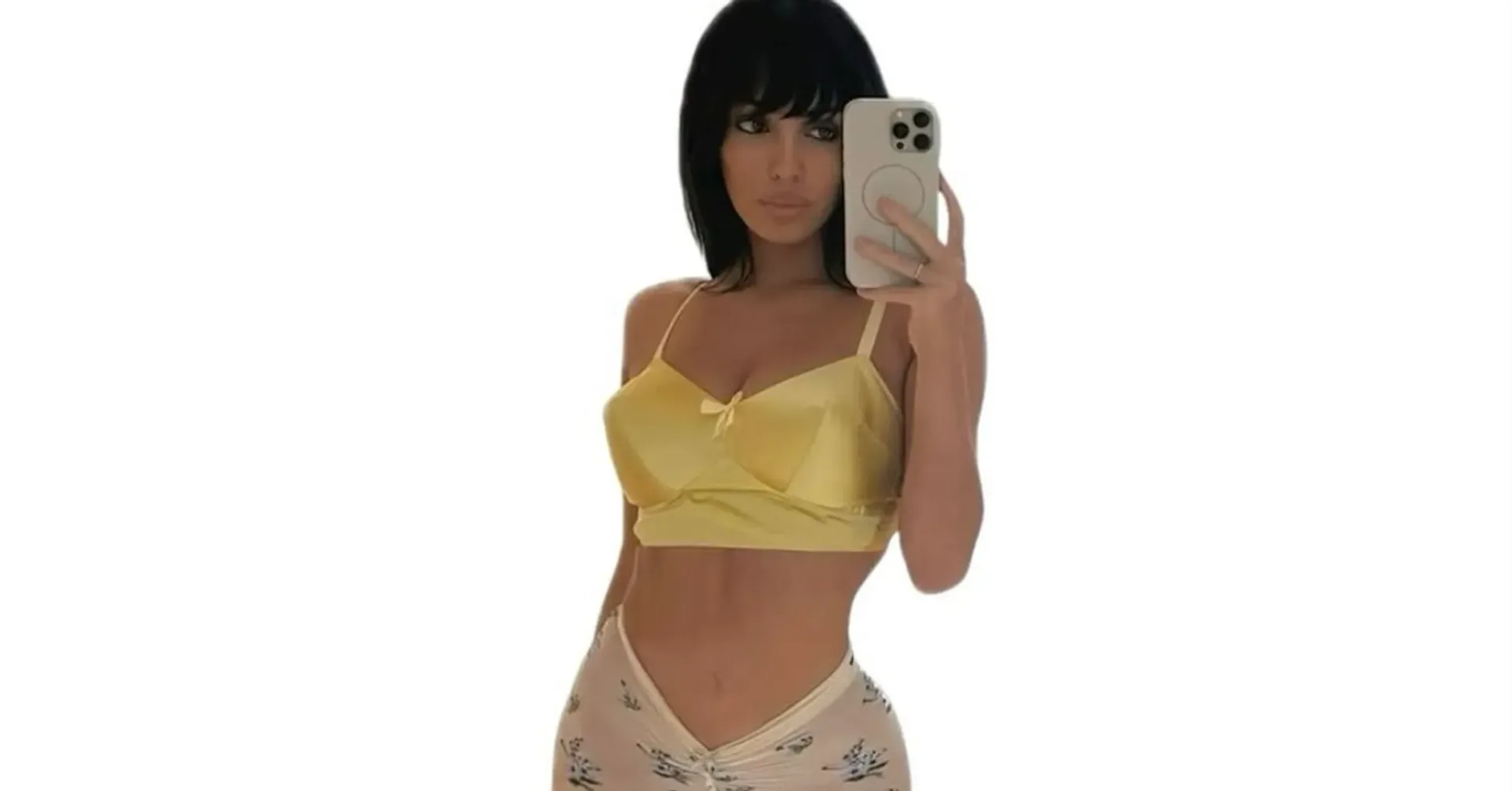
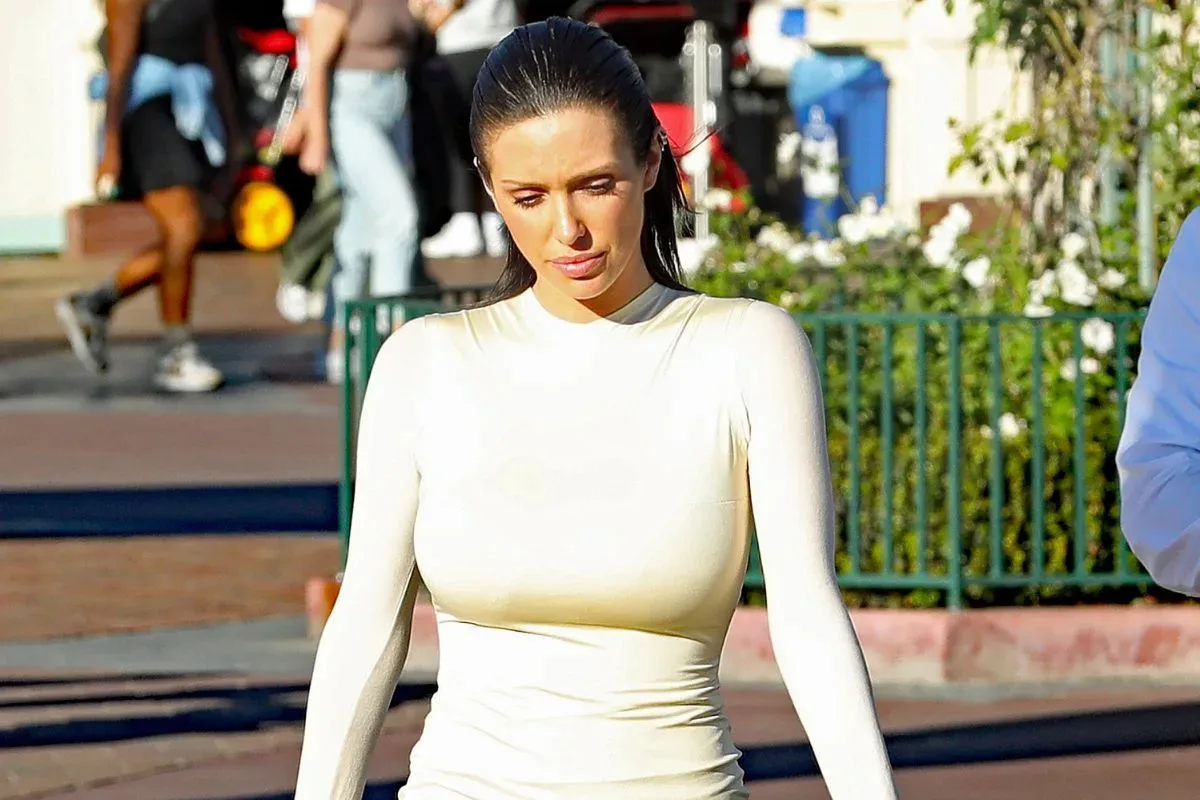
Bianca Censori’s next art installation turns the familiar gallery interaction into something deliberately more uncomfortable: visitors are being asked to kneel before addressing a 10-foot robotic double of the artist.
The work, Bianca Is My Baby Doll, is scheduled to open in New York on December 14. It is a large-scale self-portrait constructed as a moving machine, with 25 axes of movement, and is described as responding to visitors in Censori’s own voice. Attendance is not presented as a simple walk-in encounter: prospective visitors can request a place through the exhibition website by selecting a date and supplying their name and email address, after which organizers will provide further details if attendance is confirmed.
That setup matters because the exhibition is not only presenting a robot that resembles its maker. It makes the visitor’s body part of the work, requiring a posture normally associated with prayer, submission, loyalty or reverence before an interaction can begin.
A self-portrait built around authority
Censori has framed the installation as an examination of “manufactured authority” at the beginning of a “synthetic age.” The question at its center is direct: what do people believe, and who—or what—do they bow to?
“Synthetic” here refers broadly to something constructed or technologically simulated rather than naturally occurring. In this case, the robot is neither just a sculpture nor merely a screen-based likeness. Its scale, motion and voice are intended to create the conditions of a face-to-face encounter. The result is closer to an embodied avatar: a physical stand-in designed to represent a person and conduct an exchange in their place.
The phrase “25 axes of movement” indicates that the machine can move across 25 separate directions or joints of control. An axis is a direction around or along which a mechanical part can move. That specification signals a robot built for more than one fixed gesture, though the available information does not identify which individual motions it can perform, how it recognizes questions or what limits may be placed on its answers.
The voice component is equally central. The installation is said to answer in Censori’s own voice, but that should not be confused with Censori herself being physically present or necessarily speaking live. The announced format places her vocal likeness inside a machine version of her body. It is an arrangement that invites visitors to confront a familiar modern ambiguity: when a person’s face, voice and behavior are reproduced through technology, what exactly are they responding to?
The required kneeling makes that ambiguity much sharper. A conventional interactive exhibit might ask attendees to press a button, offer a prompt or stand before a sensor. Here, access to the conversation is framed as a ritual. The person has to lower themselves before the representation of an artist, not the artist in person. That distinction appears to be the point.
“The Idol” in the larger Bio Pop cycle
Bianca Is My Baby Doll is not being presented as an isolated stunt. Censori identifies it as “The Idol,” the second named entry in a seven-part series called Bio Pop. The project uses Censori’s own likeness as a recurring material, making identity, spectacle and control part of the series’ structure rather than incidental details.
The first installment, “The Origin,” was staged in Seoul on December 11 and 12, 2025. In that performance, Censori began in a kitchen wearing red latex and baking a cake. She then carried the cake into a dining room, where masked women made to resemble her were positioned at a table.
Those performers were held within furniture pieces designed to contain their bodies. The structures used brushed metal, pale upholstery and padded areas likened to medical-crutch padding. The visual language joined domestic objects—kitchen, dining table, furniture—with containment and enforced positioning. “The Origin” was also livestreamed, allowing people outside Seoul to watch in real time.
There is a clear connective thread between that first installment and “The Idol.” “The Origin” placed human bodies resembling Censori into designed structures; “The Idol” places Censori’s likeness into a robotic structure. One work foregrounds living performers within furniture, while the other places the visitor in a prescribed position before a machine. Both put the body under direction, whether it is the body being displayed or the body expected to participate.
That does not mean the two works operate identically. The Seoul event appears to have been a live performance involving several people and a staged domestic setting. The New York piece is identified as a robotic self-portrait, with its interaction organized around a visitor and a machine. Still, the progression from “The Origin” to “The Idol” gives the series a visible escalation: likeness becomes replication, and replication becomes an authority figure that can speak back.
Why the visitor’s role is the real mechanism
Interactive art is often discussed in terms of participation, a word that can sound voluntary and neutral. This installation complicates that idea. Visitors are not just invited to take part; they are asked to adopt a specific physical relationship to the work before posing a question.
Kneeling is powerful because its meaning is not fixed to one institution. It can signal devotion, humility, obedience, vulnerability, ceremony, protest or performance. By placing it at the entrance to a conversation with a robot, Censori turns an ordinary question-and-answer exchange into an encounter shaped by hierarchy. The person asking the question begins below the object answering it.
The work’s title adds another tension. Calling a 10-foot machine “my baby doll” combines language of care, possession and play with an object of monumental scale. Dolls are usually held, arranged and controlled by their owners. An “idol,” by contrast, is elevated and revered. The project’s subtitle, “The Idol,” and its larger title pull those opposing roles together: an object that sounds owned and childlike, yet is staged as something visitors may be expected to bow before.
That reversal is also the practical engine of the exhibition. The robot’s stated ability to answer questions is likely to draw attention, but the bigger artistic question is whether visitors accept the terms of that response. The installation therefore asks people to consider not only whether a voice feels authentic, but whether an authoritative presentation can make a simulation seem worthy of deference.
Questions around mediated identity are surfacing across entertainment as creators and productions increasingly build security, access rules and technical barriers into the handling of sensitive material. In a different corner of pop culture, a production’s use of layered access controls was recently discussed in connection with a closely guarded script; that five-factor-authentication approach highlights how identity and permission can become part of the experience surrounding creative work. Censori’s installation approaches control from another angle: not who is permitted to read material, but what a visitor must do before receiving an answer from a constructed persona.
What is known—and what remains open
Several important details have been established. The New York exhibition is slated to open December 14. The robotic self-portrait stands 10 feet tall, took five years to develop and has 25 axes of movement. It is expected to answer in Censori’s voice. Visitors interested in participating can submit an attendance request through the exhibition website.
Other details have not been specified. There is no description of the scope of the robot’s conversational ability, the kinds of questions it will answer, whether responses are predetermined or generated during the exchange, or the degree to which its voice is performed, recorded or otherwise produced. There is also no indication of how long individual interactions will last or how many guests will be admitted at once.
Those unknowns are significant, particularly because language such as “answer” can suggest a broad conversation when an installation may instead have tightly designed boundaries. The available description supports the fact of a voice-based interaction, but not assumptions about the robot’s intelligence, autonomy or technical method.
The next announced Bio Pop work is “Confessional,” listed for 2027. The final installment, “Bubble,” is planned for 2032. Between those points, the series has room to develop its recurring concerns: the artist as image, image as object, object as authority and audience as participant.
For now, “The Idol” presents its most provocative proposition upfront. It is not simply a question of whether a robot can look and sound like Bianca Censori. It is whether the social rituals people bring to images of power can be transferred to a machine—and whether they will recognize that transfer while they are doing it.