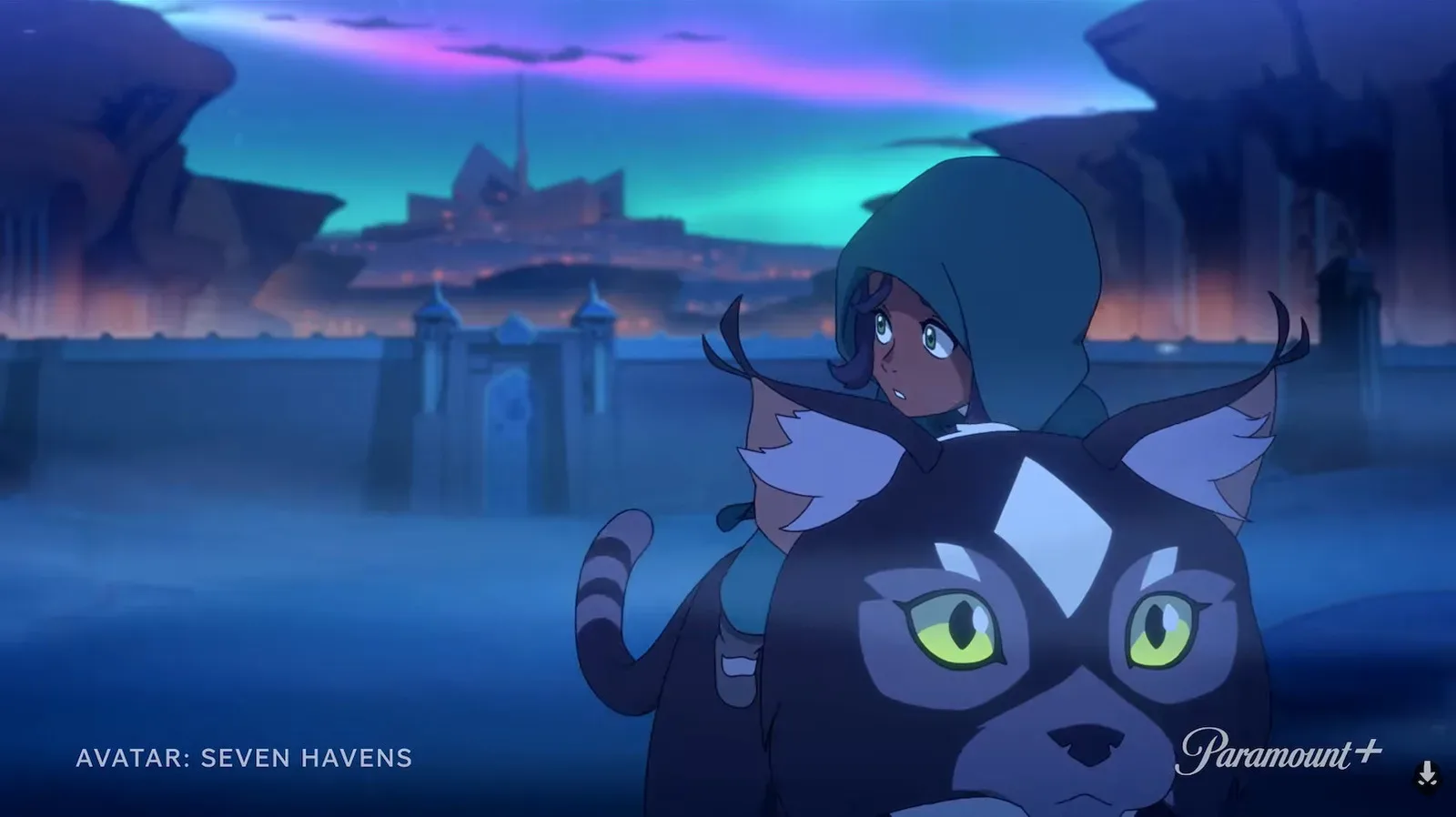
It has taken only a handful of Avatar: Seven Havens episodes for Captain Karthik to become one of the series’ most closely watched characters. The airbender, voiced by Akshay Khanna, arrives with an impressive set of labels: a member of the Order of the White Lotus, a figure known as the Human Hurricane and Warrior of the Wind, and a surrogate-father presence to the new Avatar, Nisha.
He also has the visual and emotional shorthand of a character viewers immediately latch onto: brown hair marked by white streaks, scruff, worn-looking eyes, a dry patience with the twin leads, and a mixture of gentleness and sternness. That combination has already produced plenty of admiration across the fandom. But in a story where the Avatar is viewed with suspicion, a calm guardian who seems to know more than he says is rarely going to escape scrutiny.
That scrutiny is now forming into an early fan theory: Captain Karthik may not be a straightforward mentor at all.
The moment that put Karthik under suspicion
The strongest point of concern so far is Karthik’s approach to Nisha. He can be protective and composed, but he is also forceful in his orders and convictions. In one particularly sharp exchange, he scolds Nisha and tells her to “remember [her] place.”
That line does not prove that he is secretly malicious. It does, however, establish a meaningful tension between Karthik and the show’s central sisters. Nisha is an Avatar, a title associated with the ability to manipulate all four elements. A demand that she know her place can sound less like practical guidance and more like an attempt to define the boundaries of her autonomy.
There is an important distinction here. A difficult mentor, an authoritarian protector, and a hidden villain are not interchangeable character types. Karthik might be strict because he sees genuine risks in a world distrustful of the Avatar. He might believe that Nisha needs rules to survive. Or he may have a private agenda that makes those rules convenient for him. The episodes described so far leave each possibility open.
What the theory is actually built on
The speculation is not based on one rude line alone. It centers on Karthik’s connection to Nisha’s past and, by extension, her relationship with twin sister Pavi.
Nisha and Pavi are both Avatars capable of manipulating all the elements. Nisha has lost her memories, while Karthik cared for her when she was apparently separated from Pavi. Those facts naturally invite a question that neither Nisha nor the audience can yet answer: what does Karthik know about the sisters’ separation?
Fans have proposed possibilities ranging from Karthik concealing a painful truth to his involvement in an actively harmful act, such as taking Nisha when she was young. There is no confirmation of any of those theories. At present, the central evidence is circumstantial: he was there for Nisha, she cannot fully account for her own history, and he displays a controlling streak when dealing with her.
That is enough for a mystery, rather than enough for a verdict. The difference matters, especially in fandom conversations where a character’s secrets can quickly become treated as established wrongdoing. The show has positioned Karthik as someone with access, authority, and unexplained knowledge. Those are classic ingredients for suspicion, but not proof of guilt.
A more complicated possibility: good intentions, dangerous certainty
One particularly compelling reading is that Karthik may not be motivated by ambition or cruelty. Instead, he could be convinced that he alone can make the necessary decisions for everyone else. In that interpretation, his protective behavior would be real, as would his affection for Nisha. The danger would come from his certainty that protection gives him the right to control her choices.
That would make him something more interesting than a simple hidden traitor. Rather than wanting the Avatars’ power for selfish gain, he might think that harsh actions, secrecy, or even violence are defensible if they prevent a larger catastrophe. This kind of character is often described as acting for “the greater good,” meaning they justify harm to particular people by claiming it will protect more people overall.
The phrase is morally loaded for a reason. It is easy for a person with power to decide that someone else must carry the cost of a supposedly necessary plan. For Nisha, whose missing memories already limit her ability to understand her own circumstances, that prospect is especially unsettling. If Karthik is withholding information about her past, then even benevolent intentions would not erase the imbalance between guardian and ward.
That potential conflict also gives the character room to remain sympathetic. A villain with no personal bond to Nisha would be one story. A man who truly cares for her but believes that care entitles him to make life-defining decisions on her behalf would be another. The latter would turn every moment of exhausted affection, calm advice, or protective intervention into something more complicated.
Why Karthik’s role carries so much weight
Karthik is not merely another powerful ally. As an airbender, he can manipulate wind, and his reported titles frame him as an experienced, formidable figure. His White Lotus membership also connects him to an organization that places him close to the Avatar’s world. In practical narrative terms, that gives him credibility inside the story and influence over Nisha’s path through it.
His surrogate-father role is equally significant. Mentorship in a fantasy adventure can provide training, safety, and emotional grounding. It can also create dependency. For a protagonist with memory loss, the adult who explains the world may effectively shape what the protagonist believes about herself. If that guide is honest, the relationship may be stabilizing. If he is selective with the truth, the same relationship becomes a source of control.
That uncertainty is why Karthik’s most tender traits do not settle the debate. Being tired, patient, protective, or visibly burdened may make him feel trustworthy, but none of those qualities automatically establish what he has done or what he intends to do. They could just as easily make an eventual revelation more emotionally effective.
What viewers can watch for in upcoming episodes
With new episodes arriving Fridays on Paramount+, the useful question is less “Is Karthik definitely the villain?” and more “What information would change the answer?” A few developments would be especially revealing:
- How he discusses Nisha and Pavi’s separation: Does he answer direct questions, deflect them, or offer details that can later be checked?
- Whether he respects Nisha’s choices: Firm advice is different from removing her ability to decide for herself.
- What the Order of the White Lotus expects from him: His affiliation may help clarify whether he is operating independently or under a broader duty.
- How he responds when his authority is challenged: A guardian worried for Nisha’s safety and a man protecting a secret can initially look very similar.
- Whether his knowledge precedes Nisha’s recovered memories: Any mismatch between Karthik’s account and what Nisha eventually remembers would substantially raise the stakes.
For now, Captain Karthik appears designed to sustain two reactions at once: he is a charismatic protector with a striking look and a tired, capable demeanor, and he is a man whose proximity to Nisha’s lost history makes him difficult to take at face value. The show does not need to make him an outright villain for that tension to pay off. A genuinely caring mentor who has crossed a line, or who believes he is justified in crossing one, could be the more unsettling outcome.
Readers looking for another fantasy ensemble story with a party caught in a dangerous setup can also check out this look at Dungeons & Dragons: Total Party Killers #3.