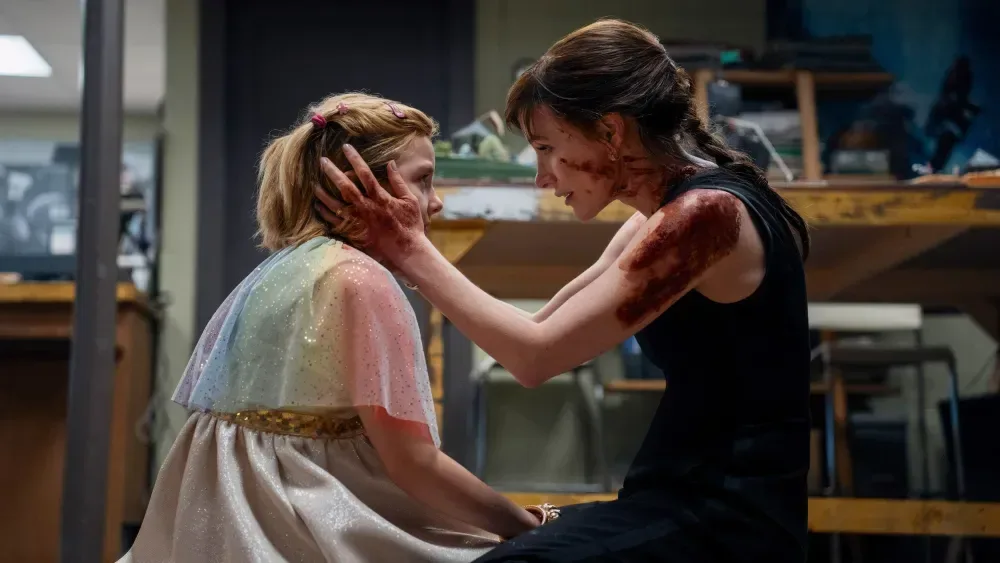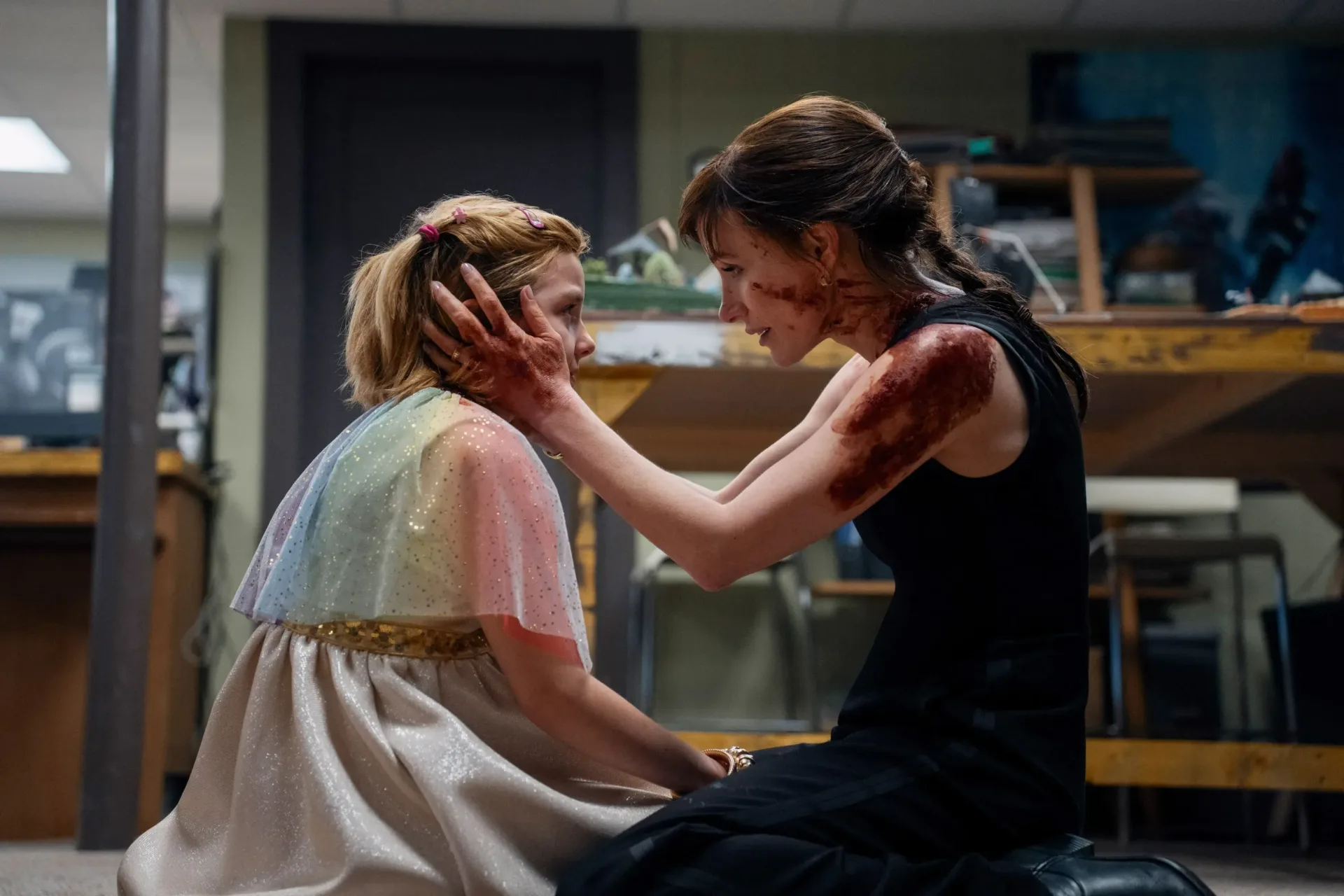
Horror movies frequently ask audiences to view ordinary family life through a distorted lens. In Other Mommy, that distortion is especially personal for Bela, played by Arabella Olivia Clark: the young character is confronted by a threatening figure who looks like her mother. Clark’s first leading feature role therefore depends on a tricky contrast. The story may be built to unsettle viewers, but the child at its center still needs to make the family relationship feel recognizably real before the nightmare version can land.
Clark, 10, appears more energized than rattled by that challenge. She has said she enjoys creepy material, including spiders, snakes and the dark, and came to the project having read Josh Malerman’s 2024 novel Incidents Around the House, the book behind the film, in three days before she had the role. By the second audition, she had a detailed relationship with the material—though she said the story still gave her chills.
That enthusiasm matters in a film whose central fear is a doppelgänger: a double of a person, usually one that turns familiarity into something frightening. Bela’s “Other Mommy” resembles Ursula, her mother, played by Jessica Chastain. Clark also plays Other Bela, an evil version of Bela, and has identified the darker role as the more enjoyable of the two. It is an appealingly direct answer, but it also points to the creative advantage of a dual role: the performer can explore opposing energies within the same world rather than simply treating a villain as a stranger.
A horror set that made room for laughter
The finished movie has a grim premise, but Clark described a set culture designed to keep the experience manageable. Director Rob Savage made sure she felt safe, while Chastain and Jay Duplass, who plays Bela’s father Russ, helped break the tension between takes with jokes, stories, photos and funny faces.
That separation is important when discussing a frightening scene involving a young performer. Film production is deliberately artificial: cameras roll for a limited piece of action, then stop; departments reset props and lighting; cast members return to ordinary conversation. Keeping the scary work visibly separate from downtime can help an actor approach intense material as a sequence of planned tasks rather than as an uninterrupted frightening environment. Clark’s account does not turn the production into a technical manual, but it does underline a basic reality of screen horror: a frightening final image can be made by a crew working methodically—and, in this case, with plenty of levity around the edges.
One moment that stuck with Clark was Chastain’s “witch cackle.” Chastain warned the crew it would be loud, and the sound still surprised Clark. The memory neatly captures the distinction between performance and atmosphere. Even an actor who likes horror can be caught off guard by a powerful vocal choice in the moment; once the camera is off, however, the set becomes a place for jokes and conversation again.
What Clark took from Jessica Chastain
Clark spent time with Chastain and her children away from the cameras, including trips to the park and hikes. She also saw Chastain studying for Harvard while balancing parenting and filming. For Clark, the lesson was less about a particular acting technique than observing someone sustain several demanding commitments at once.
It is a meaningful detail because Chastain’s screen role requires her to anchor the family at the center of the story, while Clark’s off-camera memories focus on her as a parent and a colleague. Those experiences are not proof of how any scene was performed, and they should not be confused with the movie itself. They do, however, explain why Clark speaks of the collaboration in terms of learning as well as fun. A first lead role is not only about carrying scenes; it is also a chance to watch how experienced performers prepare, manage their time and make space for younger cast members.
Related coverage includes Arabella Olivia Clark Finds the Fun Behind ‘Other Mommy’s’ Frights.
Clark had already appeared in The Housemaid, playing a younger version of Amanda Seyfried’s character. She called director Paul Feig “amazing” and said she looks up to Seyfried. Her favorite Seyfried films include Mamma Mia! and Mean Girls. Together, those credits and preferences show a young actor drawn to scary stories without treating horror as her only possible lane.
The water sequence was a carefully staged challenge
Clark’s hobbies overlap with some of Other Mommy’s physical demands. She takes swimming and sailing lessons, loves acrobatics, and said she enjoyed the film’s flips, spins and water scenes. The production’s water work took place in a large tank around 20 feet deep, according to her mother, Rachel Clark.
Rachel Clark described watching the sequence as anxiety-producing. The tank was pitch-black, the scene involved balls, Arabella wore a Sherpa hoodie that pulled her downward, and pyrotechnics created an underwater explosion. She also said the timing was carefully orchestrated and that Arabella had to be pulled underwater for the shot.
Pyrotechnics are controlled special-effects devices that create effects such as flashes, sparks, smoke or explosions. In a water sequence, their inclusion makes the planning described by Rachel Clark particularly significant: performance, camera placement, the practical effect and the underwater action must be coordinated to produce a brief screen moment. The supplied details do not establish the full safety setup or every procedure used on the production, so it would be wrong to speculate beyond them. What they do establish is that the scene was not a casual swim. It was a large-scale, choreographed piece of filmmaking that asked the young lead to work in deep, dark water amid several moving parts.
Clark’s own perspective was much simpler: she found it fun. She said she likes deep pools and can dive to 10 feet. That difference between a parent watching from outside the tank and a prepared young performer inside it is revealing without minimizing either view. The sequence sounds demanding, and it also connected with an activity Clark already enjoys. For audiences, it is another reminder that a scene designed to make a theater audience tense can be experienced by its actor as a challenge to meet one carefully planned beat at a time.
Viewers looking to preserve the ominous shadows and dark-water imagery at home may also want to check basic display settings; our guide to fixing 4K TV settings for games and movies explains why picture modes can change how dark scenes read.
From horror doubles to sharks, space and aliens
Clark is clearly comfortable with horror, but her ambitions extend to science fiction. She has talked about wanting a movie that mixes space, aliens, octopuses and sharks, as well as a chance to work with Steven Spielberg in a possible E.T. continuation. Her current sci-fi favorites include The Meg and Project Hail Mary; she singled out Rocky from the latter and imagined Rocky and E.T. becoming friends because both are aliens.
It is a child’s wonderfully maximalist pitch, but it also clarifies what she enjoys about genre work: opportunities to experience things that are not real. Horror’s doubles, science fiction’s alien encounters and creature features’ giant aquatic threats all invite a performer to react to imagined circumstances while relying on the collaborative machinery around them. For Clark, that machinery seems to be part of the attraction. She likes stunts, swimming, deep pools and the larger-than-life possibilities of genre storytelling, whether the creature is a sinister copy of a parent or a friendly being from another world.
Reading remains another part of that interest. Clark names the paranormal vampire-rabbit book Bunnicula as a favorite and has been reading Jeff Kinney’s Awesome Friendly Spooky Stories. She also likes reading spooky stories in the dark with a flashlight. That recurring interest in scary fiction helps explain why she arrived at Other Mommy having already read its source novel and ready to engage with the material rather than simply encountering it for the first time during auditions.
A useful connection with Mckenna Grace
As Clark begins leading films, she also has a potential support connection with Mckenna Grace. Rachel Clark said Grace reached out to offer mentorship and to be available to discuss growing up in the industry. Arabella Clark said the two have spoken online and that she hopes to meet Grace in person.
There is no need to inflate that early connection into a formal program or a promised collaboration. Still, the offer is notable because it comes from an actor with experience navigating a career that began young. For a 10-year-old taking on a major genre lead, having someone available to discuss the non-performance side of the work could be as valuable as any single on-set anecdote.
Other Mommy, directed by Rob Savage, opened at No. 1 and earned $12.6 million domestically on its opening day. Those figures give Clark’s first feature lead a conspicuous start. Yet the most lasting takeaway from her comments is not simply that the movie is performing well. It is that Clark approaches an intimidating assignment—a family horror story, an evil double, stunt work and a dark 20-foot-deep tank—with preparation, curiosity and obvious delight. That is a strong foundation for wherever she goes next, whether it involves another haunted home or the shark-and-alien space adventure she would clearly love to make.