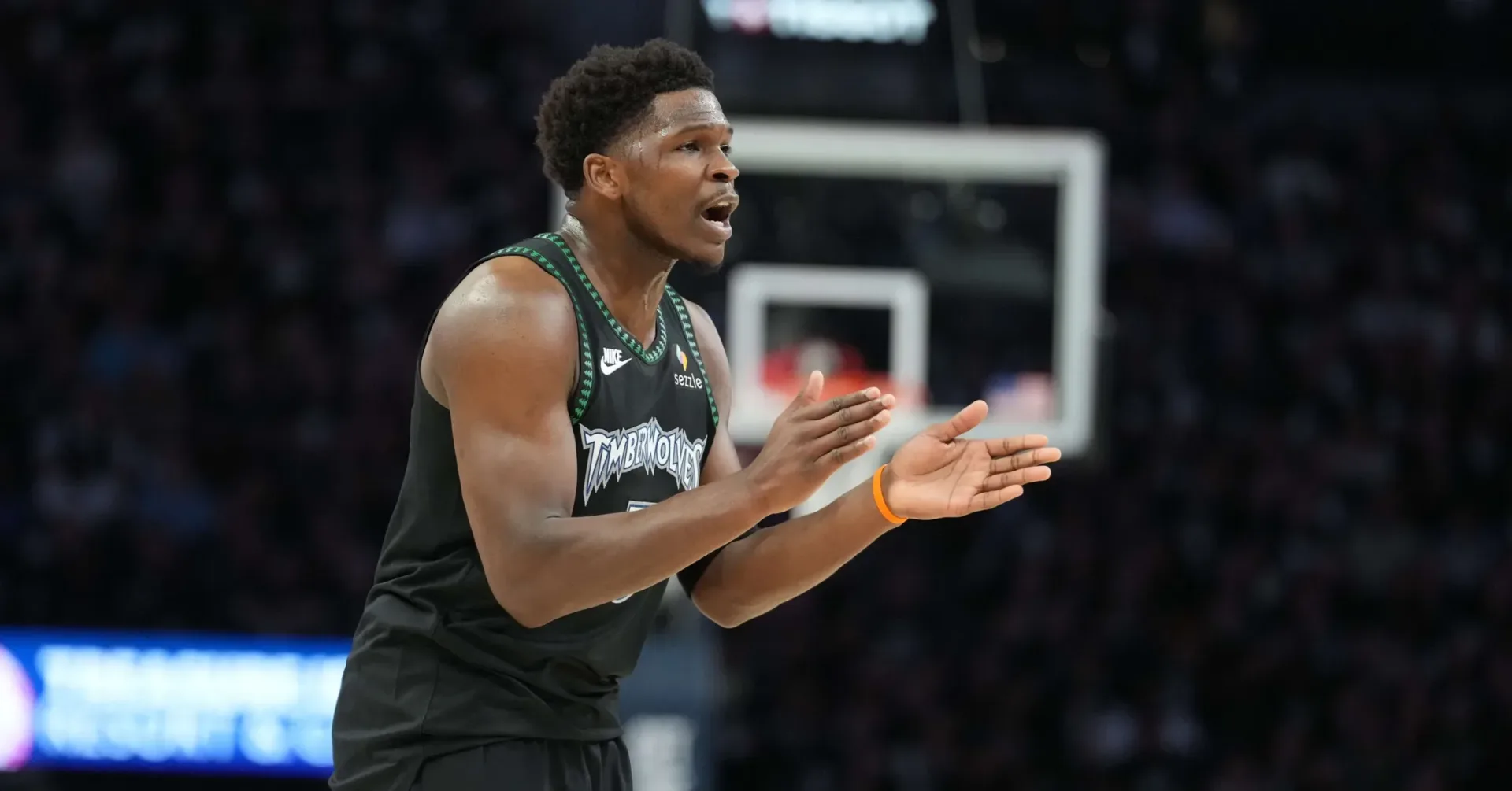
Anthony Edwards’ latest Adidas campaign is selling the AE 3 “Cold Blooded,” but its real product is Edwards’ willingness to turn a sneaker commercial into a public roast session. The spot, shared through Adidas Basketball’s Instagram account, has Edwards hosting a deliberately loose, late-night-style bit alongside his longtime friend Nick Maddox, who provides the music.
The shoe itself is present, of course. The AE 3 “Cold Blooded” is the campaign’s stated focus, and an Adidas Superstar in the same colorway is also releasing on September 18. Yet the commercial’s identity comes from who Edwards is talking about rather than from a breakdown of materials, cushioning, construction or on-court performance. LeBron James, Jaylen Brown, Jalen Brunson and Knicks assistant coach Rick Brunson all become part of the routine.
That is a notable choice in an athlete signature-shoe campaign. Rather than framing Edwards as a polished spokesperson delivering a tightly controlled pitch, Adidas is putting his competitive humor—and its potential for a little friction—at the center of the message.
The Minnesota joke comes first
LeBron is among the first prominent names in Edwards’ line of fire. Edwards jokes that Minnesota’s cold weather is why LeBron never seriously considered playing there. It is a simple setup, but a useful one for the campaign: it links Edwards to his own home market while treating one of basketball’s largest stars as a target rather than an unreachable celebrity.
On the surface, it is weather humor. In practice, it establishes the commercial’s whole hierarchy. Edwards is not approaching the ad as an athlete dutifully explaining why people should buy his latest shoe. He is behaving like the host of a comedy segment who has decided that no NBA name is too important to mention.
That framing matters because a signature line is not just a piece of footwear; it is a continuing identity attached to one player. A campaign can emphasize design, athletic achievement, fashion or personal mythology. Here, the supplied material indicates Adidas has chosen Edwards’ voice: confident, teasing and inclined to make a joke before making a sales pitch.
The ad then moves to Jaylen Brown through a joke involving Philadelphia barbers. The exact premise is less important than the pattern it continues. Edwards is building comic momentum by naming real players and letting the specificity do the work. There is a difference between a generic commercial line about rivalries and a joke that asks the audience to recognize precisely who is being referenced.
The Brunsons are not exempt
Jalen Brunson also gets pulled into the bit, as does his father Rick Brunson, an assistant coach with the Knicks. Bringing a family connection into the joke broadens the target while preserving the ad’s central idea: Edwards is treating the campaign as a conversational roast, not a standard athlete endorsement.
Fans quickly identified the names and references in the clip. That reaction is built into the format. These jokes are designed to be picked apart in short-form social discussion: who was mentioned, what the reference meant and whether a particular line was aimed more sharply at one person than another.
It is also why the spot can remain memorable even with limited direct shoe messaging. A conventional product ad asks viewers to retain an attribute or a release detail. This one gives them a series of moments to repeat. The footwear remains the commercial purpose, but Edwards’ delivery supplies the shareable hook.
There is no need to read the named-player jokes as evidence of a serious dispute. The information available describes a comedic commercial, and the tone is intentionally performative. Still, using actual league figures gives the jokes an edge that invented characters could not provide. The campaign borrows the energy of basketball’s constant debate culture—comparisons, team loyalties, rivalries and personal allegiances—without turning into a game broadcast or a statistical argument.
What “personality-led” marketing means here
Personality-led marketing is straightforward: the public-facing character of the athlete is treated as the campaign’s most valuable creative material. Rather than asking Edwards to fit a prewritten brand archetype, the campaign leans into characteristics audiences already associate with him: confidence, directness and humor.
That does not mean a campaign is unscripted, nor does it require viewers to believe every beat is spontaneous. It means the presentation is arranged to feel closer to the athlete’s public persona than to an interchangeable celebrity ad. In this case, the limited emphasis on technical sneaker detail appears intentional. Edwards is not delivering a lecture on the AE 3; he is hosting a bit.
For Adidas, that approach separates the AE line from signature campaigns that rely chiefly on solemn declarations, cinematic imagery or an extended list of product claims. The commercial’s central promise is more emotional than technical: this is an Edwards shoe, and the ad wants the audience to recognize that immediately from his manner and jokes.
That is a practical advantage in a crowded sports-marketing environment. The player becomes the differentiator. A viewer may not retain every product specification after a fast social clip, but they can remember the athlete who joked about LeBron avoiding Minnesota, took a shot at Brown and drew the Brunson family into the routine.
The same dynamic is visible across sports culture more broadly, where an athlete’s public image often reaches beyond the field or court. The overlap between performance, personality, media attention and fan conversation can also affect other hobby spaces; for a different example of how weekly football narratives can influence collector attention, see this look at Week 1 tight end storylines and the card market.
A sneaker ad built like a late-night segment
The late-night comparison is useful because it explains the spot’s priorities. A traditional commercial often follows a clear product sequence: establish the shoe, identify features, show use, then repeat the name and release information. A comedy-host structure reverses the emphasis. The host’s rhythm, guest-like targets and punchlines become the experience, while the product operates as the reason for assembling the segment.
Nick Maddox’s role on music reinforces that performance setup. The campaign is not presented as Edwards standing alone against a generic branded backdrop. It gives him a collaborator and a hosting environment, making the commercial feel like a small entertainment piece built around his presence.
That distinction is meaningful for audiences who typically scroll past direct advertising. A straightforward sales message announces itself immediately. A roast format creates a reason to watch before the viewer has decided whether they care about the product. The sneaker can then benefit from the attention generated by the jokes.
There is a tradeoff. Viewers looking for a concrete explanation of what distinguishes the AE 3 “Cold Blooded” may not receive much from this clip, because the campaign barely discusses the shoe. But that lack of technical messaging is not necessarily an omission in the creative strategy. It is the strategy. Adidas is betting that Edwards’ character can carry more impact than a conventional feature list in this setting.
The release details that are clear
The factual release information is concise. The AE 3 “Cold Blooded” arrives September 18, and an Adidas Superstar using the same colorway releases alongside it. The shared colorway creates a small crossover between Edwards’ signature basketball line and the Superstar, a separate Adidas silhouette with its own place in the brand’s catalog.
Beyond that, the provided information does not establish pricing, regions, retail partners, quantities, technical specifications or whether the releases are limited. Those details should not be assumed from the campaign’s social buzz. The advertisement’s main confirmed job is to spotlight the AE 3 “Cold Blooded” release and its matching Superstar counterpart through an Edwards-led comedy format.
It is also important to separate promotion from performance claims. The commercial supplies a personality-driven case for paying attention to the release; it does not, on the available evidence, make a detailed case about how the footwear performs in basketball. Potential buyers interested in fit, support, traction or other equipment-specific considerations would need information beyond this ad.
Why the named targets give the campaign extra charge
Edwards’ jokes work because the targets are recognizable enough that audiences immediately understand the stakes. LeBron carries obvious league-wide visibility. Brown and Brunson are similarly established names, while Rick Brunson’s inclusion adds a personal, family-adjacent wrinkle. The jokes need no elaborate fictional world-building.
That recognition makes the campaign feel more connected to the everyday language of sports fans, where players and coaches are constantly discussed as people as well as competitors. In that sense, the commercial uses basketball conversation itself as its medium. It is selling a shoe through the familiar rhythm of a debate show, locker-room jab or group-chat roast.
Edwards has previously been presented in Adidas campaigns that prioritize his natural way of speaking, and this ad continues that pattern. His confidence is not treated as something to soften. It is the primary asset. The fact that the commercial names current NBA figures directly makes that confidence appear even more pronounced.
Whether audiences remember the shoe first or the jokes first may vary. But the campaign’s construction leaves little doubt about what Adidas wants associated with the AE 3 “Cold Blooded”: Anthony Edwards at the microphone, playing host, with enough star power and nerve to tease LeBron James, Jaylen Brown and both Brunsons while his own release takes the spotlight.