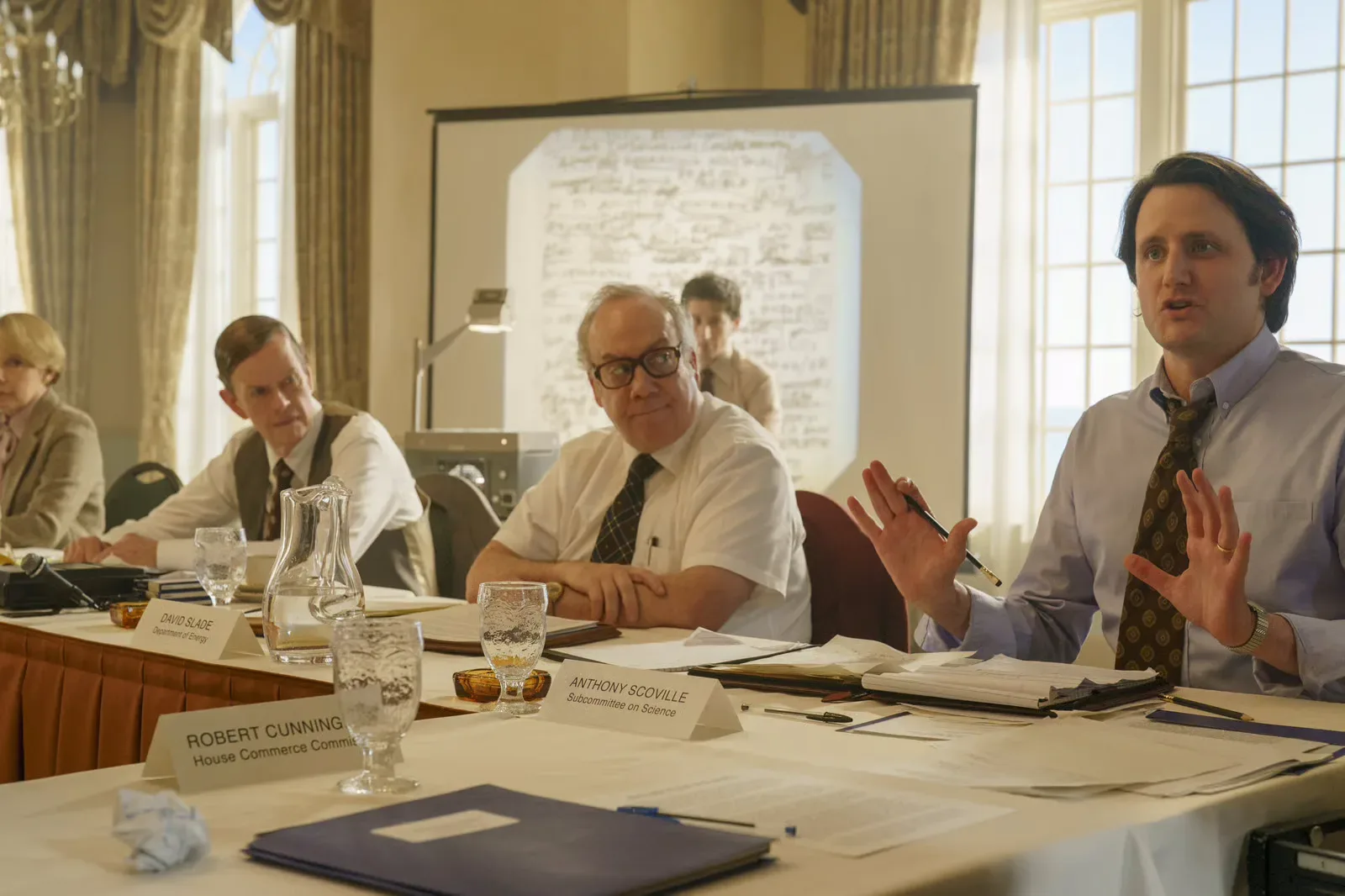
A Statement makes an unusually stark dramatic wager: a room, a committee, a few days in 1980, and an issue whose consequences extend far beyond anyone sitting around the table. Directed and co-written by Tom McCarthy, the 111-minute film centers on a real U.S. congressional initiative that brought scientists, academics, lawyers, activists and government officials to St. Petersburg, Florida. Their task was to articulate the risks posed by climate change and offer recommendations to Congress.
That setup may sound less like conventional cinema than a particularly fraught workplace meeting. The film leans into precisely that. Rather than building a conventional historical drama around private confrontations, invented domestic scenes or a chain of external events, McCarthy and co-writers Thomas Bidegain and Noé Debré use dialogue drawn from the conference transcripts. The committee’s arguments, revisions, hedges and procedural friction are not a detour from the story. They are the story.
The result, based on the film’s New York Film Festival presentation, is a docudrama fascinated by a difficult question: what does it mean when a group understands a grave problem yet cannot agree on language forceful enough to meet it?
A movie where the meeting is the action
A Statement follows roughly 20 people as they negotiate how to describe the climate threat and what response they should urge from lawmakers. Paul Rudd plays the diplomatic moderator trying to guide the gathering. Paul Giamatti is a prickly Department of Energy official; Amy Ryan plays a quiet functionary who increasingly becomes the group’s moral center. John Turturro portrays Dr. David Rose, an M.I.T. nuclear-science professor, while Evan Peters plays Rafe Pomerance, the Friends of the Earth president and early climate advocate. Tatiana Maslany, Jason Clarke, Dylan Baker, Zach Woods, Noah Robbins, Michael Cerveris and Mary Catherine Garrison are also in the ensemble.
The structure is deliberately constrained. There are no chases, grand historical montages or dramatic cutaways to show viewers what lies decades ahead. Instead, the pressure comes from competing priorities within a room full of people who largely recognize that they have been given a serious assignment.
That makes the film a useful example of a chamber drama: a story intentionally limited to a small setting and a concentrated group of characters. In a strong chamber drama, confinement makes every interruption, pause and choice of phrasing matter. Here, the form also mirrors the political subject. The committee has the data, the expertise and a direct route to Congress, but it must convert all of that into a statement that everyone can live with.
For viewers who enjoy movies built around debate, that premise has obvious appeal. The tension is verbal and institutional rather than physical. A participant may not need to persuade an antagonist completely; they may only need to weaken a phrase, delay a decision or make a recommendation vague enough to avoid upsetting an interested party. Those are modest actions on the surface, but the film’s core idea is that they can carry enormous consequences when public policy is at stake.
What the 1980 setting reveals
The unsettling force of A Statement is not that its participants are naïve about climate change. The film instead presents a group that already has access to alarming forecasts. Early on, Dr. Rose gives a presentation with five overhead-projector slides charting the direction of carbon dioxide levels and potential environmental harm. The discussion includes fossil fuels, the ozone layer and the future implied by existing trends.
An overhead projector is more than period decoration in this context. It puts the film’s evidence in an old-school, visible form: transparencies, charts and figures placed before a group that must decide what they mean. There is a small technological irony there. Data can be plainly displayed, yet interpretation and action still depend on people. Old hardware can retain a role in new setups too, though in a much less consequential setting; see this guide to using DVI-to-HDMI adapters with modern TVs.
The historical backdrop draws in part from Nathaniel Rich’s 2019 book Losing Earth: The Decade We Could Have Stopped Climate Change. The premise attached to both the book and the film is challenging because it refuses a comforting version of hindsight. The issue is not simply that later generations discovered dangers unavailable to people in 1980. The picture offered here is that specialists already had substantial knowledge—and that knowledge alone did not settle how institutions would respond.
That distinction matters. Risk assessment is the process of identifying possible harm and estimating its likelihood or severity. Policy recommendation is a different step: deciding what an institution should do with that assessment. The committee’s difficulties emerge in the gap between those activities. Participants can agree a risk exists while disagreeing about certainty, urgency, wording, political cost and the remedies worth proposing.
“Will” versus “could” is not just semantics
One major question in the film is whether the committee should write in firm predictive terms or describe potential outcomes more conditionally. Should the report say what will happen, or what could happen? It can look like hair-splitting, but it is central to how public warnings function.
Predictive language can communicate urgency. It can also expose an institution to criticism if events do not unfold in exactly the predicted fashion. Conditional language is often more faithful to uncertainty, particularly when a problem involves changing systems and future human decisions. Yet conditional language can be softened until it no longer carries the urgency the evidence warrants.
A Statement seems most interested in that friction. It depicts professionals working through uncertainty, but it also depicts the ways uncertainty can become a refuge for inaction. Some attendees are concerned with not offending powerful interests, while others want the group to deliver a far stronger alarm to Congress. Peters’ Pomerance represents the latter impulse: he believes delay has already gone too far and presses for the committee to speak plainly.
The film’s transcript-based approach is a bold way to handle that dispute. A verbatim script uses words taken directly from a documented record rather than dialogue invented to capture its spirit. It can give a historical drama unusual texture: repetitions, bureaucratic detours and awkward formulations become part of the material instead of being polished away. But that same commitment can make a film feel intentionally exhausting. A planning meeting’s rhythms are recognizable because real meetings often contain procedural circling, turf protection and reluctant compromise.
That is the formal gamble McCarthy appears to make. The audience is not merely told that institutional inertia exists; it is asked to sit inside it.
The nuclear-energy debate appears, then recedes
One thread in the meeting involves nuclear energy. When Pomerance meets Rose, the activist jokes about the scientist as a “Big Bad Wolf,” reflecting the political and cultural charge surrounding the word “nuclear.” Rose argues that renewable energy—especially solar energy as understood at the time—would not be sufficient to replace fossil fuels, and he presents nuclear power as essential to a path away from them.
The exchange is significant because it exposes a disagreement that is not simply climate advocates versus climate skeptics. It is a conflict over methods, tradeoffs and political acceptability. In other words, people who are worried about climate change may still differ sharply over the technology and policy mix they believe should follow.
The film reportedly does not pursue this argument for long. That is notable not because it resolves the energy question, but because the scene points to what the committee’s work could otherwise become: a more concrete debate over solutions rather than solely a contest over the wording of a warning. The difference is fundamental. Naming a danger is necessary, but a recommendation gains practical weight when it identifies what action should occur and who is expected to take it.
The materials surrounding the film frame Rose’s nuclear position as unusually prescient, but viewers should distinguish a character’s argument from a settled conclusion. The drama’s more broadly supported point is the one made by the encounter itself: climate policy involves competing proposals, and the political capacity to discuss consequences does not automatically produce agreement on remedies.
A demanding form for an audience willing to listen
McCarthy previously directed Spotlight and Stillwater, and A Statement continues his interest in institutions and process. Its creative team also includes cinematographer Stuart Dryburgh, editor Jane Rizzo and composer Bryce Dessner. The production is described as a Sony Pictures Classics release, with companies including Anonymous Content, Concordia Studio, Jigsaw Productions, Artists Equity, Slow Pony, Aloe Entertainment, Hammerstone Studios, Galisteo Media and Andrew Lauren Productions involved.
The key question for prospective viewers is not whether a film about a committee meeting sounds exciting in an ordinary sense. It is whether the act of watching people struggle to write a consequential document sounds revealing. The movie is built for an audience willing to pay attention to tone, qualification and the politics of who gets to define the terms of a public problem.
Its limitations are closely tied to its strengths. A transcript-faithful drama can preserve the messy texture of real deliberation, but it may also feel flat or meandering when the people in the room share more ground than their argumentative style initially suggests. The film’s talk-heavy design will likely appeal most to viewers interested in historical process and ensemble performance, rather than those looking for a conventional issue-driven drama with an obvious hero, villain or resolution.
Still, the setting carries its own tension. A weekend meeting in Florida in 1980 becomes a pressure chamber for a larger social failure: the ability to gather evidence, discuss it seriously and yet repeatedly stop short of a response commensurate with the stakes. That is a dramatic conflict even if it never leaves the conference room.