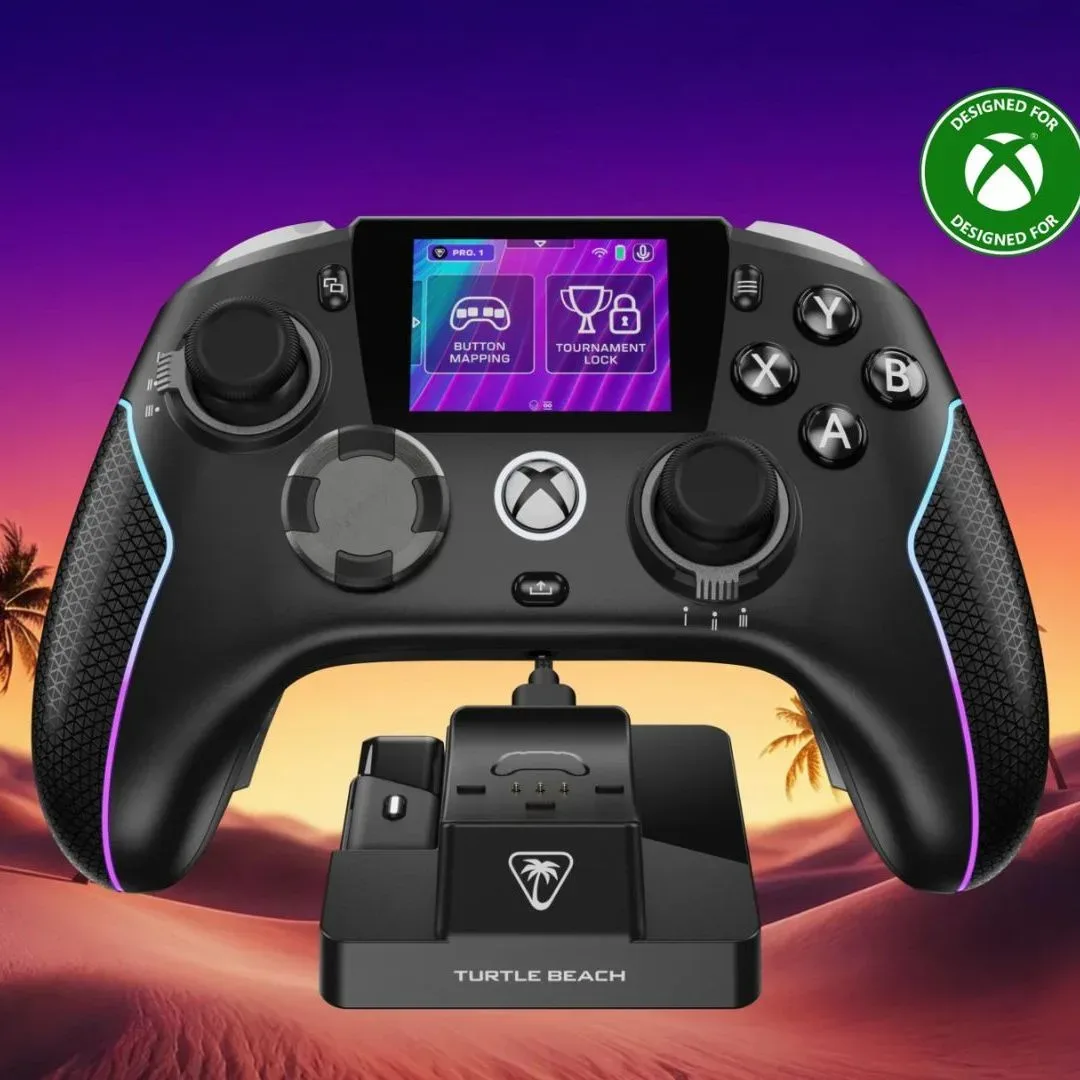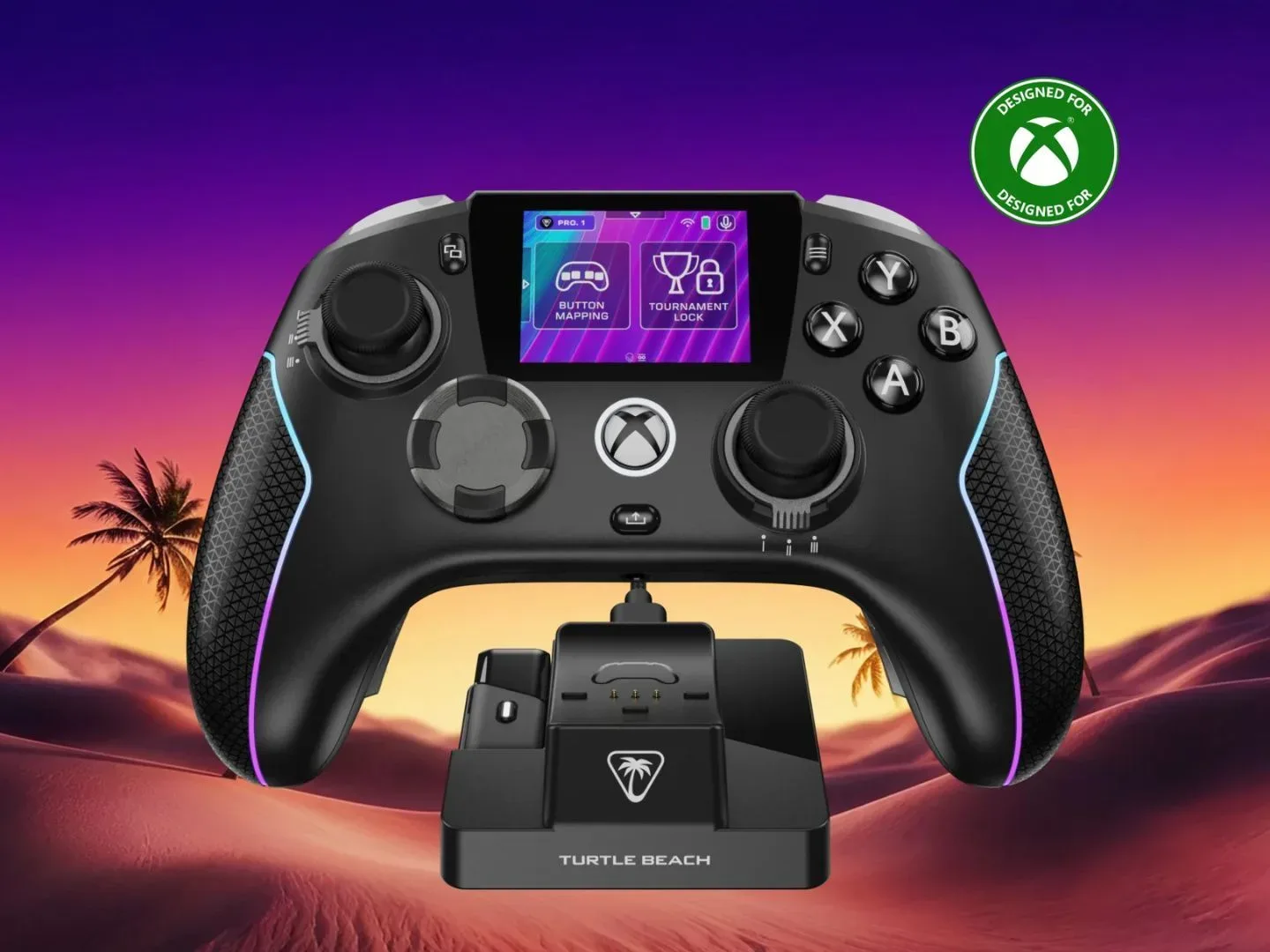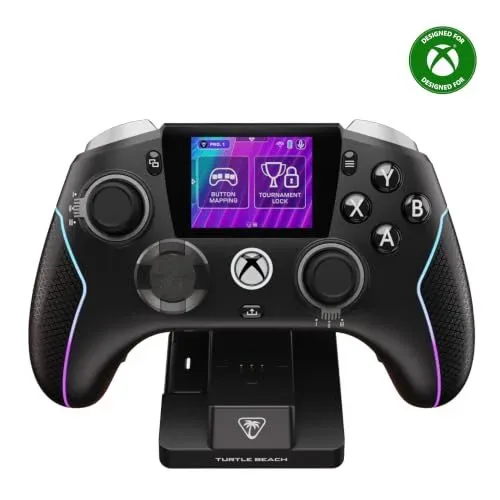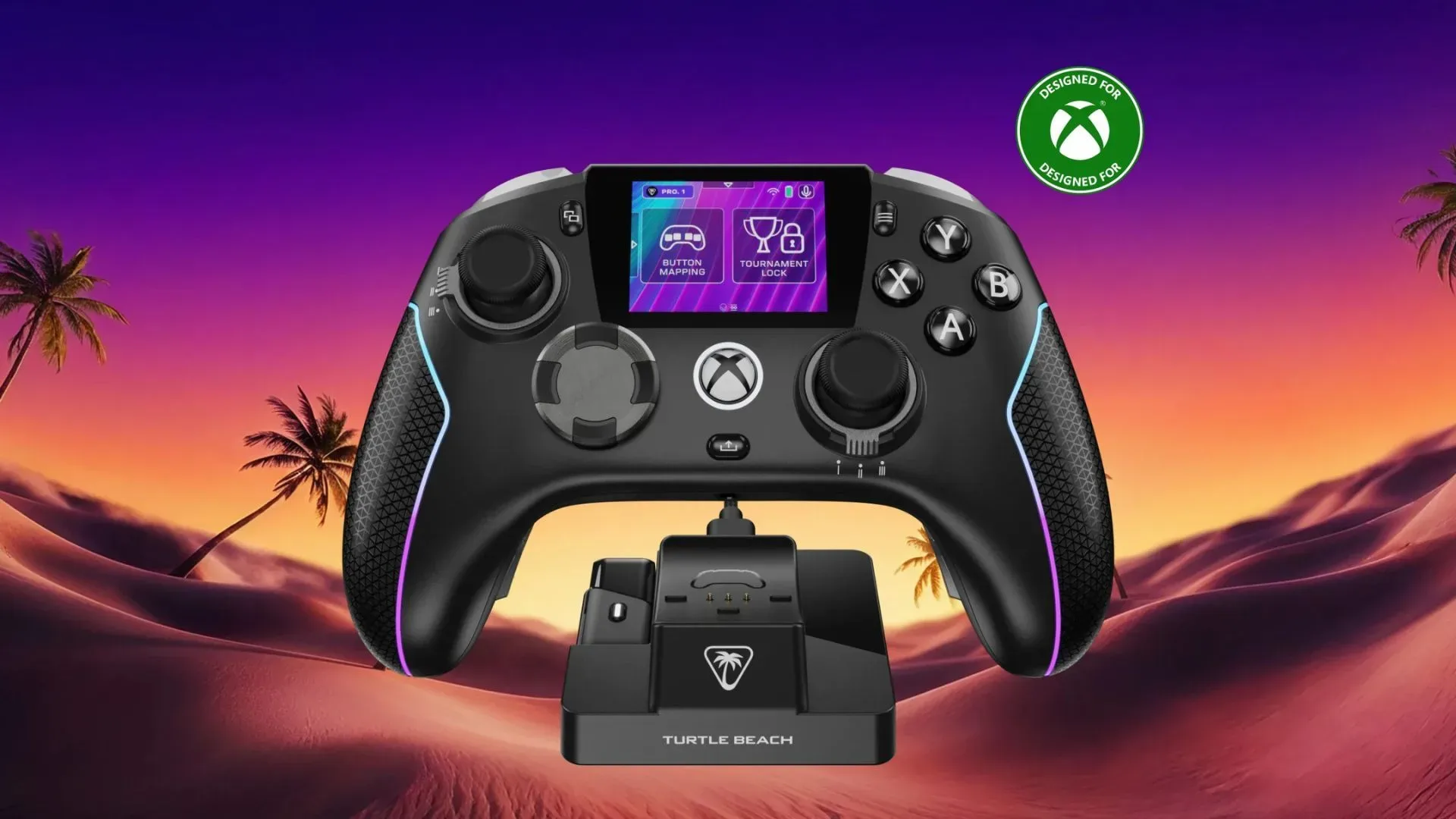
Turtle Beach has introduced the Stealth Ultra 2 for Xbox and PC, a follow-up to its early-2024 wireless controller that paired Xbox compatibility with an onboard display and settings interface. The sequel retains that unusually feature-dense premise, but the more consequential story is a list of practical hardware revisions: TMR thumbsticks, integrated switching between stick-gate shapes, a larger touchscreen, revised ergonomics, vertically arranged rear buttons, three-position trigger stops, and an 8,000Hz polling-rate claim when used wired on PC.
It is positioned as a premium gamepad, with a stated price of $199.99 / £179.99. A charging stand and carry case are included. That price matches the prior Stealth Ultra’s established tier rather than moving toward the $250 level occupied by some newer high-end controllers, but it remains a substantial purchase for players who do not need programmable rear inputs, trigger adjustment, or a controller-side settings screen.
The Stealth Ultra 2 is listed as available through Turtle Beach and selected retailers, including Amazon and Very in the UK. Still, there are limits to what can be established from the currently shown materials: the controller has not received a detailed official social-media trailer explaining every screen option, and performance, comfort, software reliability, and wireless behavior remain questions for independent testing.
A second attempt built around more useful changes
The original Stealth Ultra arrived at a moment when third-party Xbox controllers were rapidly becoming more ambitious. It stood out as one of the earlier officially licensed options to combine wireless Xbox play with a built-in screen and menu system. But screens alone have become less remarkable as premium controllers compete on customization, stick technology, trigger travel, rear controls, charging accessories, and PC performance specifications.
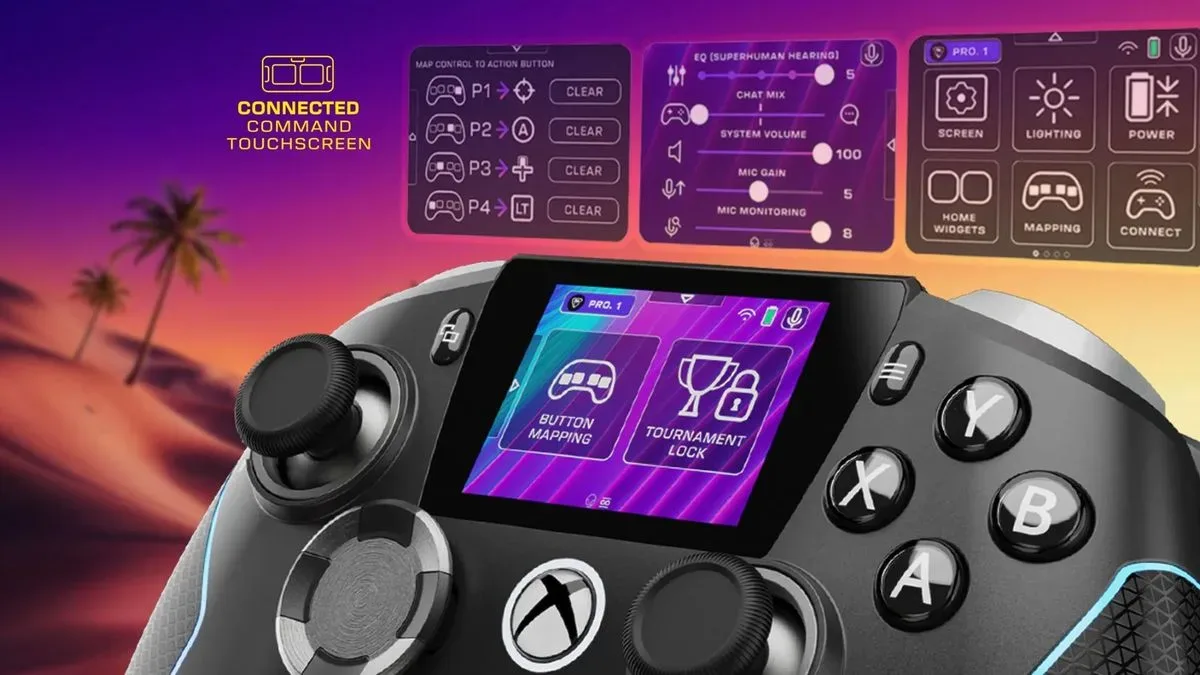
The Stealth Ultra 2 appears to recognize that a screen is only worthwhile if it makes routine adjustments easier. The larger display is expected to provide access to button mapping, audio levels, connection options, and power controls. Promotional imagery also indicates settings for the display itself and customization of the home-screen widgets.
That could matter more than the screen’s sheer existence. A controller display can potentially save someone from opening a companion app or navigating a console menu when changing a preset, checking a connection, or adjusting audio-related settings. On the other hand, the usefulness will hinge on how quickly those menus can be reached and whether the interface is clear enough to justify another screen in a player’s setup. The earlier model’s social-oriented elements have been removed, suggesting the new controller is narrowing its focus toward configuration rather than novelty.
TMR sticks and switchable gates are the headline hardware upgrade
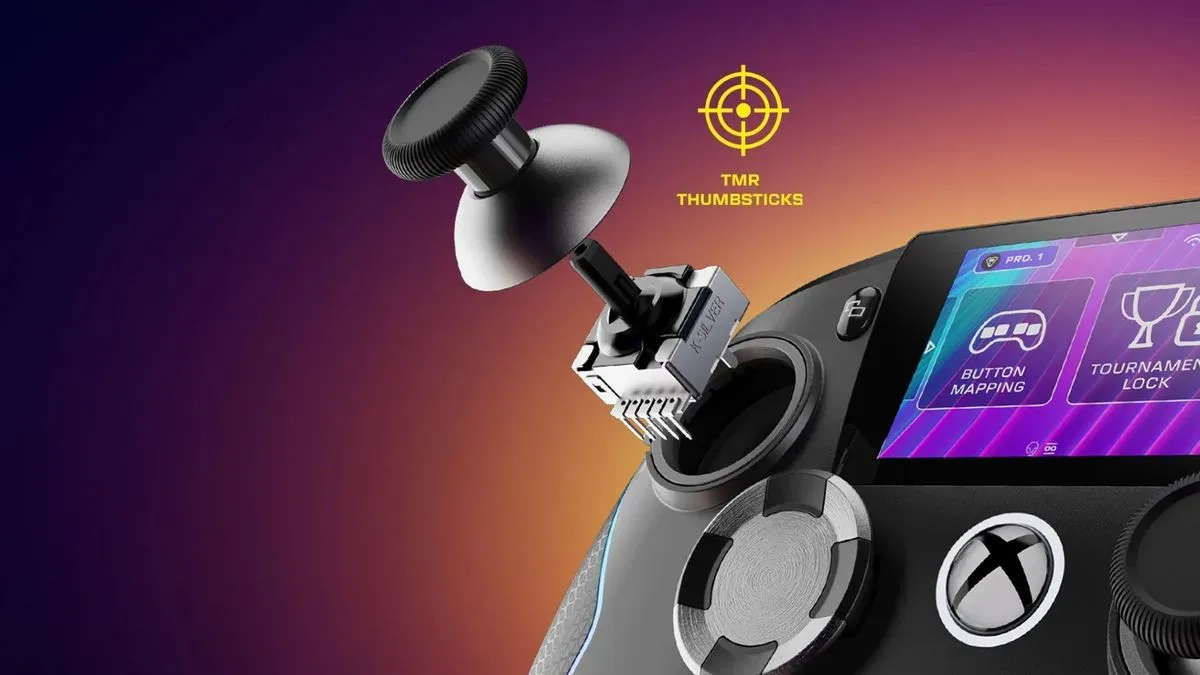
The Stealth Ultra 2 uses TMR thumbsticks. TMR, short for tunneling magnetoresistance, is a sensing technology used in newer controller stick designs. In broad terms, magnetic systems are being adopted as an alternative to conventional potentiometer-based stick assemblies, which involve physical contact as the stick moves. The key buyer takeaway is not that any one sensor label automatically guarantees perfection, but that stick technology has become a major point of differentiation for premium gamepads.
Turtle Beach also says the sticks can use swappable gate shapes through integrated switches. A stick gate is the boundary that guides the stick at the edge of its movement. Different gate shapes can change the feel of directional inputs and the physical reference a player feels while pushing a stick to its limit. The company describes this as an Xbox first in its implementation. PDP’s Victrix Pro BFG for Xbox had offered manually exchanged gates, while the Stealth Ultra 2’s approach is intended to make the adjustment part of the controller itself.
Related coverage includes Turtle Beach Stealth Ultra 2 Brings TMR Sticks, Larger Screen and 8,000Hz PC Polling.
That is potentially meaningful for people who alternate between genres and want a different physical response without disassembling or swapping components. It should not be confused with proof of a universally better aiming experience, however. Stick tension, dead-zone options, software tuning, cap shape, and personal preference all influence the result. Buyers should regard the gate system as a customization option, not a one-size-fits-all competitive advantage.
Ergonomics and rear controls receive overdue attention
Several of the Stealth Ultra 2’s design changes are less flashy than a touchscreen, but may prove more relevant during long sessions. The previous metallic, flat D-pad has been replaced with a more contoured design. The grips appear longer and slimmer, a change aimed at providing a more comfortable hold.
Most notably, the rear-button layout shifts from a horizontal arrangement to a vertical one integrated into those revised grips. Rear buttons let players assign actions that would otherwise require taking a thumb off a face button or stick. In principle, this can make actions such as jumping, reloading, or changing equipment easier to perform while maintaining movement or camera control. In practice, placement is everything: poorly positioned rear buttons can be difficult to distinguish or easy to press by accident. The vertical redesign makes a clear usability claim, but it needs hands-on evaluation before it can be called an improvement.
The controller does not add extra bumpers or additional side buttons. That distinguishes it from designs such as the Nacon Revolution X Unlimited and Razer Wolverine V3 Pro, which may appeal to players who prioritize as many extra inputs as possible. Turtle Beach’s choice instead appears to be refinement over escalation: four rear controls, a revised shape, and an interface designed to manage the features already present.
Three-way trigger-stop switches are also included. Trigger stops restrict the travel distance of the triggers. A shorter pull may suit games where a fast, repeated trigger press is desirable; a full pull can remain useful where analog trigger range matters. Three selectable settings are notable because such controls are often limited to one or two stop positions. As with the stick gates, the value is flexibility rather than an assertion that one setting is inherently best.
8,000Hz polling is a PC-focused specification with important context
For wired PC use, Turtle Beach says the Stealth Ultra 2 can reach an 8,000Hz polling rate. Polling rate describes how often a peripheral reports its state to the connected system. An 8,000Hz figure means the device is designed to report up to 8,000 times per second in that mode. It is an attention-grabbing number that places the controller among high-spec PC peripherals.
There are two important qualifiers. First, the stated 8,000Hz capability is specifically for wired mode on PC; it should not be assumed to apply to Xbox or wireless use. Second, a higher polling rate does not by itself reveal the full input-latency picture. Game engine behavior, the PC, display setup, connection mode, firmware, and controller processing can all affect the experience. The specification is most relevant to enthusiasts who play wired on PC and deliberately seek low-latency-oriented hardware, rather than a guarantee that every game will feel dramatically different.
That PC emphasis arrives while hardware costs remain a broader concern for buyers; recent reporting on pressure on PC shipments and component pricing illustrates why a $200 peripheral deserves careful comparison rather than an impulse purchase. The Stealth Ultra 2’s included dock and case improve the package on paper, though their build quality and daily convenience also need to be assessed outside promotional material.
Battery modes make the trade-off explicit
Turtle Beach lists three power profiles: Full Power, Balanced, and Eco. The company quotes up to 34 hours in Eco mode, with vibration and RGB lighting turned off. At the other end, Full Power is quoted at 10 hours with the controller’s full feature set and lighting active.
Those figures communicate a familiar wireless-controller trade-off. Features such as lighting, haptics or vibration, displays, and wireless operation consume power, while an energy-saving mode can extend operating time by limiting some of them. The charging stand reduces the friction of topping up between sessions, but quoted runtime figures should be understood as mode-specific estimates, not a universal guarantee. Balanced mode exists between the two stated extremes, though no specific runtime was provided here.
What prospective buyers should weigh
The Stealth Ultra 2 looks most compelling for an Xbox-and-PC player who values controller-side settings, bundled charging and storage, advanced stick customization, and a wired PC performance mode. It is less obviously aimed at someone whose main priority is the greatest possible number of extra inputs, since there are no added bumpers or side buttons beyond the redesigned rear controls.
- Screen users: The larger touchscreen and widget options could be useful if they provide rapid access to mappings, audio, power, and connection settings.
- Competitive PC players: The 8,000Hz wired-PC claim is the standout specification, although it should be evaluated in the context of an entire setup rather than in isolation.
- Customization-minded players: TMR sticks, selectable gate shapes, trigger-stop positions, and remapping options form the core of the controller’s premium appeal.
- Xbox-first players: Wireless Xbox support and an all-in-one package remain central, but prospective owners should decide whether these premium features justify the price over a simpler pad.
- Battery-conscious players: Eco mode’s quoted 34 hours comes with vibration and RGB disabled, while Full Power’s quoted 10 hours reflects the cost of running everything.
The more interesting part of this sequel is that Turtle Beach has not merely put a larger display on the same formula. Its reported changes address the physical interaction points that determine whether a controller feels good: stick mechanism, gate shape, D-pad contour, grip profile, rear-button placement, and trigger travel. The influence of the company’s PDP acquisition is visible in the emphasis on customization ideas associated with the Victrix Pro BFG line, even if this is a distinct controller rather than a rebranded one.
At $199.99 / £179.99, the Stealth Ultra 2 still has to clear a high bar. Its specification sheet is strong, but the unanswered questions are the ones no marketing image can settle: whether the rear buttons are comfortable, whether the larger menu system is genuinely faster to use, how the sticks feel in motion, and whether the controller delivers consistent performance across Xbox, wireless play, and wired PC use. For now, it is a more focused and potentially more competitive revision of Turtle Beach’s screen-equipped controller concept—not a reason to assume every promised refinement has already been proven.
Shop the products
Check current price, model and availability at the retailer.