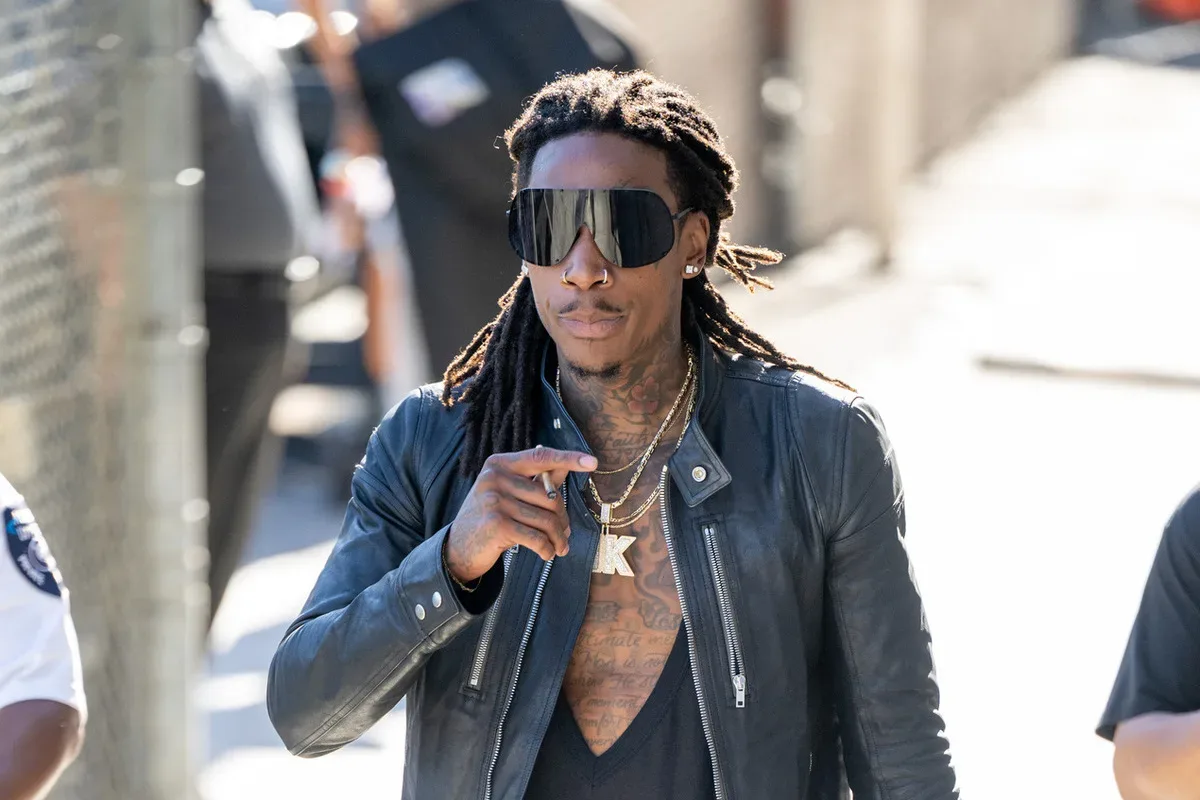

Wiz Khalifa will not serve the nine-month prison term previously imposed in Romania over a cannabis case tied to a 2024 festival appearance. The Bucharest Court of Appeal has delivered a final ruling requiring the rapper to pay a criminal fine of 9,600 Romanian lei.
The decision keeps the conviction for unlawful possession of cannabis for personal use intact. What changed was the penalty: the Bucharest court set aside the prison judgment, cancelled the warrant intended to enforce it, reopened the prosecutors’ appeal, and ultimately chose the fine following the rehearing.
It is an outcome with an important distinction. Khalifa was not cleared of the offense. The final result preserves the finding of guilt while resolving the punishment at a financial penalty rather than incarceration. The amount is also substantially higher than the initial fine ordered by a court in Constanta, which had been 3,600 lei.
What led to the case
The proceedings arose from an incident at the Beach, Please! festival in Costinesti, on Romania’s Black Sea coast, in July 2024. Prosecutors said Khalifa had more than 18 grams of cannabis and smoked an additional amount in a hand-rolled cigarette while onstage.
Police questioned him after the performance and released him afterward. Khalifa addressed the incident publicly at the time, saying he had not intended to disrespect Romania and that authorities had treated him respectfully. He also indicated he would return without bringing a large joint.
The episode is a straightforward reminder that a touring performer’s expectations, habits, or public image do not supersede the laws in the country where a show takes place. That may sound self-evident, but live performance environments can blur the line between an artist’s stage persona and conduct that carries legal consequences. In this case, the alleged conduct at the festival became the basis for a criminal case that continued long after the crowd had gone home.
A winding route through Romanian courts
The procedural history explains why the final fine matters. A Constanta judge first imposed the 3,600-lei fine in April 2025. Prosecutors appealed that ruling, and a nine-month prison sentence followed in December 2025.
Khalifa then challenged the prison sentence, but the Constanta appeals court rejected his request to annul it in February 2026. Romania’s highest court later granted a request to transfer the proceedings to Bucharest.
That transfer set up the later reversal. On November 3, Bucharest judges nullified the prison judgment and cancelled the enforcement warrant. Rather than ending the matter at that stage, the court reopened the appeal by prosecutors to reconsider the appropriate sanction.
Khalifa appeared by video on November 12. He acknowledged his actions and said he was prepared to perform community service. A week later, the court issued its final decision: a 9,600-lei criminal fine.
In practical terms, the final ruling ends the rehearing and replaces the prison exposure created by the earlier judgment. The legal record still includes the possession conviction, but the operative punishment is now the fine.
How the court calculated the penalty
The 9,600-lei total was calculated at 120 days multiplied by 80 lei. This is useful context because it shows the court did not simply select a round figure without an explained basis. The ruling applied a day-based calculation to arrive at the final amount.
A criminal fine is a penalty imposed as part of a criminal judgment, rather than an informal payment or a civil settlement. It should not be confused with the conviction itself: the conviction is the court’s finding on the unlawful possession charge, while the fine is the punishment attached to that finding.
The court also warned that Romanian law permits imprisonment if the fine is not paid in bad faith. That warning does not mean Khalifa was sentenced to prison again. Instead, it identifies a possible consequence for a failure to pay under the standard specified by the court. The present final sanction is the 9,600-lei fine.
Romania will bear the court costs connected to the appeal, according to the ruling.
Why a higher fine still represents a major change
The final fine is more than double the 3,600-lei amount ordered at the first trial. Yet it is still a fundamentally different outcome from a nine-month custodial sentence.
The sequence can be read in three stages:
- Initial trial: a 3,600-lei fine in April 2025.
- Prosecutors’ appeal: a nine-month prison sentence in December 2025.
- Final Bucharest rehearing: a 9,600-lei criminal fine, with the possession conviction maintained.
That progression makes it inaccurate to frame the resolution as a complete legal victory or as a dismissal. Khalifa avoided imprisonment, but the court retained the conviction and imposed a larger financial penalty than the one first ordered. The final judgment is best understood as a revised sentencing result, not an erasure of the underlying case.
What this means for artists performing abroad
The case is also a practical example of the legal complexity surrounding international festival appearances. A show can be built around spectacle, improvisation, and a performer’s established public identity, but artists and their teams remain subject to the laws of the host country. A decision made onstage can trigger not only an immediate police response, but also months or years of litigation through trial courts, appeals courts, enforcement proceedings, and venue changes.
For touring operations, that reality puts extra weight on advance legal preparation. The relevant concern is not whether a performer considers a substance routine or socially accepted elsewhere; the relevant concern is the law and enforcement environment where the event is being held. Festival staff, promoters, security teams, and artist representatives may all have a role in minimizing avoidable exposure, although the facts of this case do not establish what preparations were or were not made.
It also illustrates why public statements immediately following an incident should be viewed separately from court procedure. Khalifa’s 2024 post addressed his intent and described how authorities handled the situation that night. The subsequent legal process, however, turned on the possession case and proceeded through multiple rulings. Public reaction can move quickly; appeals can move in a very different timeframe.
The entertainment world often treats an onstage moment as a passing headline. Court systems do not necessarily do the same. Here, an incident in July 2024 reached its final listed resolution only after initial sentencing, a prosecutorial appeal, an unsuccessful effort to annul the prison sentence, a transfer to Bucharest, the cancellation of the enforcement warrant, and a rehearing.
The final status
The Bucharest Court of Appeal’s ruling closes the renewed appeal proceedings. Khalifa remains convicted of unlawful possession of cannabis for personal use and owes 9,600 lei under the court’s final calculation. He no longer faces enforcement of the nine-month prison judgment that Bucharest judges set aside earlier in November.
For readers following entertainment stories with legal stakes, the case is a useful prompt to separate the headline from the precise result: no prison term under the final ruling, no dismissal of the conviction, and a substantially increased fine from the original trial court’s figure. For a different corner of the entertainment landscape, see our coverage of Tom Hiddleston’s comments on Loki and Avengers: Doomsday.