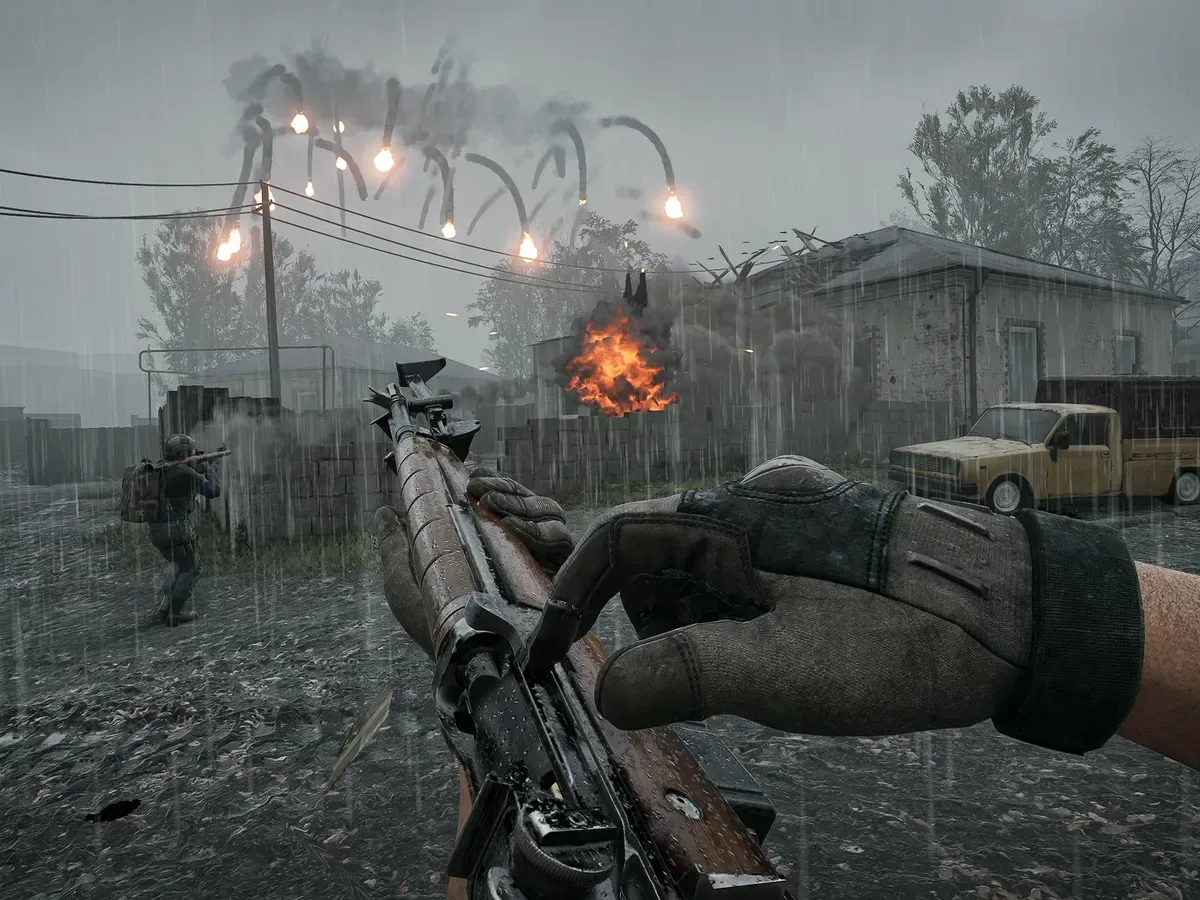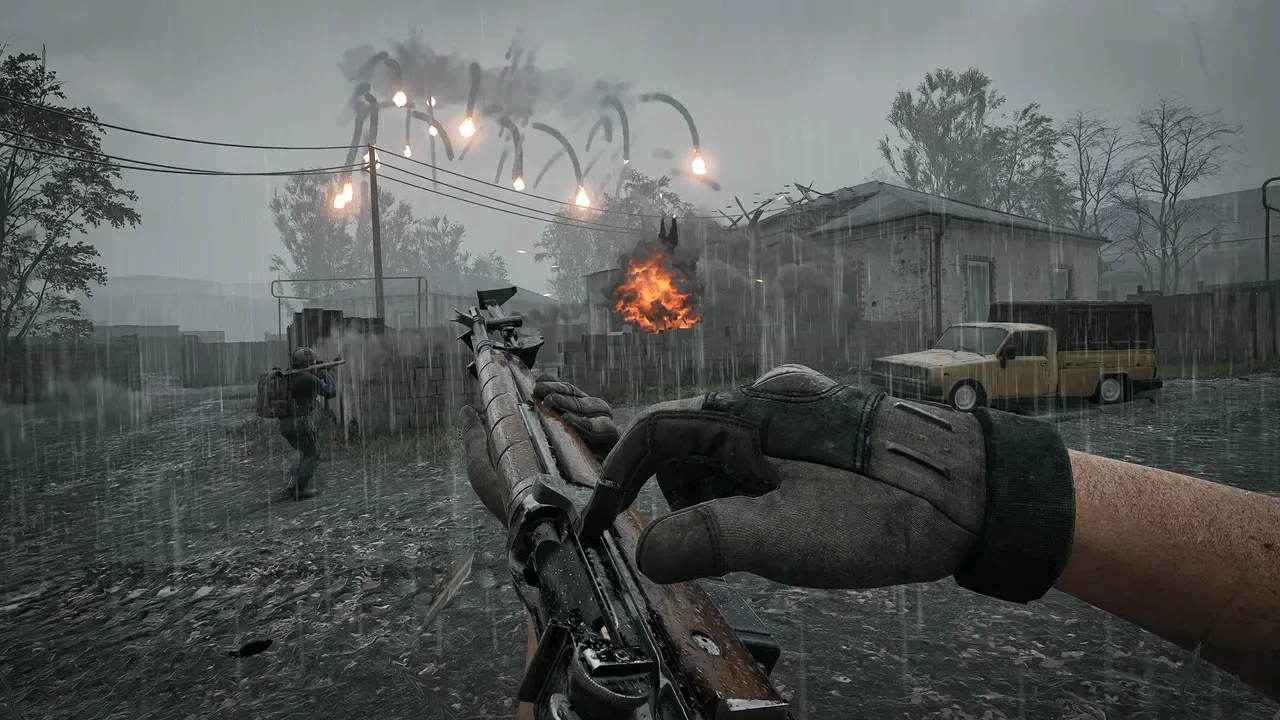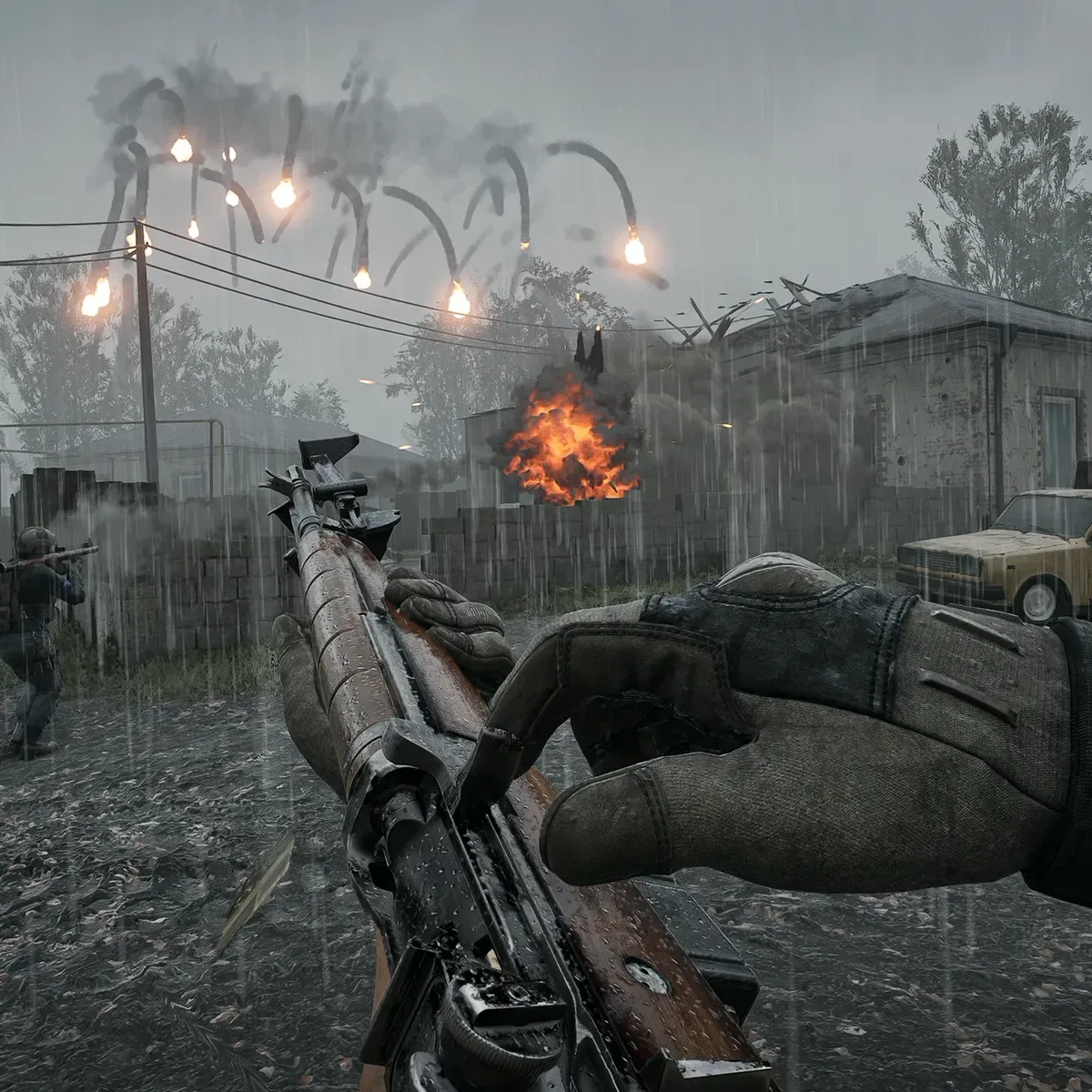
Wardogs is bringing rain to its matches with Season 2 on October 15, and Bulkhead is framing it as far more than an atmospheric coat of paint. Rainy matches will be darkened, visibility will be reduced, thunder can conceal loud actions, and rainfall itself will create surface-specific audio. Even the game’s destruction systems have a weather consequence: remove a roof and the people beneath it are no longer sheltered from the storm.
The important detail is that this is not dynamic weather. A match selected to have rain will remain rainy from beginning to end; it will not pivot from clear skies to a storm halfway through. That limitation is meaningful. Rather than asking players to react to a surprise condition at an unknown moment, Wardogs appears to be presenting rain as a consistent match-state—one close to a ruleset or mode modifier that changes how a familiar map is perceived and played.
Bulkhead senior producer Kane Allard has said the effect can be positive or negative depending on a player’s preferred style. That is a refreshingly direct way to describe a feature designed to disrupt established habits. Rain is not promised as a universal improvement to every engagement. It is a purposeful change in information: what players can see, what they can hear, and how confidently they can navigate terrain they may already know well.
A familiar map can become an unfamiliar battlefield
The most immediate shift is visual. Rain variants make maps darker and worsen visibility. In a competitive action game, visibility is not merely an aesthetic setting. It is the time and certainty with which a player can identify a threat, recognize a route, distinguish movement from scenery, or safely judge a distant position.
That does not necessarily mean every gunfight becomes less fair. It means the visual advantages players usually rely on may become less reliable. Long sightlines can be harder to exploit when the scene is dimmer or obscured. Players who ordinarily move quickly by recognizing landmarks may need to slow down, reassess and use closer reference points. Bulkhead has indicated that one developer even lost their sense of direction when seeing a map in its rainy state, because its appearance differed so much from the usual version.
Map readability is the useful term here. It describes how readily someone can understand a game space at a glance: where paths lead, which objects offer cover, where an enemy might emerge, and which landmark establishes their location. Reduced readability can make a known arena feel newly demanding without physically rebuilding it. The routes may be unchanged, but the cues used to interpret them are not.
For players, the practical implication is that rainy matches may reward deliberate movement and stronger orientation habits. Keeping track of recent turns, nearby structures and teammates may matter more when a broad visual scan tells less of the story. The weather does not create a new map layout, but it can change how quickly players extract useful information from the layout already there.
Thunder and rain turn sound into a tactical variable
The storm also changes Wardogs’ audio landscape. Thunder may be used strategically to mask gunfire or other loud sounds. That is an example of sound masking: one loud sound makes another harder to detect, especially if the two happen at nearly the same time.
Related coverage includes Wardogs Season 2 Rain Will Reshape Matches With Darkness, Noise and Reduced Visibility.
In ordinary conditions, the report of a weapon or another prominent noise may communicate that action is happening and give opponents a rough basis for reacting. Thunder adds a loud environmental event that can reduce the clarity of those signals. The value is not that thunder silently erases everything; the supplied details say it can mask noise, not that it guarantees invisibility. Timing is therefore the interesting part. A player who acts as the storm peaks may create more uncertainty than one who makes the same move during a quieter interval.
That can affect decisions well beyond shooting. Teams may become less certain about where attention should be focused, whether a loud noise came from a nearby opponent, or whether an engagement has begun elsewhere. Conversely, players who remain calm amid the noise may have an edge simply by refusing to overreact to incomplete audio information.
Rainfall itself will also sound different depending on the surface it hits, including rooftops and helmets. This is a more granular audio change than a generic rain loop. Different surfaces supply different texture to the environment, which can make a location feel more enclosed, exposed or noisy. A helmet being struck by rain also suggests that the storm’s soundscape follows the player rather than existing only as distant ambience.
The result is a match where listening remains crucial, but listening may be less straightforward. Players will need to separate meaningful cues from weather noise and account for moments when a loud natural sound makes an action harder to place. In that sense, rain adds uncertainty rather than simply lowering the volume of useful information.
Windows and destruction make shelter more complicated
Windows will fog up during rainy matches. Bulkhead has not confirmed whether fogged windows make people inside buildings less visible, so it would be premature to treat them as reliable concealment. Still, the detail is worth watching because windows sit at the intersection of observation and exposure. A pane that is harder to see through could change the confidence with which players watch indoor spaces from outside—or look outward from within.
The more firmly defined interaction is with destruction. If a roof is destroyed, those inside become exposed to rainfall. This ensures the weather is not restricted to undamaged scenery. Destruction can alter the conditions experienced by players occupying a building, making cover feel less sealed off from the environment.
It is important not to stretch that claim further than the available information. There is no stated mechanical penalty for being rained on, no confirmed effect on weapon handling, and no confirmation that a destroyed roof changes visibility in a particular way. What is clear is that Bulkhead has accounted for destruction in the weather presentation. That makes the storm more coherent: a building is not treated as permanently dry after the part that protected it has been removed.
It also reinforces the broader Season 2 idea. Rain does not operate as a detached visual filter. It responds to the state of the level. Players looking for the full technical backdrop behind the choice to avoid dynamic weather can read Bulkhead’s discussion of performance constraints and its weather plans.
Why fixed rain may be the right call for this system
Dynamic weather means conditions can shift during a match. Wardogs is not taking that route for this update. Instead, rain is set for the duration of the match. While that may sound less ambitious on paper than a system that transitions from sunshine to storms, it creates a clearer gameplay contract.
Everyone enters a rainy match under the same broad conditions. Players can adapt their expectations from the opening moments: visibility will be compromised, the audio environment will be busy, and thunder may interrupt the normal confidence attached to loud sounds. There is no implication that a team will suddenly have to rebuild its approach because an abrupt downpour arrived after a period of clear visibility.
That consistency may also help distinguish rain matches from ordinary ones without forcing rain onto every map all the time. Allard characterized the concept as something akin to a different game mode. The comparison fits because the map may retain its geometry while the priorities surrounding it change. A rain match can ask for more care with positioning, navigation and audio timing; a clear match may favor other habits.
For players who prefer clean visual information and predictable sound cues, the storm may be unwelcome. For others, the same conditions may add tension and create opportunities for approaches that are harder in clearer weather. Bulkhead is not presenting that divide as a flaw to be eliminated. The studio’s stated position is that differing reactions are part of the point, particularly because rain is not permanent across every match.
Night, snow and other weather remain possibilities—not promises
Bulkhead has not ruled out other environmental conditions, but has emphasized the gameplay and performance questions that would come with them. Snow is one example under consideration rather than a confirmed addition. The point is not simply whether snow would look different. It would have to be evaluated for how it changes play and how it affects the game’s performance.
Nighttime would carry equally obvious mechanical implications. Bulkhead CEO Joe Brammer has pointed to flashlights, NVGs and lasers as features associated with night conditions. NVG is short for night-vision goggles, equipment intended to help users see in low-light situations. Lasers and flashlights could make darkness manageable, but they could also create new visibility trade-offs: a tool that helps one player see may reveal something about their position to somebody else.
None of that confirms that Wardogs will receive night maps, snow or those tools. It shows why weather and lighting are larger design questions than a visual toggle. The existing rain implementation already demonstrates the principle: environmental conditions influence visibility, audio, navigation and the way destruction is experienced. Future conditions would need comparable consideration rather than being added as simple scenery.
What to watch when Season 2 arrives
Season 2’s rain deserves attention not because it claims to make every Wardogs match objectively better, but because it deliberately changes the information players use to make decisions. The clearest things to observe are how often thunder meaningfully obscures action, whether surface-specific rain sounds are readable amid combat, how quickly players regain their bearings on darkened maps, and what fogged windows do to encounters around buildings.
Players should also keep the confirmed and unconfirmed elements separate. Full-match rainfall, darker maps, reduced visibility, thunder masking, varied rain sounds, fogged windows and roof-destruction exposure are established details. The tactical value of fogged windows as concealment remains unclear. Snow, nighttime equipment and other weather are possibilities being weighed, not announced Season 2 features.
That distinction matters because Wardogs’ rain system is already substantial without speculative extras. It is a fixed environmental variant intended to reshape familiar spaces through darkness, noise and changing shelter—not a random storm that arrives to interrupt a normal match. Whether that becomes a favorite way to play will likely depend on how much a player enjoys adapting when the battlefield stops being easy to read.