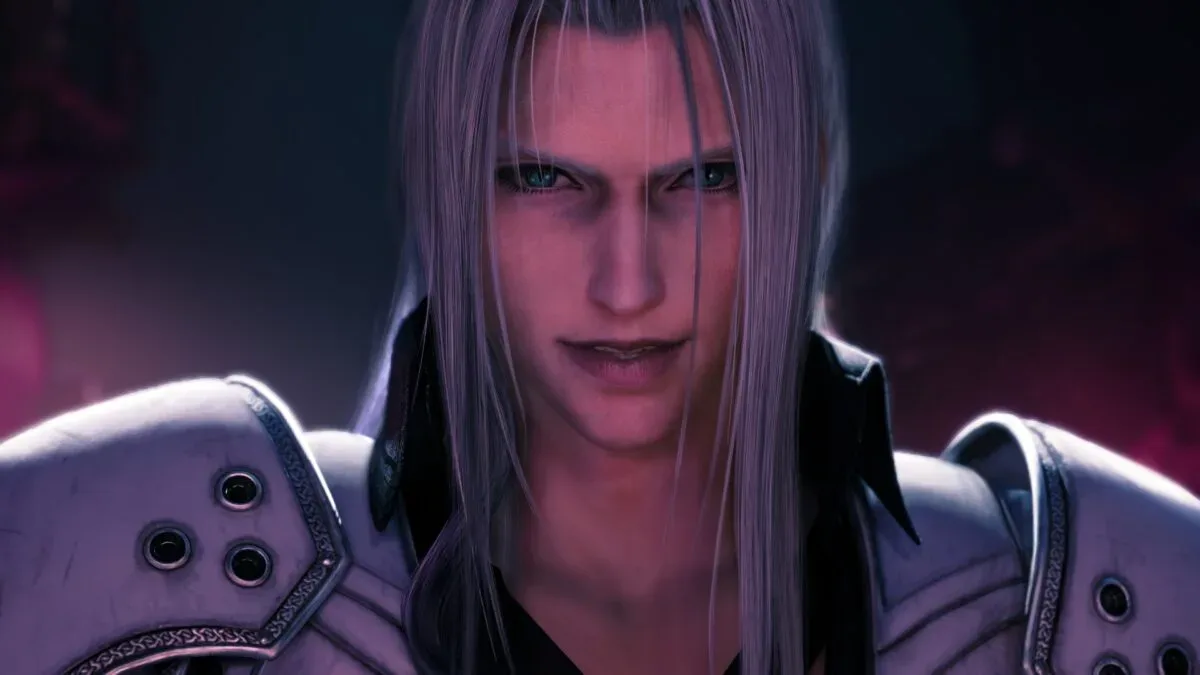
Travis Willingham is taking on one of gaming’s most recognizable antagonist roles as the new English voice of Sephiroth in Final Fantasy VII Revelation. The casting change arrives for the concluding entry in the Remake trilogy, with previous Sephiroth actor Tyler Hoechlin leaving the part because of scheduling conflicts.
Speaking during a New York Comic Con panel attended by members of the game’s cast, Willingham framed the opportunity as both an honor and a responsibility. Rather than approaching Sephiroth as a character who must constantly announce his menace, he described a performance rooted in command, ambiguity, and restraint.
“There is always, to me, nothing more dangerous than the villain in the room that doesn’t need to shout to be heard.”
That idea offers a concise explanation of what Willingham sees at the heart of Sephiroth: a villain whose threat comes not simply from intensity, but from the sense that he is never caught off balance. Willingham said voice director Kirk Thornton emphasized that Sephiroth always appears to be in control and is not easily confused or surprised.
A new English Sephiroth for Revelation
Hoechlin’s departure is a practical production change rather than a story development. He previously played Sephiroth in the Remake trilogy, but scheduling conflicts meant the role needed to be recast for Revelation. Willingham joins an ensemble that has worked together across the preceding games, making the task more involved than delivering an isolated character performance.
He said he has studied the cast’s work through the trilogy, including their interviews and videos, to better understand the group he is entering. That preparation matters in a heavily voiced role-playing game, where a character’s voice has to function in many kinds of scenes: direct confrontations, quieter exchanges, narrative revelations, and moments where the character’s influence may matter as much as his physical presence.
Nothing disclosed at the panel establishes specific story material, scenes, or gameplay for Sephiroth in Revelation. What it does clarify is the performance philosophy Willingham and the game’s voice team are bringing to the character.
Morikawa is Willingham’s “North Star”
Willingham identified Toshiyuki Morikawa as the central reference point for his interpretation. Morikawa has voiced Sephiroth in Japanese-language Final Fantasy and Kingdom Hearts games, providing a long-running vocal identity for the character.
Willingham praised Morikawa’s ability to move between being “light and alluring” and becoming dangerous or menacing. Those qualities may sound opposed, but the contrast is important to the approach described onstage. A voice that is relentlessly forceful can communicate anger, yet it leaves less room for uncertainty. A performance that can remain composed, inviting, or understated before revealing danger can make a villain harder to read.
Ambiguity, in this context, means the listener cannot always confidently determine Sephiroth’s intent, emotional state, or next move. Willingham specifically called Sephiroth ambiguous. That does not mean the character lacks purpose; it means the performance can withhold certainty. The result is a different kind of tension from a character who openly telegraphs every emotion.
Willingham’s comments also show that he is treating Morikawa’s work as a guide rather than presenting the new English performance as disconnected from the role’s broader history. Sephiroth has had multiple actors over the long life of Final Fantasy VII. Referencing Morikawa establishes a throughline with a defining Japanese portrayal while still leaving room for the English cast, director, and game’s specific dramatic needs.
Why restraint can make a villain feel larger
“Villain who doesn’t need to shout” is more than a memorable description. It identifies a useful acting principle: vocal volume and aggression are only two ways to create threat. Control over pacing, tone, pauses, and emotional transparency can communicate power without raising the voice.
For a character presented as being ahead of everyone else in the room, calmness can signal confidence. If a character does not need to react quickly, explain himself, or push to be believed, the audience may infer that he thinks the situation already belongs to him. In Willingham’s description, Sephiroth’s lack of surprise is therefore not merely a personality trait. It is part of the character’s dramatic pressure.
This is analysis of the acting approach, not a claim about unrevealed scenes in Revelation. The exact way it will appear in the finished game remains unknown. Still, Willingham’s remarks suggest players should expect an interpretation focused less on broad intimidation and more on a controlled presence that can turn threatening without obvious effort.
The reference to Morikawa’s capacity for allure adds another layer. “Alluring” does not necessarily mean sympathetic or trustworthy. In performance terms, it can mean the voice has an ease or pull that encourages attention before the danger becomes fully apparent. For an intentionally unclear villain, that tonal flexibility can be as valuable as overt menace.
Voice direction helps preserve continuity
Thornton’s involvement is notable because a voice director translates broad character ideas into choices that can hold together over an entire production. The director may help define the emotional temperature of a scene, the relationship between characters, and the degree to which an actor should reveal or conceal intent. In this case, the stated direction is especially clear: Sephiroth should seem composed under pressure and consistently in command.
That shared framework can be important during a recast. A new actor brings a new instrument, rhythm, and personal interpretation, but the director can help ensure that the character still fits the larger work. Willingham’s preparation through the existing cast’s material and his stated respect for Morikawa’s portrayal point toward the same goal: joining an established trilogy without treating its past performances as irrelevant.
Continuity does not require an identical sound. It means preserving the character traits that the production considers essential. Based on the panel comments, those traits include danger, uncertainty, composure, and the ability to shift between an almost inviting quality and a more openly menacing one.
Marisha Ray joins as Polydroid Shiva
Willingham is not the only performer associated with Critical Role joining the trilogy for Revelation. Marisha Ray has also been confirmed for the game. She will play Polydroid Shiva, a non-player character the party encounters during its journey.
Ray joins her husband Matt Mercer in the game. The panel confirmation identifies her character and its broad role as an NPC, but does not provide further details about Polydroid Shiva’s story function, abilities, location, or the circumstances in which players will meet her. Those elements should remain treated as unknown until the game provides them.
The two cast additions nevertheless underline how much of Revelation remains focused on performances as well as plot and combat. The final chapter has to complete a major game trilogy while also giving its returning cast room to land long-running character arcs. Bringing in a new Sephiroth actor at that point is an unusual challenge, but Willingham’s public explanation makes the intended foundation plain: follow the character’s established vocal legacy, collaborate with the existing cast and director, and make control—not shouting—the source of Sephiroth’s danger.
Final Fantasy VII Revelation is scheduled to launch on April 8.