Building Coen in The Blood of Dawnwalker is not simply a matter of reaching a new level and immediately buying the flashiest icon on a skill tree. Perks are purchased with perk points at road shrines, but the game also attaches practical costs and progression gates to many of its stronger options. Training can consume between one and three time segments, certain upgrades demand Manuals, some vampire abilities require enough Corruption, and other choices may remain unavailable until particular quests or bosses are cleared.
That makes early perk planning unusually important. A powerful upgrade can be worth its time cost, especially when it improves exploration, survivability, or a core combat loop used repeatedly. But spending the clock carelessly for a narrowly useful bonus may hurt more than it helps. The three trees also reflect the game’s split identity: Witchcraft is chiefly a daytime toolkit, Vampirism belongs to the night, and Swordmastery remains useful regardless of the hour.
The selections below focus on perks with broad utility rather than assuming one fixed approach. A player who spends daylight gathering resources and fighting with spells will value Witchcraft differently from someone who treats the night as an opportunity for predatory movement, stealth attacks, and blood-powered recovery. Sword-focused players, meanwhile, have especially compelling reasons to invest in defenses, stamina, and perfect-block rewards that work around the clock.
How perk investment works in The Blood of Dawnwalker
Road shrines are the destination for spending perk points earned through leveling. Before confirming a purchase, inspect its training requirement. A perk that takes time is not automatically a bad deal; the more consequential abilities are often the ones that ask Coen to devote time segments to learning. The key is to distinguish a lasting improvement from a luxury that can wait.
Manuals are another consideration. Some perks and their higher ranks cannot be acquired without these consumable items. Manuals may be purchased from merchants, obtained as rewards, or discovered by searching bookshelves. It is sensible to hold onto any relevant Manual until deciding which branch genuinely supports the intended build, rather than treating every found item as a prompt to immediately commit.
Vampirism has its own progression language: Corruption rises whenever Coen drinks blood, whether the source is human, animal, or monster. Several night powers are locked behind that value. Quest completion and boss encounters can also restrict access to perks in various trees, so a complete menu of choices is not guaranteed in every playthrough.
There is a useful social rule for discussing builds, too: explain what a perk does before insisting everyone needs it. It is roughly the same courtesy that keeps a living-room match from becoming a diplomatic incident; our guide to the unwritten rules of couch multiplayer has the spirit of it. In Dawnwalker, the “best” choice depends on whether a build needs mobility, resource efficiency, parry payoff, healing, or a way to survive a disastrous fight.
Witchcraft perks for daytime utility
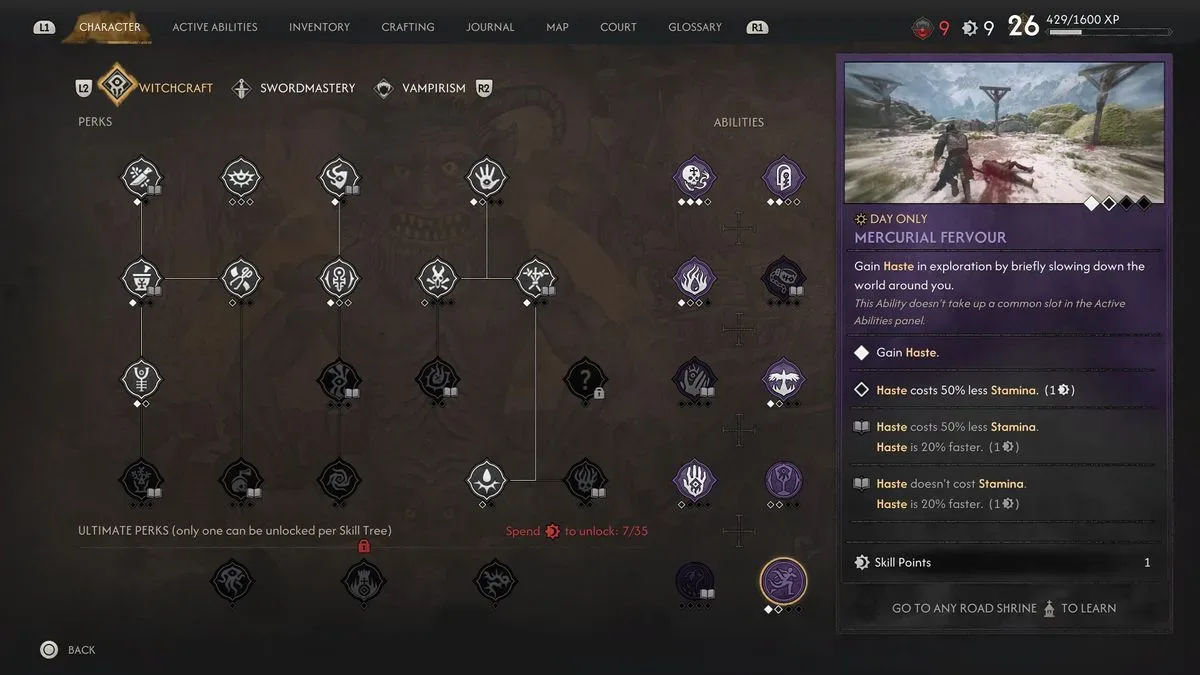
Witchcraft covers spells, material collection, crafting, and item-related bonuses. Because much of this tree is restricted to daytime, it makes the most sense for players who want their daylight hours to feel productive rather than merely transitional. Its strongest choices either ease travel and resource use or make spellcasting’s health-sacrifice tradeoff less punishing.
- Mercurial Fervour is a major quality-of-life pick because it provides a faster sprint. Daytime travel can involve substantial distances, and stronger movement makes exploration less draining.
- Frugal Witchcraft returns health after an enemy is killed by a Witchcraft spell. Since casting carries dangerous health costs, healing on spell kills helps make an aggressive magical style more sustainable.
- Forbidden Sigils grants additional Witchcraft Ability Slots. More slots mean more tactical options without constantly rebuilding the active setup.
- Amalgam allows multiple long-duration consumable buffs to stack. That opens the door to raising several attributes at the same time instead of choosing one temporary advantage.
- Life Lock is an active defensive ability that reflects the next several incoming damage instances back at their source while requiring comparatively little health sacrifice.
For a Witchcraft-led setup, Mercurial Fervour and Frugal Witchcraft are sensible priorities: one improves the rhythm of daytime roaming, while the other addresses the tree’s principal danger. Forbidden Sigils becomes increasingly attractive once there are enough abilities worth carrying. Amalgam rewards players who actively use consumables, whereas Life Lock is an appealing safety tool for difficult engagements.
Swordmastery perks that support almost every build
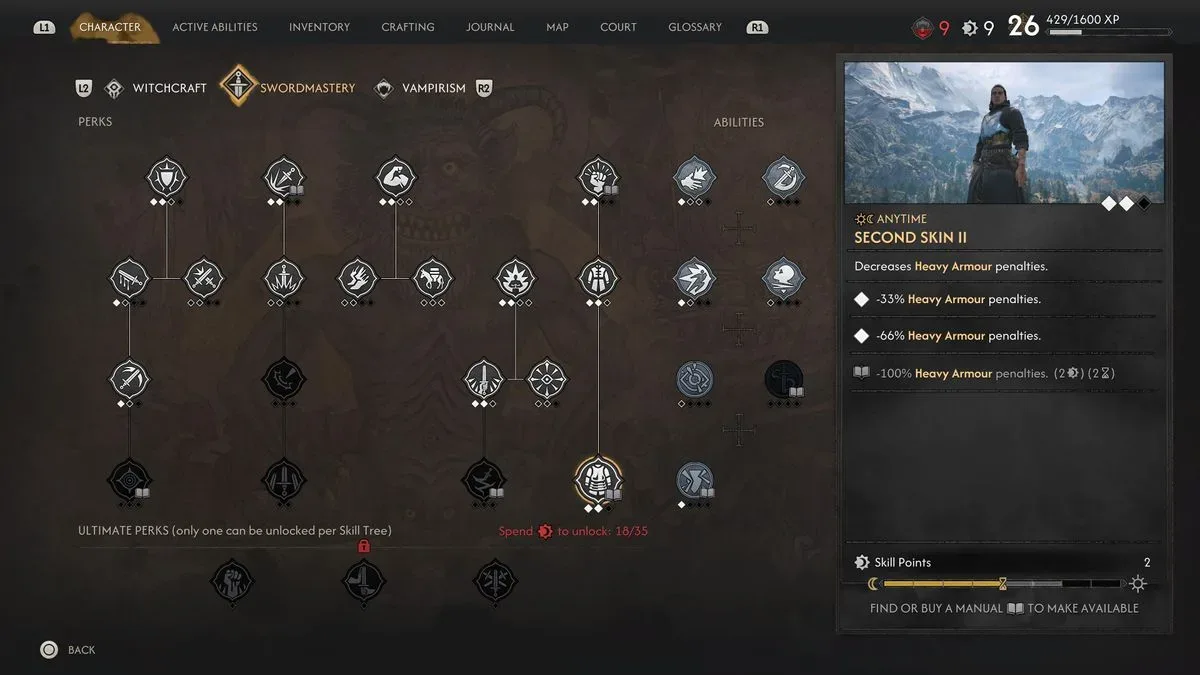
Swordmastery concerns conventional weapon fighting, stamina, carrying capacity, armor, and combat abilities. Its biggest advantage is reliability: unlike the other two trees, these benefits apply both day and night. Even a spell-heavy or vampire-heavy character can get substantial mileage from a sword tree that improves defensive timing and keeps active abilities supplied.
- Sustained Focus increases activation charges. Since active abilities consume these charges, this is foundational for many builds rather than only dedicated melee setups.
- Second Skin II grants heavy-armor proficiency and reduces the drawbacks attached to wearing heavy armor. Its value rises sharply later, when equipment decisions become more meaningful.
- Perfect Block enhances the stamina and activation-charge recovery earned through perfect parries.
- Sharp Eye applies reductions to an enemy’s defense and damage after a perfect block, turning a good defense into an opening for the entire exchange.
- Master Fencer adds Swordmastery Ability Slots for a more flexible active kit.
- Endless Effort improves stamina, making it a particularly useful investment after the earliest portion of the game.
- Broad Swing is a close-range area attack that can strike surrounding opponents, ideal when camps or crowded fights prevent clean duels.
- Swiftness boosts attack speed after a perfect block, extending the opportunity to retaliate when an opponent is exposed.
The perfect-block cluster is especially coherent. Perfect Block pays resources back, Sharp Eye weakens the enemy, and Swiftness accelerates the follow-up. Players confident in parry timing can turn defense into a repeatable offensive engine. Those less interested in precision can still benefit from Sustained Focus, Endless Effort, Broad Swing, and eventual heavy-armor support. The point is not to collect every perk with a sword on it; it is to build enough endurance and capacity that the rest of the loadout can function.
Vampirism perks for night movement, feeding and survival
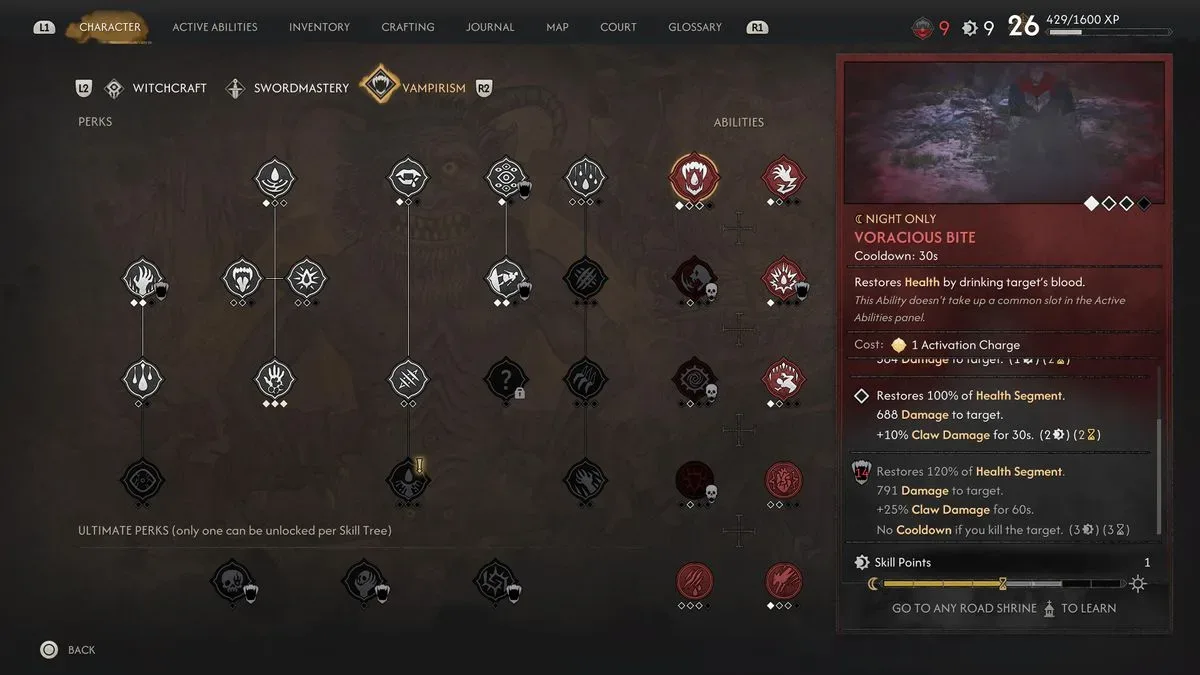
Vampirism is exclusive to nighttime and emphasizes claws, damage, mobility, recovery, and blood-related power. Its best options help Coen cover ground quickly, secure health, or escape the ultimate penalty for taking one risk too many.
- Shapeshift transforms Coen into a wolf and grants Haste, making it the tree’s answer to long-distance nighttime travel.
- Death From Above enables aerial stealth kills against enemies below. It can eliminate ordinary foes and inflict serious harm on bosses.
- Voracious Bite improves the basic bite, combining damage and healing while also setting up later upgrades.
- Endless Hunger substantially increases maximum nighttime health and reduces the likelihood of accidentally losing control to hunger.
- Nourishing Blood increases healing gained from drinking blood, useful during combat as well as between encounters.
- Hastened Corruption speeds Corruption gain and later improves health. Since Corruption also determines access to some vampire powers, taking it early effectively accelerates vampire-tree progression.
Voracious Bite, Nourishing Blood, and Endless Hunger form a strong survival package for anyone relying on night combat. Shapeshift is the practical pick for players who want to make better use of nighttime travel, while Death From Above favors a stealthier route. Hastened Corruption deserves early attention when the goal is to reach Corruption-gated vampire abilities sooner, though its value naturally depends on how much the player wants to lean into the system.
Ultimate perks: one permanent choice per tree
Each tree contains three ultimate perks, nine total, but only one can be selected from each individual tree. Picking one permanently excludes the other two in that tree for the current playthrough, so this is the clearest point at which a build should reflect actual habits rather than theoretical possibilities.
- Runic Bulwark is a standout Witchcraft ultimate for parry-oriented characters. A perfect block has a 15% chance to inflict a random Hex on the opponent. Since perfect blocking should be a familiar part of combat by the time ultimates are available, the effect can create valuable extra pressure.
- Last Stand doubles weapon damage when health is at 30% or lower. It competes with Tactical Mastery, but the low-health damage increase is exceptionally direct, particularly for a vampire-oriented approach that offers more control over health.
- Renounce Death activates once per combat instead of allowing death, granting 10 seconds of lifesteal and immortality. It is a simple, powerful answer to the game’s most fundamental problem: staying alive.
Witchcraft and Swordmastery ultimates each require spending 35 perk points in their respective trees. The Vampirism ultimate threshold is Corruption 15. Those requirements reinforce the need to specialize. A player aiming for Runic Bulwark or Last Stand should avoid casually scattering too many points elsewhere before meeting the 35-point commitment.
Choose the tree that matches the hours and encounters that define the playthrough. For day-centric magic, prioritize movement, spell sustain, and slots. For a general-purpose fighter, build around stamina, charges, and perfect blocks. For night hunting, secure healing and mobility first, then work toward Corruption-gated power. It is less about discovering a single universal answer than avoiding a perk plan that tries to be every kind of monster at once.
And if the whole exercise makes every future pickup feel like another small but consequential commitment, that is not entirely unlike the collector’s five stages of buying one small thing. The difference is that Dawnwalker makes the consequences arrive with claws, swords, and a clock that keeps moving.