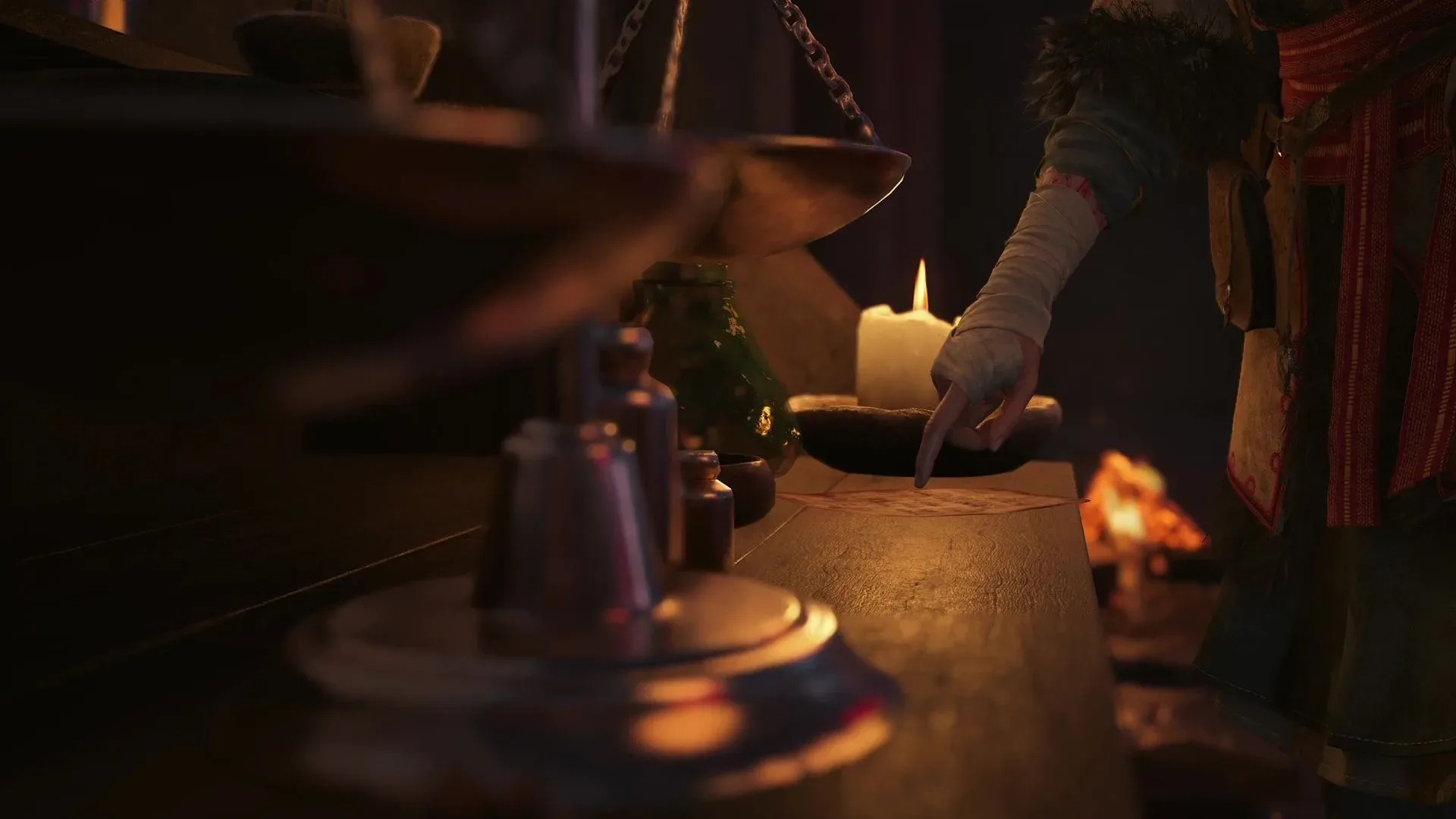
Short answer: letting Anca keep Leonica’s notes is generally the more positive outcome in The Blood of Dawnwalker, provided you can accept the unsettling implications of how she achieves it. Burning the notes is a valid role-playing decision, but it produces very little practical change beyond Anca’s immediate disappointment. Neither route appears to alter the main quest’s direction or the game’s romance possibilities.
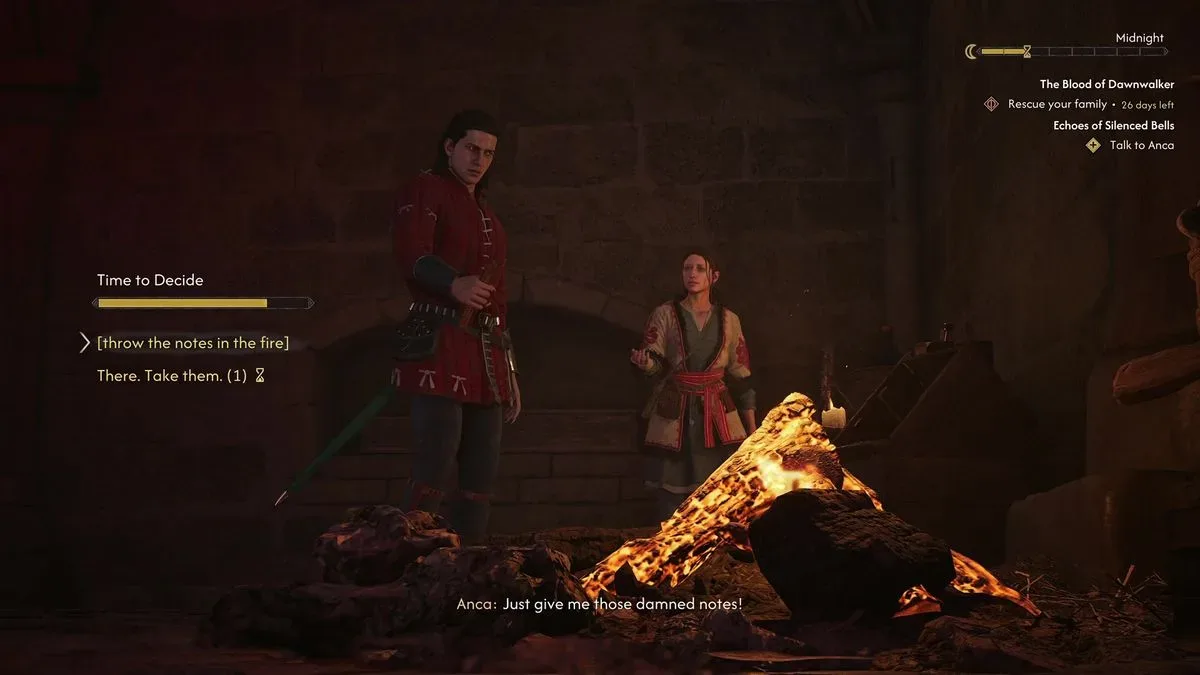
The choice arrives after Leonica has been defeated. You are holding documents tied to black magic, while Anca wants to decipher and apply their contents in the hope of helping the sisters of St. Tyna’s. That premise makes the decision feel much larger than a routine “keep item” or “destroy item” prompt. The notes may offer a way to end a curse, but they are also dangerous enough that handing them over carries an obvious moral cost.
It is the sort of decision built to make a player stare at the dialogue wheel for a minute, then wonder whether the game is quietly setting up a catastrophe several hours away. Fortunately, the long-term mechanical stakes are comparatively limited. Your decision mostly determines what happens to St. Tyna’s and how you interpret Anca’s willingness to use forbidden knowledge.
What happens if you burn Leonica’s notes?
If you throw the notes into the fire, Anca cannot proceed with the ritual work she has in mind. She is unhappy with the choice, since the papers represent her best apparent lead for saving the afflicted sisters. However, that conflict does not turn into a major split in the campaign.
After the scene, the story returns to its primary path. There is no indicated change to whether romances remain possible, and no meaningful mechanical penalty is attached to denying Anca the notes. In other words, this is not a trap choice that locks off a sweeping branch of quests, companions, or progression.
Burning the notes is therefore the cleanest answer for a character who refuses to gamble with occult material, regardless of the potential benefit. It fits a cautious protagonist, someone suspicious of Leonica’s work, or anyone who believes that good intentions are not enough to justify experimenting with black magic. Role-playing decisions do not always need a reward screen to have weight. Sometimes the reward is simply not being the person who handed over the cursed instruction manual.
That said, players choosing this route should do so because it matches their character’s principles, not because they expect a substantial content advantage. The immediate emotional consequence is Anca’s frustration, but that tension fades quickly as the story continues.
What happens if you give the notes to Anca?
Allowing Anca to use the notes leads to the outcome that most directly helps St. Tyna’s. Her ritual succeeds in removing the magic affecting the undead nuns and releases them from the curse. If your priority is saving the sisters, this is the choice to make.
The catch is that the outcome is not framed as uncomplicated heroism. The ritual works, but the aftermath implies that Anca has crossed troubling lines in order to make it work and has paid a personal price in the process. The game does not turn that implication into an enormous ongoing mechanical system, nor does it keep repeatedly punishing the player for the decision. Still, it matters thematically: helping the nuns comes through knowledge that was dangerous from the start.
Think of it as a choice between an imperfect rescue and a firm refusal. The rescue is real. So is the unease around the means used to secure it. Players who value tangible aid to St. Tyna’s will likely find this route preferable, while players who regard Anca’s safety and moral boundaries as the central concern may find it harder to endorse.
For a game choice with grim materials, the downstream effect is restrained. The issue may receive occasional passing acknowledgment in later dialogue, rather than becoming a constant companion-story crisis. The bigger payoff comes in the post-game recap, which addresses St. Tyna’s longer-term fate. That recap is narrative closure rather than a change to character power, equipment, romance, or access to the core campaign.
Which option is best?
For the most beneficial result for the sisters of St. Tyna’s, give Anca the notes. The curse is lifted, and the affected nuns are freed. That makes it the stronger option if you judge outcomes chiefly by who receives help.
For the most cautious ethical stance, burn the notes. You prevent further use of Leonica’s black-magic research, even if that means walking away from a possible cure. Anca’s response makes clear that she disagrees, but the game does not heavily punish the player for choosing restraint.
The important practical point is that neither path seems to dominate the other in standard gameplay terms. You are not deciding between a good ending and a bad ending for your own character, and you are not trading a romance path for a different one. You are deciding the fate of a specific group and setting the tone of your relationship to dangerous magic.
- Choose Anca’s route if freeing St. Tyna’s sisters matters most to you, and you can live with the implication that the ritual harms or changes Anca.
- Burn the notes if your character would reject black magic on principle, especially when the risks are unclear.
- Do not expect a major gameplay divergence from either option. The main quest proceeds either way.
- Do not choose based on romance concerns: this decision does not appear to affect them.
Why the prompt feels more dangerous than its mechanical impact
The scene is effective precisely because the game does not spell out every consequence in neat numerical terms. Anca is determined to pursue the research, and dialogue can express disapproval, but verbal objections alone do not stop her. Destroying the pages is the only way to deny her the material outright. That makes the player an active gatekeeper rather than a spectator who can merely say, “This sounds like a bad idea,” before the plot carries on.
There is also no comfortably clean option. Destroying the notes means turning away from an opportunity to save people. Preserving them allows a cure but permits someone you know to delve into something harmful. The ambiguity is the point: the papers are not merely a quest item, but an invitation to decide whether forbidden knowledge is defined by its source, its method, or the result it can produce.
That is a familiar tension in dark fantasy, but it works well here because the stakes remain personal. This is not an abstract question about saving an entire kingdom at any cost. It is about whether Anca should bear the burden of a ritual in order to help the sisters of St. Tyna’s. Players can reasonably land on either side without feeling as though they misunderstood an obvious “correct” solution.
It is also worth separating narrative consequence from mechanical consequence. Games often train us to interrogate every choice as if it were a hidden build guide: which answer produces the superior reward, the most quests, or the best approval result? That instinct is understandable. Even the etiquette around local games can turn into a tiny social contract, as explored in The Unwritten Rules of Couch Multiplayer, Now Written Down. But the Leonica notes decision is better approached as a story judgment. The outcome at St. Tyna’s matters; the campaign’s practical structure largely does not change.
A spoiler-light way to make the call
If you want to preserve the feeling of making the decision in character, use a simple question: Would your version of the protagonist accept personal corruption or suffering in an ally if it could free innocent victims? If the answer is yes, allow Anca to have the notes. If the answer is no, commit the papers to the fire.
Players who want the kindest direct outcome for the nuns should not overthink it: Anca’s ritual succeeds. Players who feel the game has supplied too little certainty about the danger are equally justified in refusing to enable it. The ambiguity surrounding what Anca risks is part of why the choice can feel uncomfortable, not evidence that a huge hidden punishment is waiting around the corner.
There is a small collector-brain temptation to treat every branching prompt like an object that must be preserved in pristine condition until its future value is known. Sometimes that instinct is useful; sometimes it is just paralysis wearing a fancy plastic sleeve. The Collector’s Five Stages of Buying One Small Thing captures the familiar spiral. Here, the useful information is straightforward: the choice affects St. Tyna’s story and some later flavor, not the overall viability of your playthrough.
Will the choice come up again?
Yes, but lightly. If Anca uses the notes, the event can be mentioned later in dialogue, and the post-game recap addresses the long-term condition of St. Tyna’s. If you burned them, the immediate disagreement with Anca does not become a major enduring rupture. The broader narrative keeps moving.
That post-game material is where the game gives the decision its clearest sense of permanence, without turning it into a mechanical obstacle. Players hoping to see how their intervention shaped the world should pay attention to the recap, but those looking for a radically different main campaign should temper expectations.
So, burn Leonica’s notes if refusing forbidden magic is essential to your character. Give them to Anca if saving the sisters is the priority. The latter offers the more helpful outcome for St. Tyna’s, while the former remains a coherent, consequence-light decision for anyone unwilling to let the cure come at Anca’s implied cost.