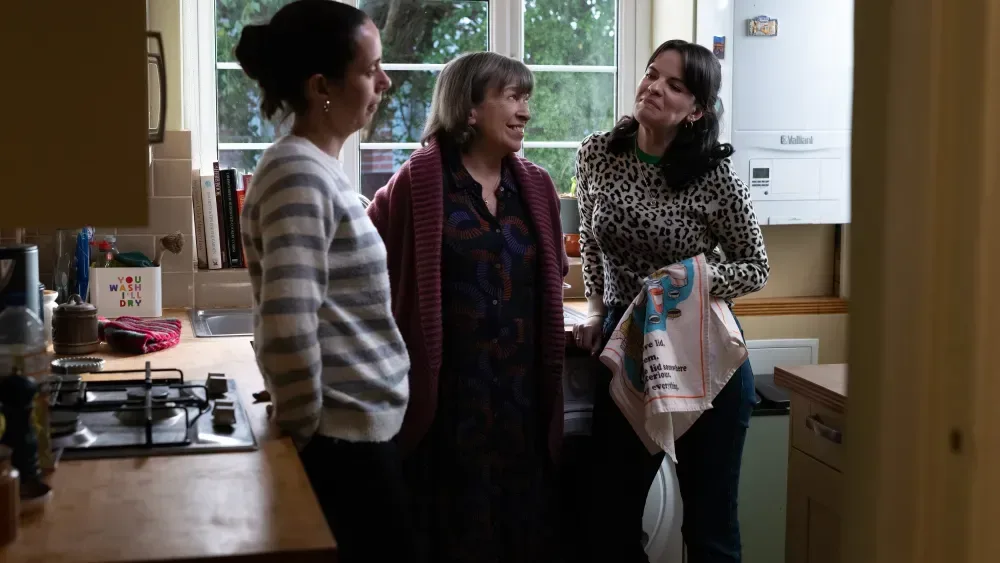
Mike Leigh’s Tender Loving Care emerged as the defining winner at the San Sebastián Film Festival, collecting the Golden Shell for Best Film alongside the Jury Prize for Best Screenplay. Kate O’Flynn also received a Silver Shell for Best Leading Performance for her work in the film, sharing that acting prize with Asta Kamma August of Growth of the Soil.
That three-award result gives Tender Loving Care a particularly clear festival-night sweep: the top prize for the film itself, recognition for Leigh’s screenplay and a major performance award for O’Flynn. The jury was headed by filmmaker Ira Sachs.
What the Golden Shell sweep means
The Golden Shell is San Sebastián’s Best Film award, so its placement at the top of the official-selection honors makes it the headline result. In this case, the win is reinforced by the screenplay and leading-performance prizes rather than standing as a single isolated trophy. That does not tell audiences anything specific about the film’s plot, distribution plans or release date—none were included with the awards—but it does establish that the jury recognized multiple parts of the same production.
Festival awards often separate a film’s overall achievement from the individual crafts that helped create it. Here, the jury’s selections point to three distinct areas:
- Golden Shell for Best Film: the event’s top honor for the complete feature.
- Jury Prize for Best Screenplay: recognition for the writing credited to Mike Leigh.
- Silver Shell for Best Leading Performance: recognition for an actor in a principal role, awarded jointly to O’Flynn and August.
For viewers tracking the season’s prominent festival titles, the immediate practical takeaway is simple: Tender Loving Care is now the San Sebastián title with the strongest official-awards profile. It also received the Transforma Award, adding another honor outside the core official-selection lineup.
Other major official-selection winners
Ah Biao’s Border received the Special Jury Prize. Amanda Kernell won the Silver Shell for Best Director for Brace Your Heart, while Javier Cámara took the Silver Shell for Best Supporting Performance for 5 More Minutes.
Growth of the Soil was another multiple winner. In addition to Asta Kamma August’s shared leading-performance Silver Shell, Oskar Dahlsbakken won the Jury Prize for Best Cinematography.
Cinematography refers to the visual photography of a film: the work involved in how scenes are photographed and presented on screen. The award therefore singles out the image-making contribution rather than directing, writing or acting. Paired with August’s acting honor, the result puts Growth of the Soil alongside Tender Loving Care as one of the official-selection films recognized in more than one category.
Related coverage includes ‘Tender Loving Care’ Takes Golden Shell as San Sebastián Announces 2026 Winners.
The principal official-selection awards were:
- Golden Shell for Best Film: Tender Loving Care, Mike Leigh
- Special Jury Prize: Border, Ah Biao
- Silver Shell for Best Director: Brace Your Heart, Amanda Kernell
- Silver Shell for Best Leading Performance: Kate O’Flynn for Tender Loving Care and Asta Kamma August for Growth of the Soil
- Silver Shell for Best Supporting Performance: Javier Cámara for 5 More Minutes
- Jury Prize for Best Cinematography: Oskar Dahlsbakken for Growth of the Soil
- Jury Prize for Best Screenplay: Tender Loving Care, Mike Leigh
Audience prizes go to ‘La Bola Negra’ and ‘NAZA’
The festival’s audience honors drew attention to two very different works. Javier Calvo and Javier Ambrossi’s Spanish queer epic La Bola Negra won the Audience Award for Best Film. The film arrived at San Sebastián after receiving the People’s Choice Award in Toronto the prior week, making this a second audience-driven prize in quick succession.
Yuval Abraham and Rachel Szor’s NAZA received the Audience Award for Best European Film. The documentary is described as an exposé of Israeli war crimes in Gaza. An audience award is distinct from a jury award: it reflects the response registered by festivalgoers rather than the deliberation of the appointed official jury. Keeping that distinction in view matters when reading a winners list: Tender Loving Care led the jury-selected official honors, while La Bola Negra and NAZA were the audience-recognized titles.
That split gives the festival’s final results more than one center of gravity. The Golden Shell identifies the jury’s top film, whereas the Audience Award for Best Film marks the title that connected most strongly with the participating public. Neither category substitutes for the other; they answer different questions about the festival program.
New directors, Latin Horizons and Zabaltegi-Tabakalera
Beyond the headline competition, the awards covered films and projects across several strands. Naëmi Ada’s Body of Glass won the New Directors Award, while Yoon Dan-bi’s The World Before received a special mention in that section.
Alessandra Sanguinetti’s The Illusion of an Everlasting Summer won the Latin Horizons Award, with Fernando Eimbcke’s Flies earning a special mention. Jane Schoenbrun’s Teenage Sex and Death at Camp Miasma received the Zabaltegi-Tabakalera Award, and María Aparicio’s Sometimes Sadness, Sometimes Rebellion received that strand’s special mention.
Other program prizes included the Best Original Music Award for Amine Bouhafa’s work on Milo; the Irizar Basque Film Award for Elsa Oliarj-Inès’s Txakun txakür; the Culinary Zinema Award for Michael Dweck and Gregory Kershaw’s Burgundy; and the RTVE Another Look Award for Ryusuke Hamaguchi’s All of a Sudden.
Juan Miguel Gelacio and Esteban Hoyos García’s Five Years, Four Months won the Spanish Cooperation Award. These honors demonstrate the breadth of a festival awards program: recognition extends beyond the central competition to music, regional cinema, food-focused cinema and other curated strands.
Industry and project awards
San Sebastián’s awards also included prizes for works in progress, developing projects and short-form work. Such awards are not the same as prizes for completed feature films. A work-in-progress, often abbreviated as WIP, is a project still being finished; industry awards in that area recognize projects at a different stage from titles receiving festival-premiere awards.
Among the announced industry results, Juan Sebastián Mesa’s Lovers Go Home! won the WIP Latam Industry Award. Tatiana Huezo’s Galerna received the Egeda Platino Industria Award for Best WIP Latam. Val Jashari’s In a Manner of Speaking won both the WIP Europa Industry Award and the WIP Europa Award.
Felipe Solari Yrigoyen’s The Amateurs received the XIII Europe-Latin America Co-production Forum Best Project Award. Ingrid Pokropek’s The Illusions won the DALE! Award, Selma Cervantes’s Mourning Sound won the Artekino International Award, and Inês Nunes’s The Spirit Healer Is Away for the Weekend received the Casa Wabi-ESCINE Award.
The startup challenge honored Pixentinel, credited to Luis Zabala, as Best Spanish Project. Virtual Location Scouting, credited to Antti Ahokoivu, was named Best European Project and also received a special mention for entrepreneurship.
For readers interested in another recent piece of film criticism, Joking Joystick’s review of Her Private Hell examines how atmosphere and visual ambition can shape the experience of a movie even when other elements remain unresolved.
Short-film honors and the complete picture
Previously announced prizes rounded out the festival’s broad winners list. Maarij Reka’s Erased From the Map won the Nest Award, with Julia Coldwell Serra’s Nobody Barks receiving a special mention. Diego Luna’s Ashes took the Euskadi Basque Country 2030 Agenda Award.
Ekain Albite’s Akira won both the Tanta Award and the Sideral Award. Zaira Zanguitu’s Shady Birds received the Music Library & SFX Award, while Safaa Khatib’s Different Colors of Sabir won the Dogwoof Award. Alfonso García’s The Hammock received the Epe-Ibaia-Elkargi Award.
Josu Ozaita’s Esperantza won the Eusko Label Micro Short Film Award, with Hands by Mikel Urretabizkaia named runner-up. Javi Prada’s Prejuicios took the Loterias Award, while Lucía Saavedra’s Headscarf was the runner-up.
The final slate therefore spans completed competition films, audience favorites, emerging filmmakers, regional work, projects in development and shorts. Still, the night’s clearest headline belongs to Tender Loving Care: its Best Film, screenplay and acting victories make it the festival’s most decorated official-selection title.