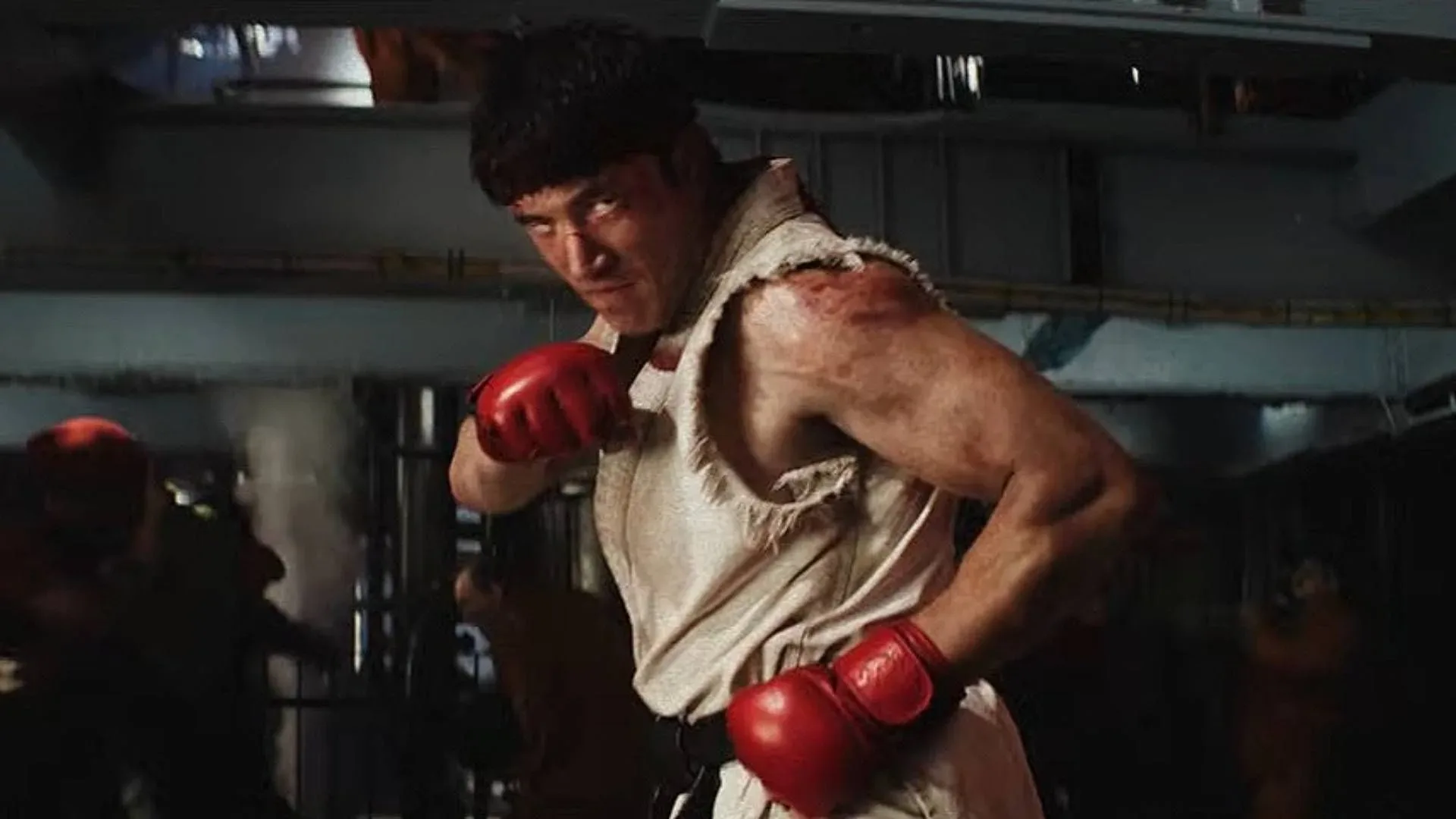
Movie trailers usually ask for two and a half minutes of attention, perhaps a willing suspension of disbelief, and the occasional tolerance for a bass drop loud enough to disturb nearby furniture. The new Street Fighter trailer asks for something much more dangerous: decent timing on an arcade control setup.
A special interactive version of the teaser, released on YouTube, presents the trailer through an arcade machine and lets viewers play along with it. Before the footage gets underway, the experience supplies a tutorial. Then, as the action unfolds, players are invited to attempt inputs and combos rather than merely admire someone else landing them with expensive cinematic lighting.
It is an appropriately cheeky idea for Street Fighter, a series whose name has long meant different things to different people. For some, it means competitive mastery, frame data, difficult execution and the eternal search for a safe way to approach. For others, it means picking a favorite fighter, confidently attempting a special move, and learning that the controller has apparently become a legal document written in a language they do not speak. This trailer appears prepared to welcome both camps, then grade them.
An arcade trailer with a score to settle
The playable teaser is designed around an arcade-cabinet presentation. Its tutorial establishes the interaction before the trailer starts, while the combat sequences provide the clearest moments to join in. The centerpiece is the confrontation between Ryu, played by Andrew Koji, and Ken, played by Noah Centineo. Rather than simply cutting from pose to punch to title card, this version makes room for the audience to try the action themselves.
At the end, the experience delivers a score based on how well the player performed. That small feature is doing a great deal of work. A standard trailer ends with a release date and the usual feeling that a person has watched marketing. A scored trailer ends with a release date and numerical evidence that the player may need to spend the next several years in the training room.
The concept also gets at the particular pleasure—and occasional humiliation—of fighting games. Watching a clean combo is impressive. Trying that combo, missing an input, and receiving an immediate score is a far more personal relationship with the material. The teaser effectively turns promotion into a miniature challenge mode, which is far closer to the language of an arcade fighter than a passive video window could be.
That does not mean the interactive trailer replaces a game, or that it needs to. Its role is much smaller and stranger: a promotional detour that lets the film borrow a bit of the series’ muscle memory. Players who have internalized fighting-game motions may see it as an invitation. Everyone else can discover the classic truth that the phrase “simple tutorial” is sometimes a trap laid by people with faster thumbs.
Why the format fits Street Fighter
Street Fighter has always carried an unusually visible relationship to performance. Matches are not only about winning; they are about reads, reactions, signature moves and making an opponent look at least a little bit silly. An arcade-styled trailer can tap into that energy because it asks the viewer to participate in the spectacle, even if only briefly.
There is also a natural nostalgia to putting the teaser inside an arcade machine. The franchise has deep roots in arcade culture, where strangers could line up behind a cabinet, watch a match in progress, judge every missed anti-air in complete silence, and then take their turn with suspicious confidence. A browser-based interactive trailer is plainly not the same social setting, but the cabinet framing is a smart nod toward that history.
It helps that this is a movie property where the fighting itself is not decorative. The film’s stated setup has Ryu and Ken entering the brutal World Warrior Tournament, only to become caught in a deadly conspiracy. A story built around a tournament and its fighters has a ready-made reason to emphasize rivalry, technique and escalation. Letting the trailer’s audience participate during a Ryu-versus-Ken exchange makes more thematic sense than asking them to click through, say, a detective’s evidence board or a wizard’s tax return.
The online reaction described around the teaser reflects that logic. Fans have responded positively to the notion that a fighting-game trailer can include actual inputs, while others have joked about the inevitably punishing combo challenge. Both responses understand the gag. The trailer is not pretending every viewer is tournament-ready; it is turning the fear of execution failure into part of the fun.
For anyone who remembers the social chaos that appears when a group tries to share a fighting game controller, the idea has familiar energy. Joking Joystick’s guide to the unwritten rules of couch multiplayer covers the kinds of rituals that emerge when spectators become challengers. The interactive teaser compresses that transition into a marketing clip: watch the bout, try the moves, accept the score, and decide whether the machine has slandered you.
The movie’s cast and tournament premise
Koji’s Ryu and Centineo’s Ken lead the cast. They are joined by Callina Liang, Joe Anoa’i, David Dastmalchian, Cody Rhodes, Curtis “50 Cent” Jackson and Jason Momoa. The announced ensemble signals a broad roster built around the recognizable characters and personalities that a Street Fighter adaptation needs to juggle.
Adapting a fighting-game series for a feature film is always a balancing act. The source material offers iconic fighters, instantly recognizable visual language and decades of fan expectations, but a movie also needs to give its matches narrative stakes. The World Warrior Tournament premise provides a useful foundation: it offers an arena for the characters to meet, compete and collide, while the conspiracy pushes the story beyond a simple bracket.
Director Kitao Sakurai has said the goal was to create a movie with its own distinct tone rather than something that feels like a conventional, ready-made video-game adaptation. He has also indicated that the creative team supported a less conventional approach. That aspiration is visible in the trailer experiment itself, at least as a piece of promotion. Whether the finished film delivers on that separate question remains for its theatrical run, but an interactive teaser is a more distinctive opening move than another collection of slow-motion punches cut to ominous percussion.
A small experiment in making promotion playable
Interactive media has often tried to erase the boundary between observer and participant, sometimes with grand ambitions and sometimes with a button that says “press here to make a thing happen.” This Street Fighter teaser falls in the modest but fitting category: it does not need to transform cinema. It only needs to briefly let people feel that watching a fight is not quite enough.
That impulse overlaps with a larger interest in immersive formats and shared digital experiences. Recent discussion of immersive storytelling and shared spaces shows how creators continue looking for ways to make audiences more active within a work. The playable trailer is far less elaborate than an XR installation, but it follows a similar instinct: the format should reinforce the subject. In this case, the subject is a game series about making split-second decisions under pressure, so the pressure gets invited into the trailer.
There is a practical advantage, too. The score gives viewers a reason to replay the teaser, compare outcomes, or quietly pretend they were only experimenting with the controls. It transforms a one-time viewing into a little piece of repeatable participation. That may be the ideal scale for a trailer gimmick: recognizable enough to discuss, small enough not to obscure the actual footage, and mischievous enough to feel true to the property.
The new Street Fighter film is set to arrive in theaters on October 16. Until then, its arcade-style trailer has offered an unusually literal answer to the question of what viewers should do during a fight scene. They can watch Ryu and Ken square off—or they can attempt the combo themselves and let a score decide how much trash talk they have earned.