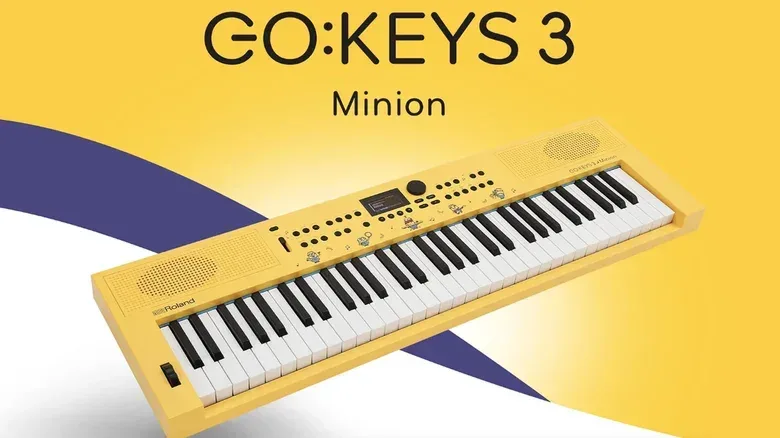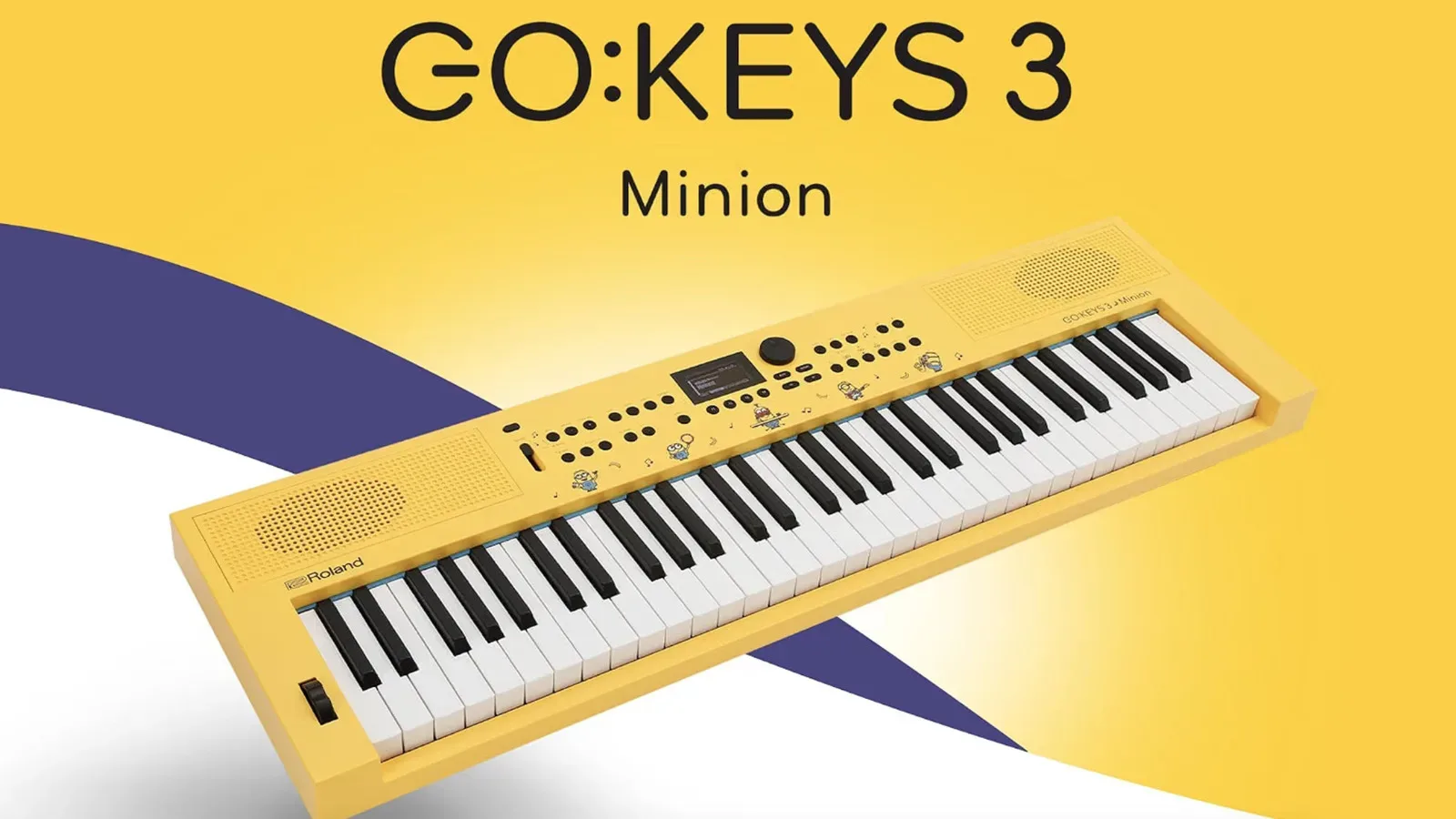
There are musical instruments designed to disappear into a studio. There are musical instruments designed to look respectable on a piano stand. And then there is Roland’s GO:KEYS 3 Minion, a bright-yellow 61-key keyboard decorated with Minions artwork and equipped to put the franchise’s famously nonsensical voices across its keybed.
The premise is magnificently direct: take an established beginner-focused portable keyboard, paint it the color of a banana with ambitions, add blue trim reminiscent of the characters’ overalls, and give players 32 Minions-themed sound variations. Those variations include sounds associated with Bob, Kevin and Stuart, meaning a simple melody can become an arrangement for several tiny yellow chaos agents.
It is an unusual product, but it is not merely a decorative toy keyboard. Under the illustrations is the standard GO:KEYS 3 platform, with 61 keys, built-in speakers, AA battery power and Roland’s ZEN-Core sound engine. That gives this particularly loud visual object a substantial list of conventional instrument sounds, too: more than 1,000 sounds spanning acoustic pianos, synthesizers, orchestral instruments and drums.
A real portable keyboard wearing Minions pajamas
The GO line is aimed primarily at people beginning to make music, which makes the crossover easier to understand. A character-themed exterior can lower the intimidation factor of a keyboard for a younger player, while the underlying feature set means the instrument is not limited to novelty noises.
Keybed simply means the keys and their playing mechanism: the physical section a musician presses to trigger notes. Here, Roland supplies 61 keys. That is fewer than the 88 keys found on a full-size acoustic piano, but it is a common size for portable keyboards and gives a learner room for melodies, chords and many two-handed parts without making the instrument as unwieldy as a full piano.
The integrated speakers and AA battery capability are equally practical details. Together, they suggest a keyboard that can be moved around the house or used away from a fixed outlet. For a family, that may mean practice can happen in a bedroom, living room or wherever the musical Minions have not yet been banished. It also means the product’s theme is not its only defining function: portability is built into the proposition.
The important bit: it has more than gibberish on board
The Minions material is the headline, including the prospect of playing character voices melodically across the keys. Roland has shared audio examples that put the vocal sounds to work on familiar music, an idea that lands somewhere between sound design, comedy and a small-scale attack on classical dignity. Johann Strauss’ The Blue Danube, for example, is an entirely different kind of waltz when its apparent singers are animated yellow henchmen.
Still, the 32 themed variations sit alongside a considerably wider sound library. Roland says the keyboard uses its current ZEN-Core sound engine and includes access to more than 1,000 sounds from the company’s library.
A sound engine is the system that creates or plays back an instrument’s tones. In practical terms, it is why a keyboard can move from piano to strings, drums or synthesizer sounds rather than producing only one fixed timbre. Timbre is the character or color of a sound: it is what makes a piano note sound different from a flute note even when both are playing the same pitch.
That distinction matters for anyone considering the GO:KEYS 3 Minion as a first instrument. The Minions voices may be the instant conversation starter, but piano, synth, orchestral and drum sounds are the tools likely to support ordinary practice and experimentation after the initial run of “what if this whole song were sung by Stuart?”
The keyboard can also download additional sounds through Roland Cloud Connect. That expands the idea beyond the sounds loaded at the outset, though prospective buyers should consider what they want from the instrument before treating the themed variations as a substitute for a broader music-making workflow. The central appeal remains an accessible portable keyboard with an enormous amount of visual personality, not a stripped-down souvenir with a few buttons.
Who the crossover makes sense for
This is most naturally a gift proposition for a budding musician who already loves the Minions. The familiar characters could make the keyboard feel personal in a way a standard black model does not. The 61-key layout, speakers, battery power and range of conventional sounds give that gift some staying power beyond a single joke.
It may also appeal to an adult collector or franchise fan, but its value in that case is different. This is not described as a limited collectible or a display-only replica. It is an instrument intended to be played. Buyers drawn chiefly to the yellow case should remember that the practical hardware and sound library account for much of what is being sold.
There is a broader lesson in the design, too. Beginner gear does not have to look austere to be legitimate. A playful theme can be an invitation to interact with an instrument, particularly for a new player who sees keyboards as complicated or overly formal. The best outcome is not that someone plays only Minions voices forever, however noble that cause may be. It is that the novelty gets hands on keys, and the larger sound set gives those hands reasons to keep returning.
The $65 question
Roland lists the GO:KEYS 3 Minion at $450. The comparable non-branded GO:KEYS 3 is around $385, making the difference roughly $65 for the Minions design, illustrations and themed sound content.
Whether that premium feels justified depends almost entirely on who will use it. For a buyer choosing between functionally similar models, the standard version may be the more straightforward value. The supplied facts point to the same core GO:KEYS 3 foundation beneath the themed treatment, so the extra money is principally payment for presentation and franchise flavor.
For the exact person who wants both a capable entry-level portable keyboard and an instrument that appears to have escaped from an animated film, the calculation changes. A themed object can be more motivating than a neutral one, especially when it is likely to be visible every day. That kind of enthusiasm has practical value if it encourages practice rather than becoming a very expensive piece of yellow furniture.
There is also no need to confuse this with the mechanical keyboards used for PC play, despite the shared name. Those are computer input devices, such as the equipment covered in Logitech’s recent competitive PC gear lineup. Roland’s product is a musical keyboard: its keys produce notes and control instrument sounds, not movement inputs and chat messages. Although, in a perfect world, both categories would offer a dedicated Minions setting.
Novelty, but with a useful foundation
The GO:KEYS 3 Minion is unapologetically strange, and that is exactly why it stands out. Its 32 character-themed sound variations make room for musical goofing around; its standard specifications give it a more serious purpose. A player can explore pianos, synths, drums and orchestral sounds, then immediately return to turning a melody into a Minion chorus.
At $450, it asks buyers to pay a noticeable premium over the non-branded model. But the instrument is at least built on a proper 61-key, speaker-equipped, battery-capable keyboard with a large sound catalog rather than a purely cosmetic novelty. For a beginner who will genuinely be delighted by Bob, Kevin and Stuart appearing at rehearsal, that may be the difference between a keyboard that gets played and one that just quietly judges everyone from the corner.