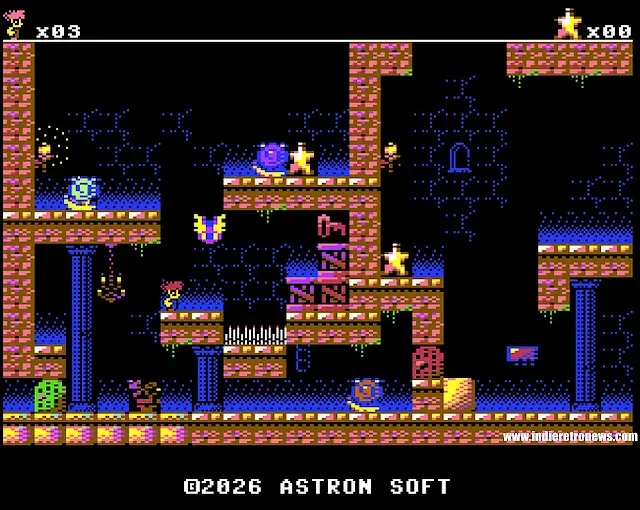
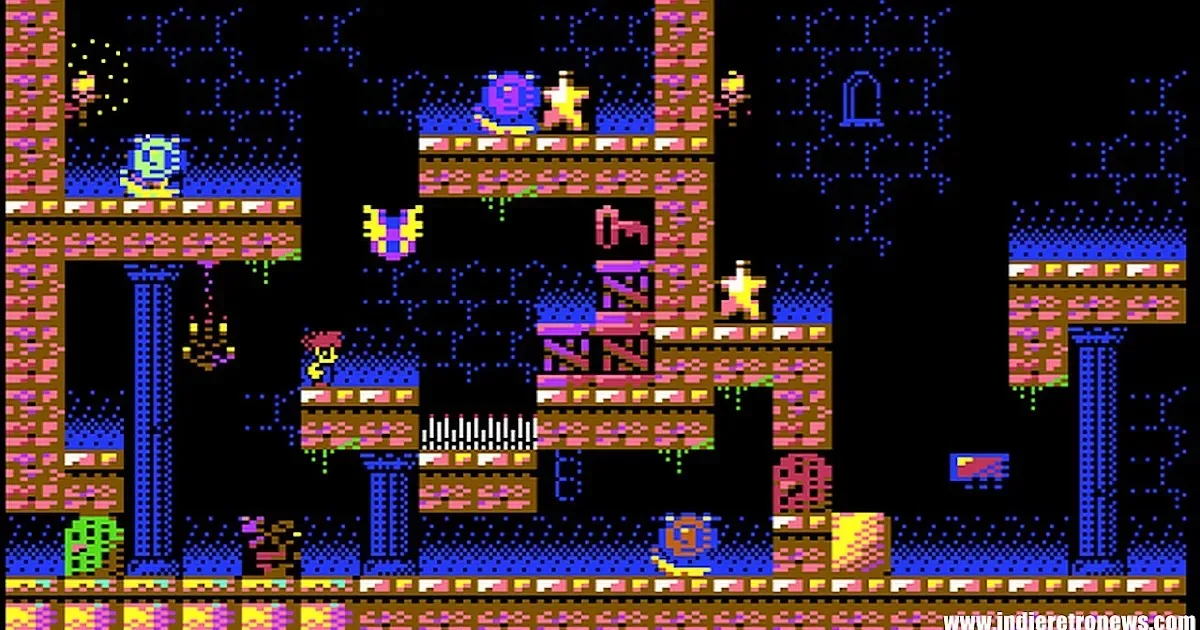
There is a new castle raid brewing on the Commodore 64, and its stakes are appropriately celestial. Zezito and the Lost Stars, an upcoming platformer from Iapetus, puts a small-scale rescue mission at the centre of a much larger night-sky problem: the witch Malandra has locked away 99 stars in her castle, leaving the sky in danger of losing its sparkle.
The setup gives Zezito a very specific window to act. Malandra is away at an annual general witch meeting, so the hero slips into the castle to retrieve the missing stars before she returns. It is not an entirely unguarded burglary, however. Bats and spiked snails remain inside as obstacles, meaning the task is not simply to reach a collectible, but to navigate hostile rooms long enough to bring each one back into the world.
A playable Commodore 64 demo is already available, with 36 of the 99 stars included. That provides a substantial portion of the game’s stated collection objective while the full release is still described as coming soon. Details on the demo can be found through this Commodore 64 demo listing.
A compact premise built around a clear objective
The appeal of the premise is its clarity. The number 99 establishes a complete target for the finished game, while the castle gives that target a natural place to be distributed. Rather than framing the stars as incidental bonuses, the game’s fiction makes their recovery the central job. The night sky needs them back; Zezito has the opportunity; the castle is where the work happens.
For more context, explore Old PC Fans Can Still Earn Their Keep as Desk Coolers, Cabinet Exhausts or Spare Parts.
That distinction matters in a platformer. A platformer is a game built around moving a character through spaces that demand positional control: traversing ledges, avoiding hazards and choosing safe routes through a level. The supplied details do not describe Zezito’s controls, level structure, timer, health system, checkpoints or the exact rules for collecting stars. Still, bats and spiked snails point to an obstacle-driven format in which awareness of enemy placement should be as important as spotting the next objective.
The antagonist’s absence also gives the adventure a pleasant bit of comic momentum. Malandra has created a catastrophic problem for the sky, but she is unavailable because of a meeting. Zezito’s mission is therefore a break-in conducted during the most bureaucratically convenient gap imaginable. It is a tidy premise for a game that can let the castle’s defences do the threatening while keeping the tone light.
What the demo establishes
The demo’s 36 stars are more than a token sample of the final tally. They represent a defined slice of the 99-star objective, allowing players to engage with the game’s most important stated activity: seeking out and recovering lost stars while handling the castle’s residents.
It is important not to read more into that figure than it supports. A 36-star demo does not, on its own, confirm that the final game will be divided into three equal sections, that every star is equally difficult to reach, or that all hazards appearing in the finished release are already present. It does establish that the demo has a collection goal with a meaningful count, and that its content is connected directly to the broader story rather than being described merely as a detached technical preview.
For prospective players, the demo is the most useful available reference point. It can answer practical questions that a premise alone cannot: how the character feels to guide, how sharply enemies pressure the route, and whether the game’s castle exploration has the rhythm they want from a C64 platformer. Those are personal judgments, not confirmed product features, but they are exactly the kind of questions a playable build is positioned to help a player assess.
The castle is occupied, even if its owner is not
Malandra may be away, but the castle still has a defensive personality. The listed threats are a swarm of crazy bats and nasty spiked snails. That pairing suggests two visually distinct kinds of trouble without requiring the game to spell out a large enemy roster. Bats are naturally associated with movement through the air, while a spiked snail suggests a grounded, hazardous obstacle. How either enemy behaves has not been detailed, so players should avoid assuming patrol patterns, attack behaviour or whether contact causes a restart or some other penalty.
What is certain is that Zezito cannot treat the building as an empty museum full of stars. The objective and the dangers are intertwined. Every route toward a missing star may require a decision about spacing, timing or a safer path. In a platformer, that is often where a simple collect-a-thon becomes memorable: the item itself is visible, but the route to it is the actual challenge.
The star count also gives the adventure a useful sense of progress. Each recovered star is an easily understood unit of restoration. Whether a player finds the collection method relaxing, demanding or both will depend on the details of the levels, but the basic appeal is immediately legible: the darkness has 99 little problems, and Zezito is there to remove them one at a time.
A new project for the C64 audience
The Commodore 64 platform is fundamental to the story here. Zezito and the Lost Stars is being made for the C64, rather than merely borrowing its aesthetic on another system. The project is also described as being developed without AI assistance. That is a statement about the development approach, not a description of gameplay, but it is part of how Iapetus is presenting the game.
For players who still seek out new releases for long-running hardware, a demo is especially valuable because it makes the project tangible before the full version arrives. The supplied information does not set a full-release date, list a price, identify distribution formats or specify hardware requirements beyond the Commodore 64 focus. “Soon” is the available release guidance, and it should be treated as such rather than converted into a calendar estimate.
There is also no need for the concept to overcomplicate itself. A witch has hidden the stars. The hero is in her castle while she is gone. Bats and spiked snails make the route unsafe. The demo has 36 stars, while the full game is planned around 99. That is enough to communicate both the setting and the core motivation, leaving the demo to demonstrate how the journey actually plays.
What to watch as the full game approaches
As more information arrives, the most useful details will be the ones that clarify the relationship between the demo and the full 99-star quest. Players will likely want to know how broad the final castle is, whether the stars are arranged in a linear progression or across branching routes, and how the enemy hazards develop across the adventure. None of those points has been confirmed yet, so they remain questions rather than promises.
For now, the clean takeaway is that Zezito and the Lost Stars has a playable C64 demo and a focused platforming premise. It asks players to make the most of Malandra’s meeting schedule, recover as many stars as possible, and avoid becoming a snack, a pincushion or an unfortunate footnote in a witch’s castle-security report. The full game is planned to follow soon; the 36-star demo is the immediate way into Zezito’s nocturnal rescue job.