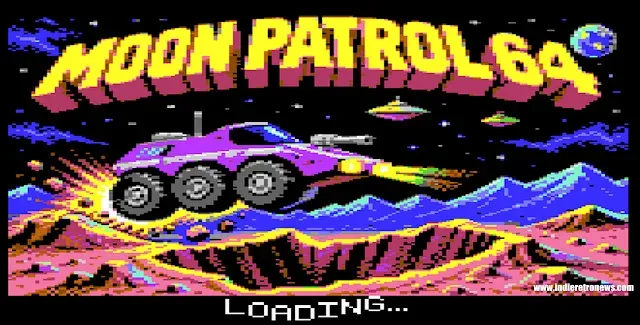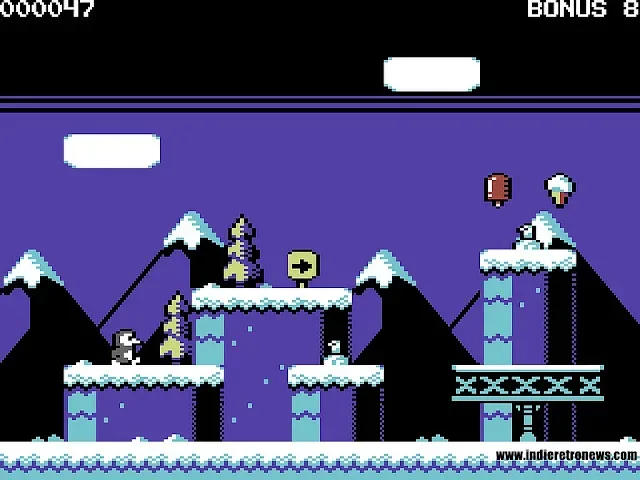
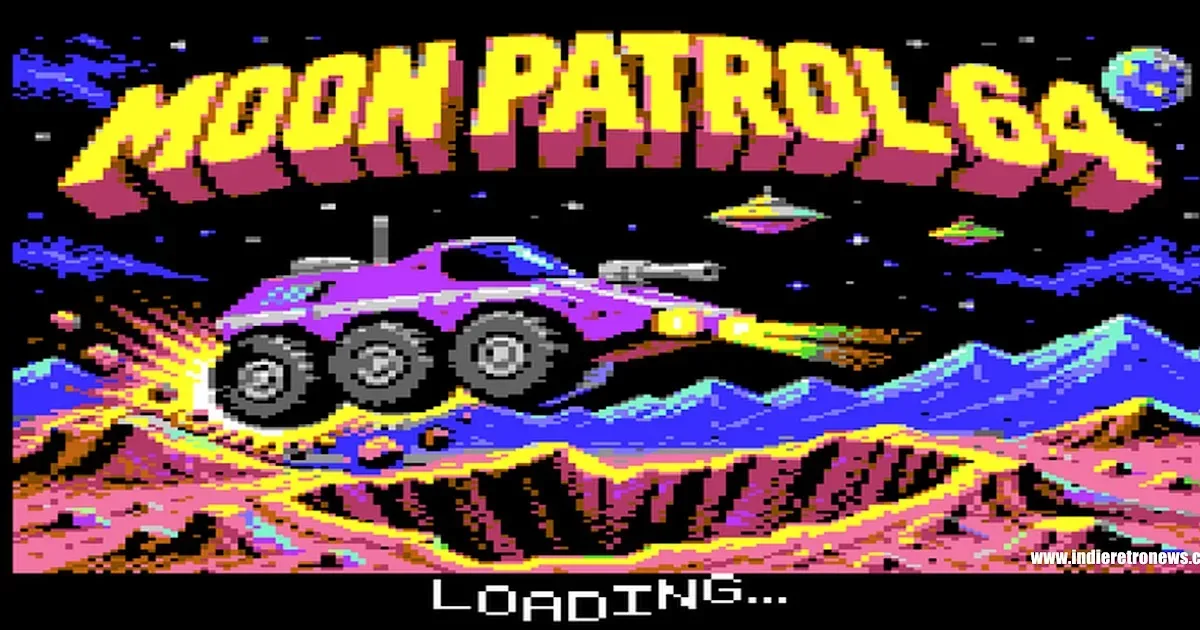
Moon Patrol 64 is a new unofficial Commodore 64 version of Irem’s 1982 arcade classic, putting the series’ moon buggy back on a machine where technical presentation and instantaneous arcade-style pressure are central to the appeal. The project is credited to Realite-Games and described as having been developed with AI capabilities. Its stated goal is not to radically reinterpret the original’s premise, but to deliver the recognisable rhythm of a lunar run: drive onward, survive the terrain, shoot in two directions and make it to the next checkpoint.
That simple description conceals why Moon Patrol has endured as an arcade design. A player is not merely steering around obstacles. They are continually dividing attention between the ground immediately ahead and threats occupying the air above. Moon Patrol 64 retains that split-focus setup, with a moon buggy that can fire forward as well as upward while racing through scrolling lunar scenery.
A familiar arcade problem: the road is dangerous and so is the sky
The key hazards named for Moon Patrol 64 are craters, boulders, falling bombs, hostile ground vehicles and swooping UFO formations. Each asks for a different response, and that is what makes the format more demanding than a straightforward shooter or a straightforward driving game.
- Craters and boulders are terrain problems. The player must judge a jump at the right moment rather than react after the buggy has reached the obstacle.
- Falling bombs turn the upper part of the screen into an immediate danger zone, making position and timing matter even when the road seems clear.
- Ground vehicles compete for attention with the landscape directly in the buggy’s path.
- UFO formations give the upward-firing weapon a clear purpose and add another moving layer to monitor.
Forward fire and upward fire are therefore more than a nostalgic detail. They establish two threat lanes. Firing forward addresses dangers approaching along the route, while firing up lets the player respond to enemies and attacks from overhead. The complication is that shooting does not remove the need to keep moving or to prepare for a jump. The intended tension comes from choosing the next priority quickly enough that none of those tasks gets neglected.
Moon Patrol 64’s checkpoint structure supports that arcade mindset. Checkpoints divide a run into short, visible objectives: reach the next marker, preserve the attempt, then deal with the next stretch. Rather than promising a sprawling adventure, the format concentrates on repeatable execution and incremental progress. The session high-score table, with three-initial entry, reinforces the point. This is a game built around a run, a score and the temptation to improve both.
What the Commodore 64 version is aiming to preserve
The project is said to begin with an animated Realite introduction before the buggy reaches the lunar surface. During play, its stated presentation features animated wheels, layered scrolling landscapes and SID sound effects. Those elements matter because they are directly tied to the sensation of speed and forward momentum that a Moon Patrol adaptation needs to sell.
Layered scrolling means visual layers move across the screen separately, creating a sense of depth as the vehicle travels. In practical terms, it helps prevent the environment from feeling like a single static strip sliding past the buggy. The supplied details do not specify exactly how many layers are used or how the effect is technically implemented, but the intended result is clear: the lunar route should feel like a landscape being crossed rather than a fixed backdrop.
SID sound effects refer to audio made for the Commodore 64’s Sound Interface Device, usually shortened to SID. In a game that relies on fast, repeated player decisions, effects for firing, danger and movement can be part of the feedback loop, not merely decoration. The available information identifies SID effects but does not detail a soundtrack, composer or individual sound cues, so it would be premature to make larger claims about the audio package.
Animated wheels are a similarly small but appropriate touch. The buggy is the player’s focal point, and wheel animation visually connects its movement to the terrain challenge below it. When the game’s hazards include holes, rocks and timed leaps, that connection is useful: it keeps the vehicle grounded in the world even as the action demands attention above the horizon line.
AI is part of the project description, not a substitute for specifics
Moon Patrol 64 is described as being developed with the capabilities of AI. That phrasing establishes AI as part of the project’s development context, but it does not identify the tools used, the assets affected or the precise role AI played in programming, art, audio or design. Those distinctions matter. “Developed with AI” can cover many very different workflows, and no additional technical breakdown is supplied here.
It is worth keeping that uncertainty intact rather than turning a broad label into a claim about how the game was made. The observable design description is much more concrete: an unofficial C64 adaptation with an animated intro, scrolling scenery, SID effects, dual-direction shooting, checkpoints and a high-score table. Those are the features prospective players can use to understand the game’s intended character.
AI’s role in game development remains a broader industry discussion, including questions of authorship, process and whether tools meaningfully improve the games that ultimately reach players. For related context on that wider debate, see this look at an AI-focused industry pitch and the case for games made without it. Moon Patrol 64 itself should be evaluated on the limited facts currently available, rather than treated as proof of any general conclusion about AI-assisted development.
Why the game’s restraint is the important part
An unofficial retro adaptation can take several routes: it can chase visual novelty, expand the premise, or focus on reproducing the pressure that made the original memorable. Moon Patrol 64 appears to be pursuing the last option. The mechanics described are immediately legible to anyone familiar with the 1982 game’s basic identity, and they fit the Commodore 64’s culture of score-chasing action games.
That does not mean fidelity can be assumed in every respect. No detailed comparison of stages, difficulty, controls, scoring rules or audiovisual accuracy is provided. There is also no supplied information about distribution, supported hardware configurations, controls, release timing or price. The most accurate reading is narrower: Moon Patrol 64 is presented as a fast-paced tribute designed to evoke the arcade loop on Commodore 64 hardware.
Still, the feature list gives retro players a useful expectation. The game is likely to reward concentration over exploration. A successful run should depend on reading the terrain early, remembering that the sky can punish tunnel vision, and using each fire direction without losing the timing of a necessary jump. High-score entry gives that performance a traditional arcade endpoint: a place on the current session’s table, identified with three initials.
What to watch for in an arcade-style run
For players approaching this kind of design, the useful mental model is not “clear every enemy,” but “protect the route.” A UFO formation may be worth firing at, yet the immediate crater remains the larger threat if a jump window is closing. Likewise, a clear stretch of ground is not automatically safe when bombs can descend from above. The game’s tension is created by these overlapping demands.
- Look ahead on the ground. Terrain hazards require advance timing, especially when a jump is the required answer.
- Keep the upper screen in view. Bombs and UFOs make it costly to focus entirely on the road.
- Use the correct firing lane. Forward and upward shots exist to address distinct directions of danger.
- Treat checkpoints as short-term goals. Reaching the next one is the immediate measure of progress during a run.
- Respect the score table. The three-initial ranking format signals that repeat attempts and cleaner execution are part of the appeal.
Moon Patrol 64’s pitch is ultimately direct: classic moon-buggy action rebuilt for the Commodore 64, with scrolling lunar visuals and SID-backed arcade feedback. Its unofficial status, the limited detail around AI use and the absence of wider release information are all important qualifiers. But for fans of compact retro action, the core proposition is easy to understand: jump the craters, shoot in both directions, reach the checkpoints and try to earn those three initials.