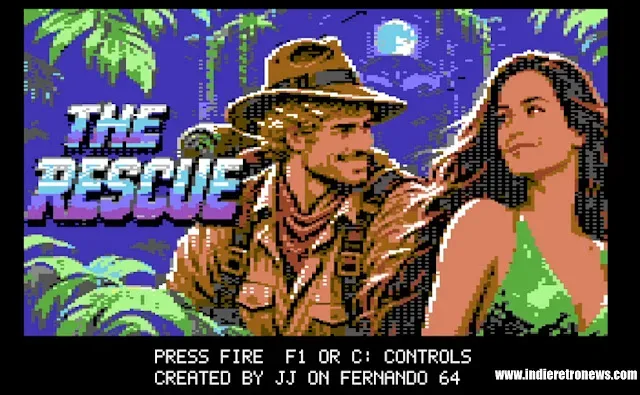

The Rescue, a new Commodore 64 action game from Fernando64JJ, sets its operation in 1987, in jungle territory controlled by the militia leader Colonel Varga. Its premise is pointedly high-risk: John Jericho must extract Adri, a medical-camp worker abducted after recording the militia’s atrocities. Before he can get to Varga’s stronghold, however, Jericho must survive an aerial approach and then fight through a lengthy ground campaign.
That structure is the important part. The Rescue is not presented as a single uninterrupted run-and-gun mission. It begins with two helicopter flight phases across coastlines and deltas, where enemy jets and gunships are the immediate threats. It then changes pace for a 10-stage assault on foot, moving through locations that include airstrips, ancient temples and the Colonel’s fortified compound. The final confrontation is set in Varga’s pitch-black quarters.
A mission built around changing combat conditions
The helicopter sections establish a different kind of pressure from the ground stages. Aerial opponents such as jets and gunships demand attention while the player is flying through exposed territory, making the opening phases a test of navigation and avoidance as much as direct attack. The following on-foot stages narrow the focus to hostile spaces occupied by guards, snipers, riflemen and attack dogs.
In practical terms, the transition matters because it prevents the game’s central mission from relying on just one combat rhythm. The early flight segments put Jericho in motion against airborne opposition; the larger ground campaign puts him in territory where positioning, concealment and information gathering can affect the outcome. Rather than treating the jungle merely as scenery, The Rescue uses bushes as part of its stealth option.
The game’s 10 ground stages also give the journey a clear escalation through distinct environments. An airstrip, temple and heavily defended compound suggest different kinds of danger without claiming that every stage plays identically. The supplied details do not specify each level’s layout or the precise controls, but they do make clear that the campaign is designed to move from approach, to infiltration, to a final interior showdown.
Stealth is tied directly to scoring
The Rescue gives players a broad choice between force and restraint. A forceful approach can mean direct engagements with enemies, but raising an alarm has a meaningful consequence: hostile riflemen, snipers and attack dogs flood the screen. That turns detection into more than a narrative flourish. It changes the immediate combat problem, increasing the number and variety of enemies a player must manage.
The quieter alternative is to creep through bushes, collect intelligence and eliminate guards from behind. Those actions can earn large bonuses at the end of a stage. This is a significant design decision because it puts a visible reward behind cautious play rather than simply asking players to avoid alarms for role-playing reasons.
What “end-of-stage bonuses” mean here
An end-of-stage bonus is an additional score award calculated when a level is completed. In The Rescue, stealthy behavior is specifically connected to substantial bonuses. The exact scoring formula is not detailed, but the implication is straightforward: getting through an area quietly can matter even after the immediate danger has passed. Players pursuing high scores will therefore have a reason to weigh the short-term safety of open combat against the potential value of a clean, controlled infiltration.
Related coverage includes The Rescue Brings Helicopter Raids and Jungle Stealth to Commodore 64.
That score incentive could also make replaying stages more purposeful. One attempt might focus on simply surviving an alarm-heavy route, while another might seek a more disciplined approach that gathers intelligence and removes guards from behind. The game is described as allowing both paths; it does not say that either method is mandatory in every encounter.
Alarms change the stakes
An alarm, in this context, is the game state triggered when the player’s presence is discovered. The consequence described for The Rescue is a screen crowded by additional threats. That is especially notable because the enemies are not all interchangeable. Riflemen, snipers and attack dogs are listed alongside guards, while the game says every enemy type requires its own strategy to defeat.
The exact tactics for each type have not been detailed, so players should not assume particular weapons, weaknesses or counters. Still, the stated emphasis on distinct strategies suggests that identifying what is on screen—and deciding whether to engage or stay hidden—will be central to success. An alarm can therefore turn a route built around observation into a much more immediate multi-enemy encounter.
From coastlines to Colonel Varga’s quarters
The Rescue’s narrative gives its movement through these spaces a clear objective. Adri is not simply missing: she was taken after documenting atrocities committed by Varga’s militia. Jericho’s push through the region is consequently framed as an extraction mission that passes through the organization’s territory and culminates in a confrontation with its leader.
The final encounter is described as tense and takes place in darkness inside Varga’s quarters. “Pitch-black” is a useful detail because it signals a change in atmosphere from the outdoor travel and jungle cover of earlier sections. It also helps make the finale feel like an endpoint to the infiltration, rather than merely another open combat arena. No details have been provided on the mechanics of that showdown, so its exact form remains unknown.
The game’s setting is deliberately compact: 1987, jungle territory, an oppressive militia force and a rescue target caught in the consequences of exposing it. That focus works with the game’s two-route play philosophy. A loud advance risks becoming an all-out fight against a militia response, while a hidden path places the emphasis on getting through defended territory without letting that response escalate.
Visual presentation and SID music
Alongside its action systems, The Rescue includes full-screen title artwork and separate illustrations for every level. Distinct level art can help each phase retain an identity as the campaign shifts between coastal flights, delta routes, airstrips, temple spaces and the fortified compound. It is a presentation choice that fits a game built around a sequence of set locations instead of one undifferentiated battlefield.
The soundtrack is composed by Retroverse Jack and uses SID music. SID refers to the Commodore 64’s Sound Interface Device, the machine’s sound chip. In this case, a “cinematic SID soundtrack” describes music intended to support the game’s dramatic, mission-based tone while being created for that characteristic C64 audio hardware. The supplied information does not identify individual tracks or sound effects, but it does credit Retroverse Jack for the score.
New games continue to give Commodore hardware a reason to be part of current gaming conversations, especially when they make the constraints and character of the platform part of their identity. The Rescue’s combination of illustrated stages, a dedicated SID score and multi-part action campaign places it in that ongoing stream of C64 projects. For another recent example of a new game targeting the computer, see Icy Escort’s momentum-based Commodore 64 puzzle design.
What players can expect—and what remains unspecified
Based on the available details, the clearest expectations are a two-part helicopter approach, 10 on-foot stages, enemy-specific combat considerations, and a scoring system that recognizes stealth. Players who prefer a direct action route can expect alarms to intensify the opposition. Players inclined toward stealth can expect bushes, intelligence pickups and rear takedowns to be meaningful parts of the route, with major stage-end bonuses attached.
Several practical details have not been provided. There is no stated release date, distribution method, price, control scheme, supported storage format or explanation of how the intelligence collection system works. There is likewise no detailed breakdown of the tactics needed for each enemy. Those omissions are worth keeping separate from the features that have been described: The Rescue is a C64 action game with aerial and ground phases, not a fully specified technical manual.
What is clear is the intended tension. Jericho’s mission is not only about reaching Colonel Varga; it is about deciding how much attention to attract on the way. By rewarding silent progress while making alarms flood encounters with varied hostiles, The Rescue makes that choice part of the game’s score and moment-to-moment risk, not just its jungle-war presentation.