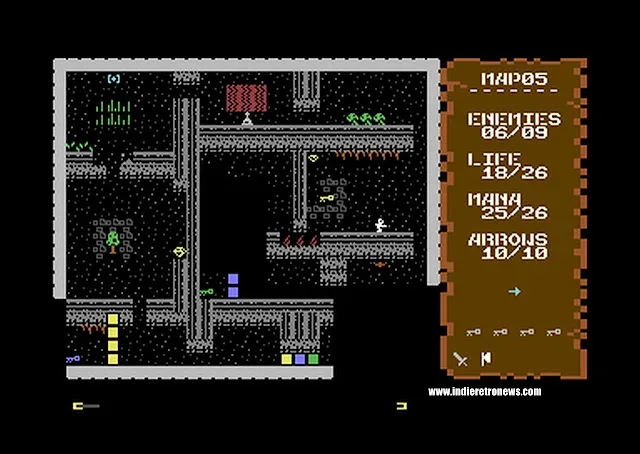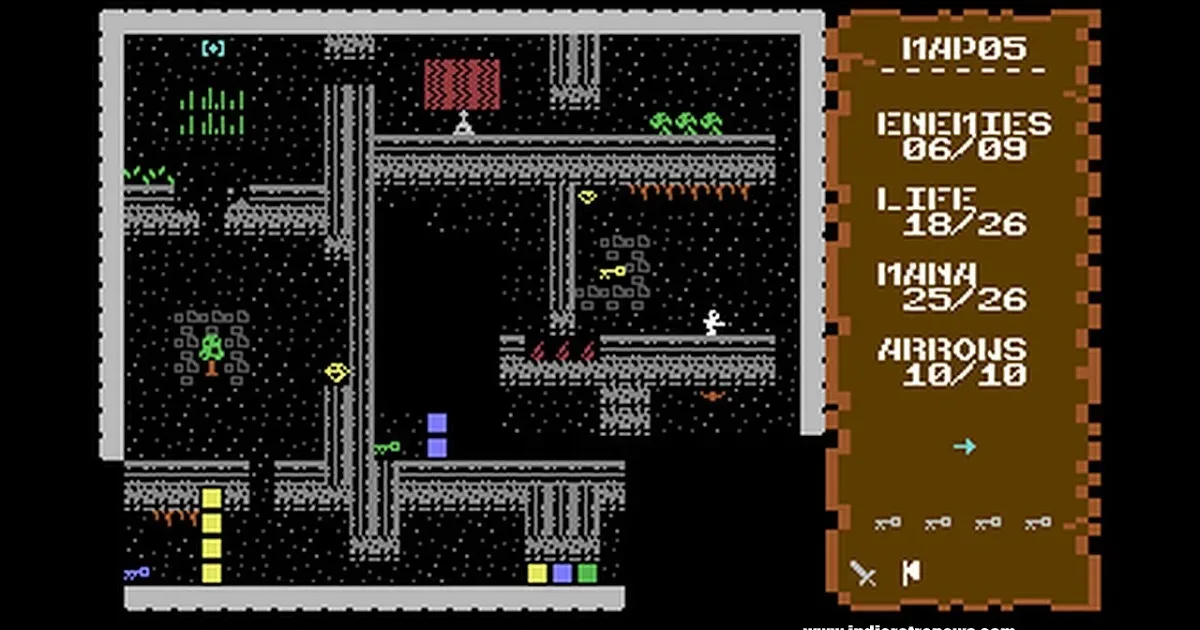
Warlock, a top-down fantasy action game from developer Haplo, has been released for the Commodore 64. The project takes some of the hostile, dark-fantasy energy associated with first-person shooters such as Heretic, but rebuilds that mood around an overhead viewpoint and deliberately constructed stages rather than a run-based roguelike format.
That distinction is central to what Warlock is presenting. Its 25 levels are hand-crafted, with hidden areas and treasure built into their layouts. Players are not expected to repeatedly begin from scratch after permanent death, and the maps are not procedurally generated. Instead, the game is designed around authored exploration, combat encounters and progression across a set campaign-like sequence of levels.
Haplo is also credited with Shift and Tenebra. With Warlock, the developer’s new C64 game combines five weapons, eight enemy types, environmental hazards, teleporters, event-triggered enemy spawns, upgrades, perks, curses, original music and custom sound effects into a compact fantasy-action package for the long-running home computer.
A top-down answer to first-person fantasy shooting
The comparison point of classic fantasy shooters describes the game’s intended atmosphere rather than its camera angle. Warlock is not first-person: players view the action from above. That shift changes the practical rhythm of play. In a top-down action game, movement, enemy positioning, open routes and hazards are visible as parts of the same tactical space. Players can read more of an encounter at once, but must also keep track of threats approaching from several directions.
For more context, explore Netflix’s ‘East of Eden’ Sends Steinbeck’s 1952 Novel Back to Amazon’s No. 1 Spot.
The genre blend matters because the game is described as a slasher, not solely as a shooter. An arsenal of five distinct weapons implies that combat variety is one of Warlock’s main systems, although the available information does not identify the individual weapons or explain their exact behaviors. What is clear is that weapon choice sits alongside character development systems rather than being the game’s only form of progression.
Warlock’s levels also contain interactive elements beyond enemies. Teleporters can alter navigation and routing, while environmental hazards make the map itself part of the danger. Hidden treasure and secret areas give players reasons to investigate spaces that may not be strictly necessary for simply reaching an exit or surviving an encounter.
What “not a roguelike” means here
Warlock explicitly rejects the roguelike label. The term is broad in modern games, but it commonly refers to repeatable runs built around random or procedural variation, with a major setback—or a full reset—when the player dies. Permadeath is the sharpest version of that idea: death permanently ends a character or run rather than allowing a conventional continuation.
Related coverage includes Warlock Brings Handcrafted Fantasy Slashing to Commodore 64.
Warlock instead uses fixed, hand-crafted maps and does not impose that looming permanent-loss structure. This does not automatically mean the game is easy, nor does it tell players every rule of failure, lives or retries. It does establish a different design promise: exploration can be learned and revisited as part of a deliberate layout, rather than treated as a disposable route through a randomly assembled run.
That is a meaningful choice for secret hunting. Handcrafted secret areas can be placed in relation to specific rooms, hazards, teleporters and enemy encounters. Their discovery can reward attention to a particular environment rather than pure luck with a generated map. The supplied details do not say what each secret contains, how many secrets exist, or whether any are required for completion, so those questions remain open. But their inclusion makes thorough exploration an evident part of the game’s identity.
Analysis: authored levels make knowledge valuable
In an authored-level action game, a player’s familiarity with the terrain can become a form of progress. A teleporter that initially causes confusion may later become a useful shortcut. A hazard-filled passage can become easier once its placement is understood. An encounter that introduces enemies through a trigger can be approached more carefully on a return visit once the trigger’s location is known.
That does not make the experience less replayable. It simply frames replay differently. Rather than relying chiefly on changing map layouts between runs, Warlock can draw replay value from finding secrets, trying different upgrades, perks and curses, and improving command of its existing levels. The game is described as having “plenty” of depth and replayability, but no further rules have been detailed for its progression combinations.
Combat encounters can change as players cross the map
Warlock features eight enemy types, with foes introduced through an event-triggered spawning system. Event-triggered spawning means an enemy arrival is tied to an in-game condition or event rather than necessarily being present from the moment a level loads. The exact triggers have not been specified. They could be linked to player movement, interaction or other level events; the available information only confirms that spawns are dynamic and event-driven.
For players, the important implication is that rooms may not be fully understood at a glance. Reaching a location, activating something or moving through a particular area may change the combat situation. In a top-down game, this can work closely with the map’s structure: a previously clear route can become contested, a hazard can become more dangerous under pressure, or a teleporter can become an escape option rather than just a navigation device.
The game’s five weapons and eight enemy types provide a defined combat vocabulary. The supplied details do not attach named enemy behaviors, damage types, ammunition systems or weapon statistics to those numbers, so it would be premature to claim particular counters or optimal builds. Still, a finite set of weapons and foes complements the stated handcrafted approach. Players can potentially learn recurring threats and refine their response, rather than facing an unlimited pool of unpredictable combinations.
Upgrades, perks and curses shape the build
Warlock’s progression system is described as deep and uses three connected categories: upgrades, perks and curses. In general game-design terms, an upgrade is an improvement to a capability; a perk is a modifier or special benefit that changes how a player approaches situations; and a curse usually introduces a drawback, complication or trade-off. Warlock’s exact options, unlock rules and effects have not been detailed.
Even with those limits, the presence of all three systems signals an interest in customized playstyles. The notable word is not simply “progression,” but “customized.” The game is positioned to let players shape how they handle its maps and enemies instead of only increasing a single power value in a straight line.
Curses are especially notable because trade-off systems can make a choice more interesting than a simple upgrade. A benefit that comes with a cost asks the player to decide what kind of risk they can manage. In the context of maps with traps, secrets, teleporters and changing enemy pressure, that could create meaningful distinctions between a cautious explorer and a more aggressive combat-focused approach. That is analysis of the stated systems, not a claim about any particular curse effect.
Designed as a complete C64 action package
Warlock arrives with five original music tracks and custom sound effects. Those details matter for a game that aims for an atmospheric fantasy-shooter tone while operating from an overhead perspective. Music and effects can help distinguish combat, environmental danger, exploration and key interactions even when the player is reading the action from a broader camera view.
The game’s stated feature list is unusually focused around map-driven action: 25 designed levels; secret areas and hidden treasure; hazards and teleporters; a set of weapons and enemies; dynamic spawn events; and build-defining upgrades, perks and curses. None of those components alone determines how the game feels, but together they point toward a structured action adventure built for learning spaces, uncovering their surprises and developing a preferred approach to combat.
For retro players interested in newly made software for original-era hardware, Warlock’s appeal is in that contrast. It draws on a familiar dark fantasy action mood, but does not present itself as a modern procedurally generated run machine scaled down to an older platform. Its pitch is more specific: a Commodore 64 game with designed levels, repeatable exploration and enough progression choices to encourage experimentation without turning every death into a permanent reset.