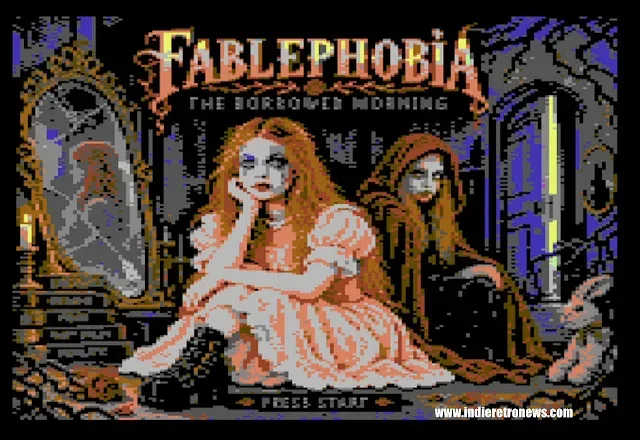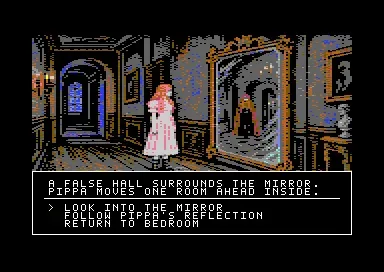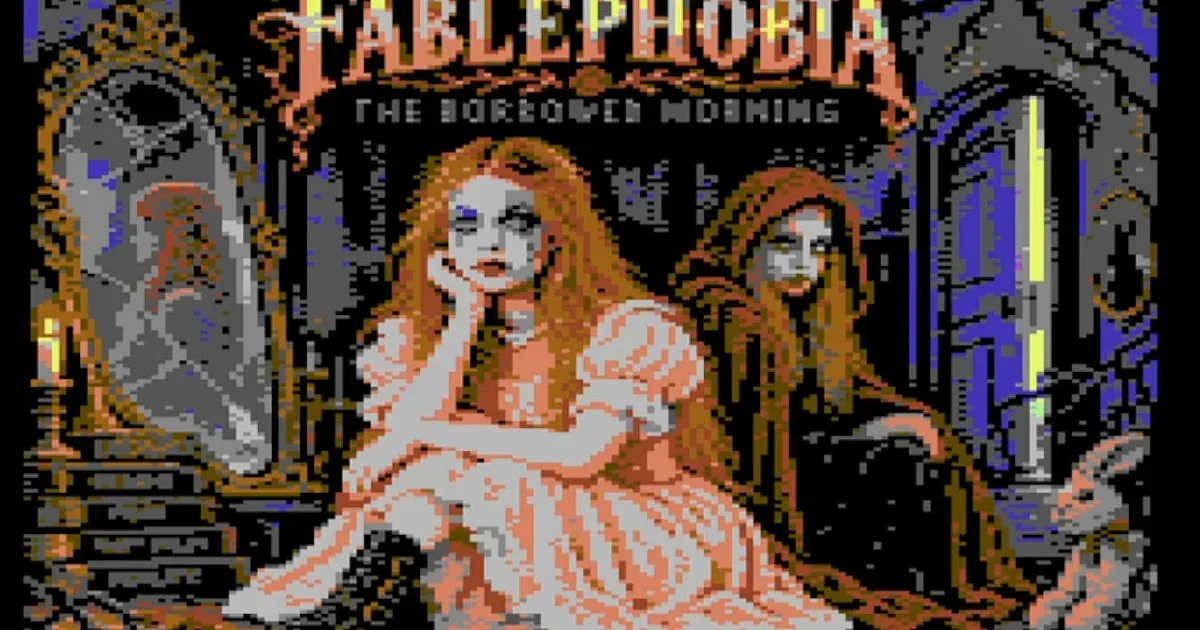
FablePhobia: The Borrowed Morning is a compact graphic adventure for the Commodore 64 that favors atmosphere over sprawl. Players take control of Alice as she moves through the quiet corridors of a sleeping house in search of Pippa, following a route that leads past forgotten rooms and uncanny mirrors to a well lit by moonlight.
That is a deliberately intimate premise for a machine whose games are often remembered for arcade action, sports, shooters and sprawling home-computer experimentation. Rather than attempting to compete on sheer scale, FablePhobia appears built around a contained mystery: a handful of striking places, a clearly defined protagonist, choices that move the player through the story, and puzzles intended to be approachable rather than punishing.
It is also notably brief. That limitation has been part of the early player discussion, but it has not prevented a generally favorable response from people commenting on its itch.io page. The graphics, story and joystick support have drawn particular appreciation, while some players have said they would like to see the idea developed into a longer game.
A haunted-house premise sized for a short adventure
The central image is immediately suited to graphic-adventure design. A house that is asleep is not simply an abandoned location: it implies a space with rules, memories and perhaps a will of its own. Alice’s pursuit of the elusive Pippa gives the player a straightforward objective, while the rooms, mirrors and well provide distinct visual and narrative landmarks.
Short-form adventures have little room for detours, so recognizable spaces matter. They can establish a mood quickly and give each interaction a sense of place. FablePhobia’s path through hushed interiors and into a moonlit exterior setting suggests an experience focused on escalating unease rather than a large inventory of locations.
That approach can be especially effective in a brief game. Instead of requiring players to remember a huge cast or map, it asks them to pay attention to the immediate mystery. A mirror can signal distorted perception, a forgotten room can suggest buried history, and a well can serve as a natural threshold between the familiar house and something deeper or stranger. Those are interpretations of the game’s stated setting rather than confirmed plot details, but they help explain why the premise has a clear atmospheric hook.
What choice-driven mechanics mean here
The game is described as using intuitive, choice-driven mechanics. In practical terms, a choice-driven graphic adventure is one where the player advances by selecting actions or responses rather than relying on fast reflexes. The important challenge is observation and decision-making: noticing what the scene presents, deciding what to investigate, and choosing how to proceed.
That does not necessarily mean every decision branches into radically different stories. The available information only establishes that choices are central to interaction, not how many routes, endings or consequences the game contains. Players should therefore not assume a wide branching narrative. What can be said is that the design aims to keep the act of moving through the story understandable.
Related coverage includes FablePhobia: The Borrowed Morning Brings a Brief, Eerie Adventure to Commodore 64.
The source material also characterizes the puzzles as straightforward. For a short mystery game, that is a meaningful design decision. Straightforward does not have to mean trivial; it can mean the game prioritizes momentum and atmosphere over opaque logic. Adventure games can sometimes stall when a player cannot infer which item, object or dialogue option the designer expects. A smaller project with clearer puzzles has a better chance of sustaining its tone from room to room.
Joystick integration is more than a footnote
Early feedback specifically mentions seamless joystick integration. On the Commodore 64, that matters because controller input is part of the platform’s identity, not merely a compatibility checkbox. A game built around choices and scene interaction needs its controls to feel natural; awkward cursor movement or inconsistent selection would quickly break the mood.
The positive remarks do not establish a technical benchmark or provide details on supported controller configurations. They do, however, indicate that players found the joystick implementation unobtrusive enough to call out as a strength. For a game seeking the feel of a native C64 release, smooth input supports the illusion that the experience belongs on the hardware rather than merely passing through it.
Native-looking C64 visuals carry the atmosphere
FablePhobia has been praised for its distinct C64 graphics. The description does not provide a technical breakdown of its art process, resolution, palette use or animation, so it would be premature to make claims about how the visuals were produced. Still, the response highlights an important point: the game’s visual identity is doing real work.
Graphic adventures depend on environments to communicate both mood and clues. In this case, the art has to sell the difference between a corridor, a neglected room, a mirror and a moonlit well while maintaining the story’s quiet, eerie tone. The early comments suggest that the game succeeds at making those spaces memorable despite its limited length.
There is a useful contrast with another current retro project, Lost in the Middle Ages on Amiga 500, which is pursuing a very different kind of adventure structure. FablePhobia’s identity is not action-platforming or expansive exploration; it is a concise, scene-led mystery with choices and puzzles at the forefront.
The AI conversation needs specificity
The project has been discussed by players in the context of AI-made games, and that conversation is understandably colored by concern over low-effort work. “AI game” is a broad label, though, and the available details do not specify what tools were used, which portions of the production involved them, or how development decisions were made. Those gaps should remain gaps.
What the early comments do indicate is that some players judged the finished result on the experience in front of them: its graphics, story, controls and compact design. Their reactions have been comparatively positive, even while acknowledging its short runtime. That distinction is worth preserving. A label can spark a discussion, but it does not replace an assessment of whether a game communicates an idea, controls cleanly or gives players a satisfying sequence of discoveries.
Equally, positive initial comments should not be inflated into a broad critical consensus. The feedback described so far is early community reaction, not a detailed technical evaluation or proof that every player will respond the same way. The fairest reading is modest: this small Commodore 64 adventure has found players who see promise in it, and several would welcome a larger version.
Who this short adventure may suit
- Commodore 64 players: Those looking for a contemporary game with distinct C64 visual character and joystick-friendly play.
- Adventure-game fans: Players who prefer environmental mystery, choices and direct puzzles to action-heavy challenges.
- Atmosphere-first players: Anyone drawn to eerie domestic spaces, surreal objects and a compact story hook.
- Curious observers of AI-assisted game work: Players interested in assessing an individual project on its specific qualities, while keeping the project’s undocumented production details in mind.
Players looking for a lengthy adventure should calibrate expectations before diving in. Its brevity is openly acknowledged in the early response. But a short runtime can also be an advantage when the objective is a focused mood piece: a game can introduce a mystery, lead Alice through a sequence of strange spaces, and leave its impression without turning every interaction into a major systems showcase.
For now, FablePhobia: The Borrowed Morning’s appeal is clear and appropriately small-scale. It offers an eerie house, a missing figure to follow, a protagonist named Alice, choice-led interactions and uncomplicated puzzle solving, all framed by visuals that early players have found charmingly C64-specific. The calls for expansion are perhaps the strongest signal of all: the existing idea appears to have left some players wanting another trip through that sleeping house.