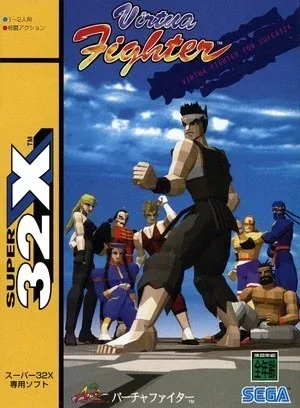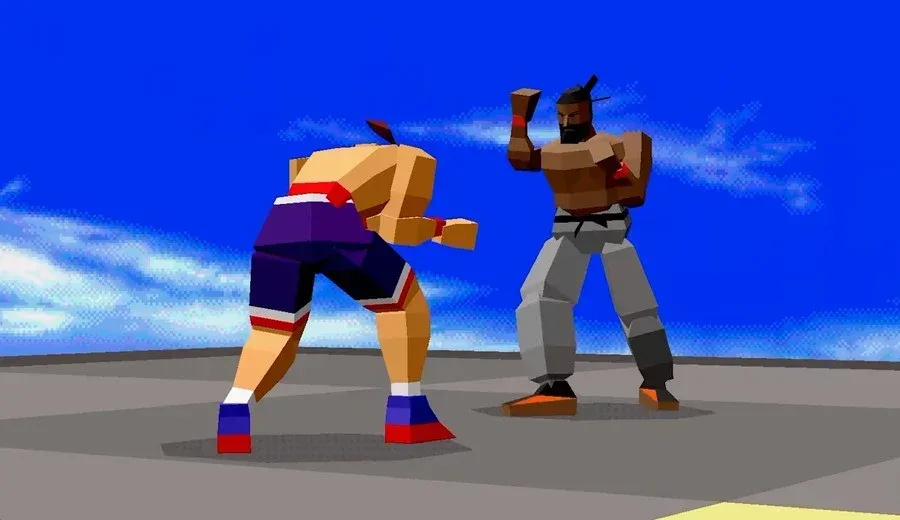
Virtua Fighter was never supposed to be an easy game to bring home in 1994. Sega’s landmark arcade fighter had arrived the previous year on Model 1 hardware, where its fast polygonal characters made an immediate case for a different future of one-on-one combat. Street Fighter II, Mortal Kombat, and Fatal Fury had already turned 2D fighting games into arcade royalty, but Virtua Fighter looked like it had wandered in from a future where everybody had knees made of triangles.
That technological gap made the home-console question awkward. Conventional 16-bit hardware was well suited to translating the sprite-based fighters of the era, but Virtua Fighter’s identity was tied to 3D geometry and speed. Sega eventually brought the game to both the Saturn and its Mega Drive/Genesis add-on, the 32X, in late 1994. Neither home version was identical to the Model 1 original, yet the 32X edition remains an especially fascinating feat: a full-speed-feeling polygon fighter on a cartridge for hardware that spent much of its brief existence being treated like an expensive plug-in with an identity crisis.
Now fan developer SEGA MODEL KING, also known as WangDrum, is putting that unlikely port under a much brighter spotlight. Following work on a faithful recreation of the original Model 1 Virtua Fighter, the developer has shifted attention to the 32X release with a project that re-renders its 3D material in HD and adds interpolation intended to display motion at 60 frames per second rather than the game’s original 30.
The result is not simply a case of stretching a 1994 image until every polygon looks like it has been through a photocopier. The work described for the project reaches inside the way the 32X game produces its geometry, aiming to preserve the game’s 2D presentation while giving its 3D fighters a less constrained rendering environment. It is a technical restoration project with a distinctly retro-gaming point of view: respect the original machine’s work, then remove a limitation that only existed because the machine had to survive the mid-1990s.
A big arcade idea meets very small home hardware
Virtua Fighter’s 1993 arcade debut is routinely recognized as a foundational moment for 3D fighting games. Yu Suzuki’s game did not merely place familiar fighting-game concepts into a polygonal arena; its visual language and movement made 3D feel integral to the contest. Its influence would be felt across later franchises, including Tekken and Soulcalibur, even as the genre kept evolving into stranger shapes, sharper models, and increasingly dramatic hair physics.
At home, though, the original game demanded compromises. Sega’s Saturn version could deliver a close, if not exact, counterpart to the arcade experience. By the time it reached some markets, the pace of 3D fighting-game development had already become unforgiving, with PlayStation’s Battle Arena Toshinden arriving in the United States in early 1995. Early polygon fighters dated themselves in public at an alarming speed; one month you were the cutting edge, and the next month someone else had given their fighters shiny floors.
The 32X version faced a more absurd technical brief. The add-on sat between the Mega Drive/Genesis and the Saturn in Sega’s crowded hardware strategy. Its architecture could be notoriously difficult to develop for, but capable teams demonstrated that it could do more than merely add another power brick to the living-room floor. Virtua Fighter on 32X offered brisk play, responsive-feeling animation, cartridge-based loading, and ambitious sound and music work that sought to echo the Saturn release.
For collectors and preservation-minded players, that makes it more than a curiosity. It is evidence of how much a developer can extract from a machine when the project and the hardware are properly matched. Anyone looking to revisit original consoles through modern displays should also remember that an HD remake and a clean console signal are separate questions; our guide on mapping a retro console’s connections before buying an HDMI adapter is useful background for the latter.
Related coverage includes Virtua Fighter 32X Fan Project Rebuilds Sega's Classic Port in HD at 60FPS.
Why ordinary upscaling would not solve the problem
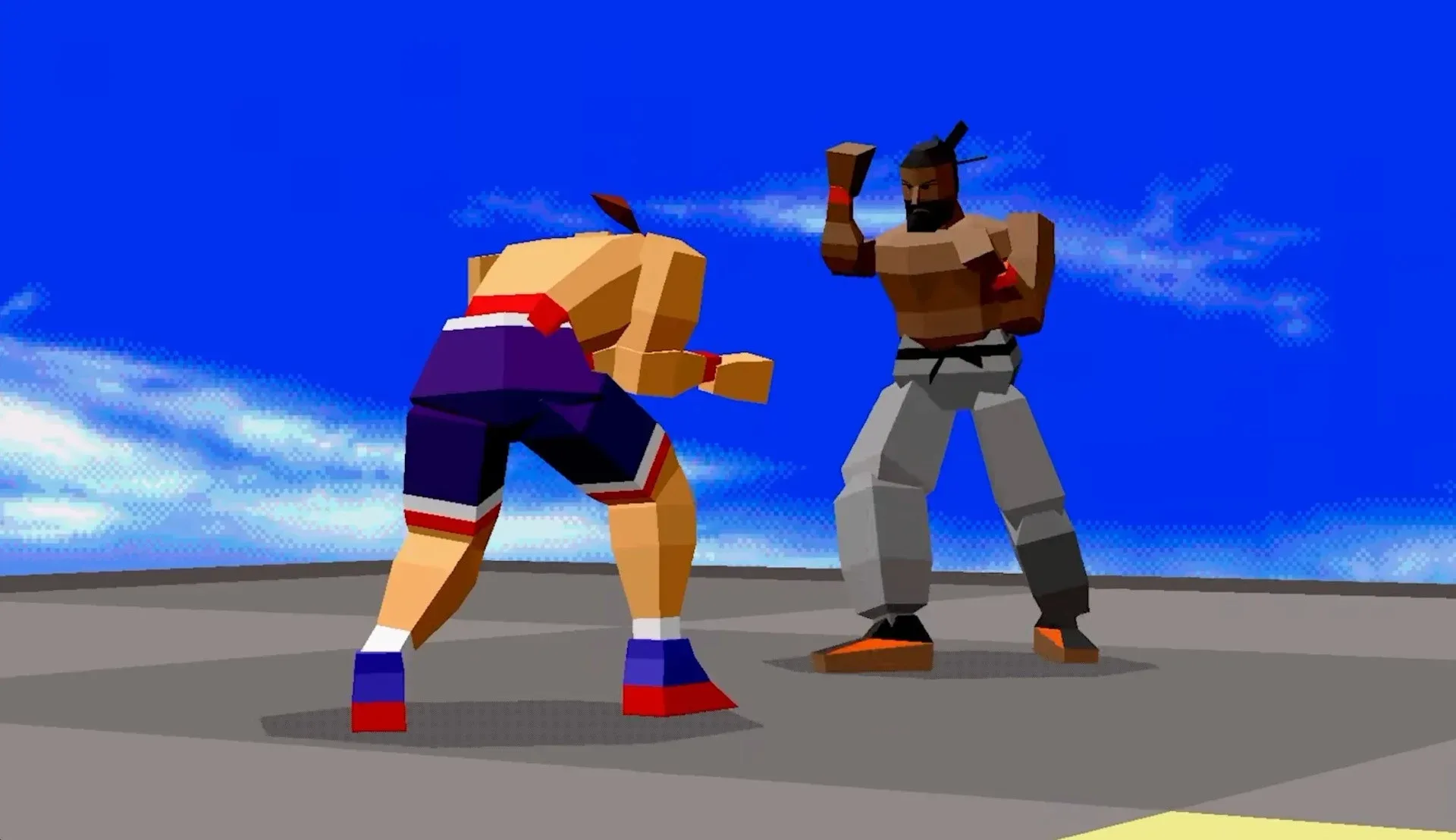
The original 32X Virtua Fighter display runs at 320 by 224 pixels. A straightforward upscale could enlarge that output, but it would not change the granular coordinate system governing the final placement of the game’s vertices. In practical terms, the polygons would be bigger, yet their movement would still be bound to the old low-resolution grid. That is the difference between giving an old painting a larger frame and actually restoring detail in the painting itself.
WangDrum’s approach, as outlined by the developer, intercepts camera-space floating-point vertex information, matrices, bone data, and camera information during the transformation process associated with the 32X’s SH-2 interpretation. From there, the project reconstructs the coordinate space and uses a custom floating-point renderer to draw geometry extracted from the game ROM without locking it to the original pixel grid.
The important distinction is that the Mega Drive side continues to handle 2D components while the custom rendering path is responsible for the 3D geometry.
That split matters because it keeps the project connected to the original port’s visual structure rather than treating Virtua Fighter as a set of loose models dropped into a brand-new presentation. HUD elements and other two-dimensional material retain their original role, while the elements that most obviously benefit from higher-resolution rendering—the fighters and their polygonal environments—receive the new treatment.
It also explains why this is more technically interesting than an HD filter. Filters can soften, sharpen, scanline, or scale an existing image. Re-rendering can address how the image is made in the first place. For a game whose significance rests so heavily on early real-time polygons, that distinction is huge. Virtua Fighter’s blocky limbs may be historically charming, but they were never intended to spend eternity imprisoned behind a 320-by-224 fence.
60FPS interpolation changes the feel as well as the look
The project also includes newly written interpolation code intended to bring displayed animation to 60FPS from the original 30FPS. It is an enticing proposition: smoother movement can make these early models look less like they are negotiating each motion one polygon at a time. At the same time, it is the part of the work most likely to divide purists.
Frame rate is not merely a specification on the back of a box. It shapes timing, animation cadence, the perceived weight of attacks, and the particular visual rhythm people remember. A 60FPS presentation may appear more fluid, but the original 30FPS cadence is part of how the 32X version was experienced. That does not make interpolation an invalid choice; it means the project is best understood as a remastering experiment rather than a museum display locked behind glass.
The HD rendering arguably makes the strongest immediate case for the project. Higher resolution exposes the care embedded in the 32X character models, work that was easy to overlook on period displays and within the original output constraints. It also makes one of the port’s clever compromises much easier to spot.
The faces tell a 32X survival story
During matches, the game uses simplified facial detail on its characters. In victory poses, when the system can devote its attention to rendering a single fighter rather than sustaining a full bout, those facial features become more complete. It is a wonderfully practical trick: preserve processing resources when the action is most demanding, then spend them on personality when the match is over and the camera has time to admire a winner.
Seen through the HD re-rendering, that decision becomes less like an old graphical flaw and more like an artifact of smart production. Developers in the 1990s constantly made these decisions, often invisibly: lower detail here, reuse an asset there, reserve the big flourish for a moment when the hardware can breathe. Modern resolutions have a way of revealing those choices, and this project makes the 32X team’s trade-off legible without erasing it.
A useful reminder of what the 32X could do
The 32X has a reputation that can overshadow its software. Its short life, awkward market position, and association with Sega’s turbulent mid-1990s hardware transition mean it is frequently reduced to a punchline or a footnote. Virtua Fighter offers a persuasive counterargument. It may not be the definitive version of the game, and it was necessarily compromised beside arcade hardware, but it is still a remarkably ambitious cartridge release.
That is why WangDrum’s focus is compelling. Rather than starting with a universally celebrated conversion, the project examines a port that has always asked players to look past the hardware’s reputation. It shows the technical thinking that enabled a 3D fighter to run on the add-on, then uses modern rendering to make that effort easier to appreciate.
Interest around the work has already led to requests for similar attention to 32X games including Star Wars Arcade and Virtua Racing Deluxe. Those requests are understandable, but they should remain requests for now. The confirmed focus is Virtua Fighter, and no broader slate of 32X remaster projects has been established.
For the moment, the project is a sharp demonstration of what game preservation and fan engineering can reveal. It does not rewrite the 32X’s history, nor does it need to. It lets one of the system’s boldest achievements walk back into the ring with smoother motion, cleaner polygons, and enough visual clarity to show just how hard Sega’s developers were swinging in 1994.