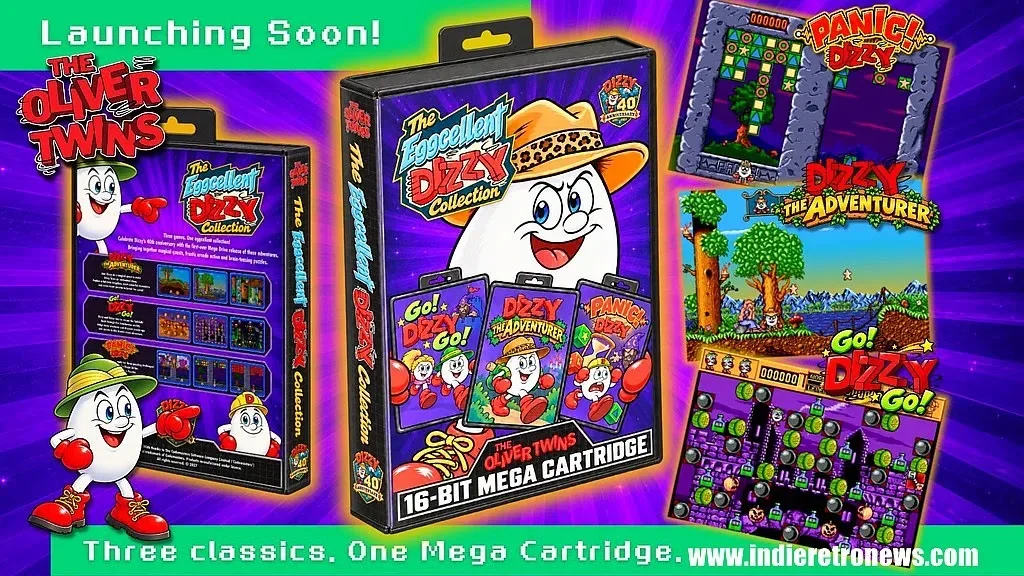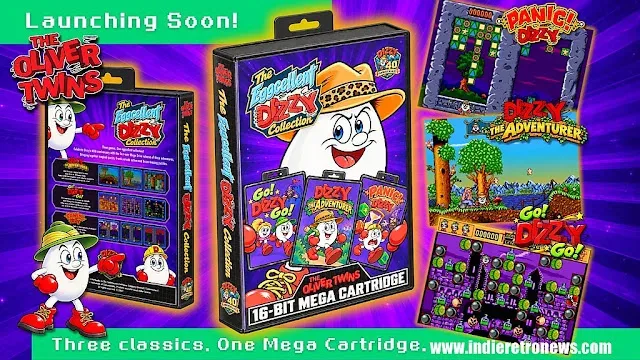
The Dizzy series is set to return to its 16-bit home in a particularly cartridge-shaped way. The Eggcellent Dizzy Collection is a forthcoming Kickstarter project from Philip and Andrew Oliver, the Oliver Twins, intended to place three Dizzy titles on one Mega Drive/Genesis cartridge: Dizzy The Adventurer, Go! Dizzy Go!, and PANIC! Dizzy.
That is a concise premise, but it is also one with a clear appeal. Rather than presenting three versions of the same kind of game, the proposed compilation spans adventure, maze action and puzzle-oriented challenges. For people who know Dizzy chiefly as an egg-shaped hero associated with the Yolkfolk, the package is positioned as a compact tour through several styles of play. For fans of Sega’s 16-bit hardware, its significance is just as much about the format: a single physical cartridge for Mega Drive/Genesis systems.
The campaign is being framed around 40 years of Dizzy adventures. A Kickstarter pre-launch page is available for people who want a notification when funding begins, although the available details do not specify a campaign launch date, funding target, reward tiers, cartridge production details, regional compatibility, or a delivery window. Those omissions matter: at this stage, the collection is a planned crowdfunded release rather than a finished product with confirmed availability.
Three games, three approaches
The strongest part of the collection’s pitch is its variety. These are not described as one continuous trilogy or as interchangeable entries. Each game is built around a distinct objective and structure, which should make the cartridge useful both as a nostalgic package and as an introduction to different corners of the Dizzy catalogue.
Dizzy The Adventurer: a fairy-tale rescue mission
Dizzy The Adventurer supplies the collection’s story-led component. Dizzy enters a magical fairy-tale world with the goal of saving Daisy. In practical genre terms, an adventure game prioritises exploration and progression through a setting over a short score-chasing loop. The supplied description does not detail its item systems, maps, enemies or individual puzzles, so it would be premature to promise any particular mechanics. What is clear is the central role it plays in the set: it gives the compilation a longer-form, character-driven adventure alongside its more immediately focused arcade-style games.
That rescue premise also gives new players a simple starting point. They do not need prior Yolkfolk knowledge to understand the immediate stakes: Daisy needs saving, and Dizzy is the hero sent into the fairy-tale setting. Returning fans, meanwhile, can approach it as one of the three distinct flavours represented on the cartridge rather than merely an extra mode.
Go! Dizzy Go!: reflexes inside colourful mazes
Go! Dizzy Go! moves the emphasis to reflexes and maze navigation. The game is described as taking place in vibrant mazes, a phrase that signals a different rhythm from the fairy-tale rescue setup. Maze games ask players to read routes, react under pressure and keep momentum while negotiating confined spaces. Even without further confirmed specifics about hazards or scoring, the basic structure makes its role in the trio easy to understand: it is the action-forward counterpoint to the adventure entry.
That contrast is valuable on a multi-game cartridge. A player who wants a brief burst of immediate movement and route-finding can choose Go! Dizzy Go!; someone looking for the more narrative-shaped premise can choose Dizzy The Adventurer. The collection therefore does not rely on a single genre to justify three included games.
Related coverage includes Eggcellent Dizzy Collection Brings Three Classics to Mega Drive.
PANIC! Dizzy: three mental challenges
PANIC! Dizzy rounds out the package with a trio of mental challenges. The available information does not name or explain those challenges, so their rules and complexity remain unconfirmed. Still, the description establishes a puzzle-led identity that separates it from maze reflexes and an adventure quest.
“Mental challenges” is broader than a technical genre label, but it communicates an important expectation: this entry is aimed at thought and problem-solving rather than being defined solely by speed. Together, the three games create a deliberately mixed menu—adventure, reflex maze play, and puzzles—under a single Dizzy banner.
What a Mega Drive/Genesis cartridge means here
The Mega Drive and Genesis are the same 16-bit Sega console family under different regional names. Calling out both names in the project description signals the intended hardware audience across regions, but it does not by itself confirm that every cartridge will work on every regional console. The supplied information does not state whether the release will be region-free, whether there will be separate editions, or whether any adapter will be needed. Collectors and players with original hardware should wait for those specifics before treating compatibility as settled.
Likewise, “single cartridge” confirms the intended physical format but not the rest of the package. No box contents, manual, cartridge shell style, save functionality, run size or manufacturing partner have been detailed in the supplied material. Those are practical questions for physical retro releases, especially for supporters deciding whether they are backing a game to play, display or keep sealed. For now, the confirmed claim is straightforward: all three named games are planned for one 16-bit Mega Drive/Genesis cartridge.
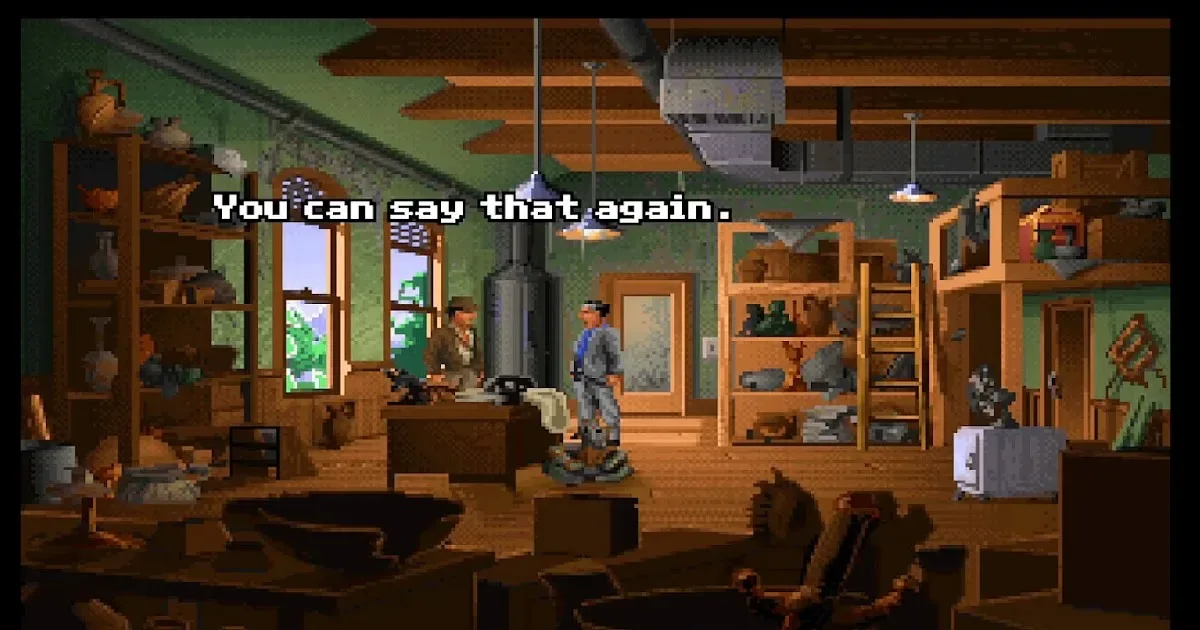
The project arrives amid continuing interest in retro software for original systems and original-style formats. That broader context can be seen in other preservation and enhancement work around classic games, including recent Amiga AGA enhancements for Monkey Island 2 and Fate of Atlantis. The Dizzy package is a different kind of project, but it shares the basic idea that older platforms can still be a destination for newly assembled or newly supported releases.
Kickstarter support: what is confirmed and what is not
Crowdfunding is central to this plan. Kickstarter is a platform where supporters pledge toward a project before it is fully funded and produced. A pre-launch page is not the same thing as an active campaign: it is a way to follow the project and receive a notification when the campaign goes live. It does not establish a final price, guarantee funding success, or confirm shipment.
For anyone considering support, the distinction is worth keeping tidy. The information currently establishes the project name, the Oliver Twins’ involvement, the three included games, the target Mega Drive/Genesis cartridge format, and the broad gameplay identities of each title. It does not establish the financial terms or final production plan.
- Confirmed: The planned collection combines Dizzy The Adventurer, Go! Dizzy Go!, and PANIC! Dizzy on one Mega Drive/Genesis cartridge.
- Confirmed: Philip and Andrew Oliver, known as the Oliver Twins, are behind the forthcoming Kickstarter campaign.
- Confirmed: Interested followers can use the project’s Kickstarter pre-launch page to be notified when funding begins.
- Not stated: A campaign start date, funding goal, pledge prices, release date, shipment timing, packaging, and compatibility specifics.
This is not a criticism of the campaign; it is simply the appropriate boundary for a project still at its pre-launch stage. Retro game backers benefit from separating the announcement itself from details that may appear later in the campaign. It also prevents a pre-launch notification from being mistaken for an order or a completed sale.
Why the selection makes sense for Dizzy fans
Dizzy has enough identity that a collection can appeal to people who recognise the character immediately, but this particular selection also makes a case beyond recognition alone. A three-game anthology works best when each included title earns its place through a distinct reason to revisit it. Here, the reasons are apparent from the proposed designs: save Daisy in a fairy-tale adventure, navigate colourful mazes with quick reactions, or tackle three puzzles.
There is a practical advantage to that spread as well. The cartridge could suit different play sessions without requiring the player to change hardware or swap media. The adventure can be the choice for a session focused on progression; the maze game offers a more concentrated test of reactions; and the mental-challenge format supplies a puzzle alternative. That is analysis based on the announced game descriptions, not a claim about exact game length, difficulty or quality—none of which has been detailed here.
For longtime Yolkfolk followers, the 40-year framing makes the collection a celebration of a durable character and the creators associated with him. For newcomers, it offers a clearer proposition than a single isolated game: three different entry points to the same retro series. The real test will come when the Kickstarter opens and fills in the unanswered production and compatibility details. Until then, The Eggcellent Dizzy Collection is a promising, clearly defined idea with a deliberately old-school destination: one cartridge, three games, and a Mega Drive/Genesis waiting for an egg-shaped return.