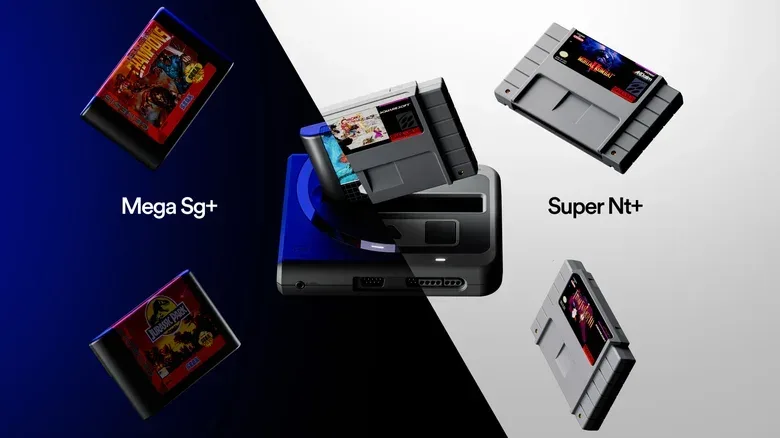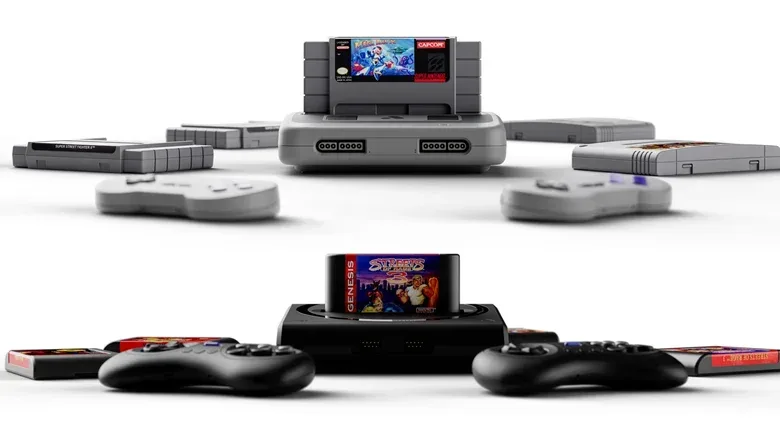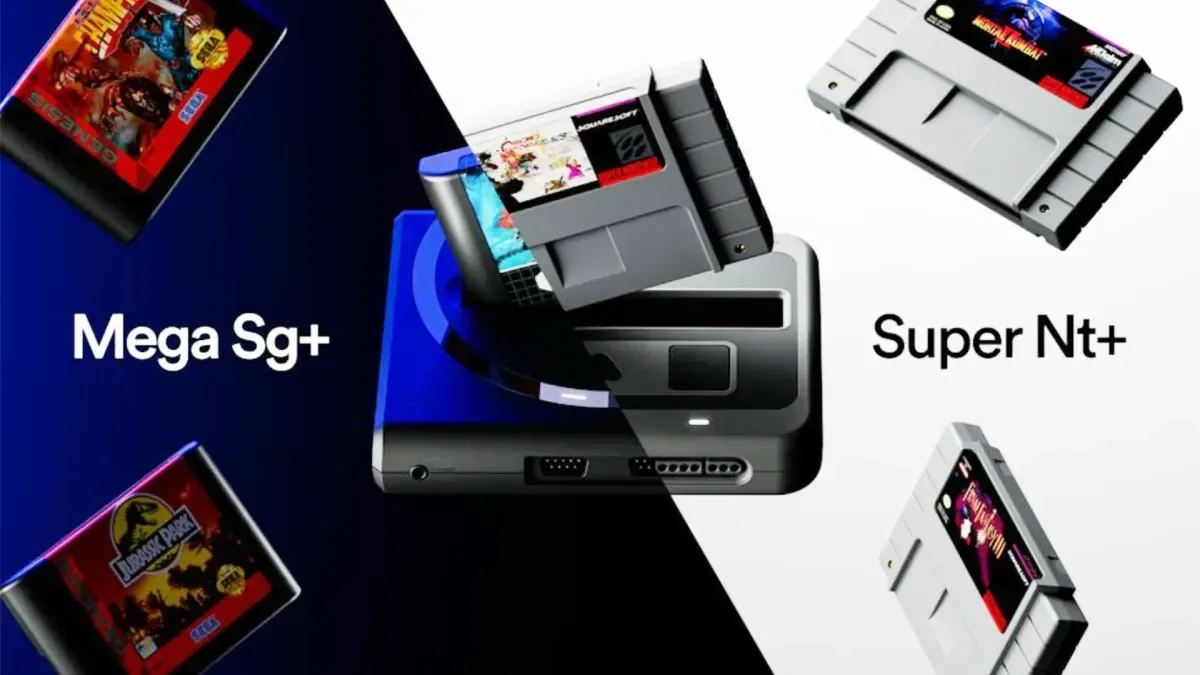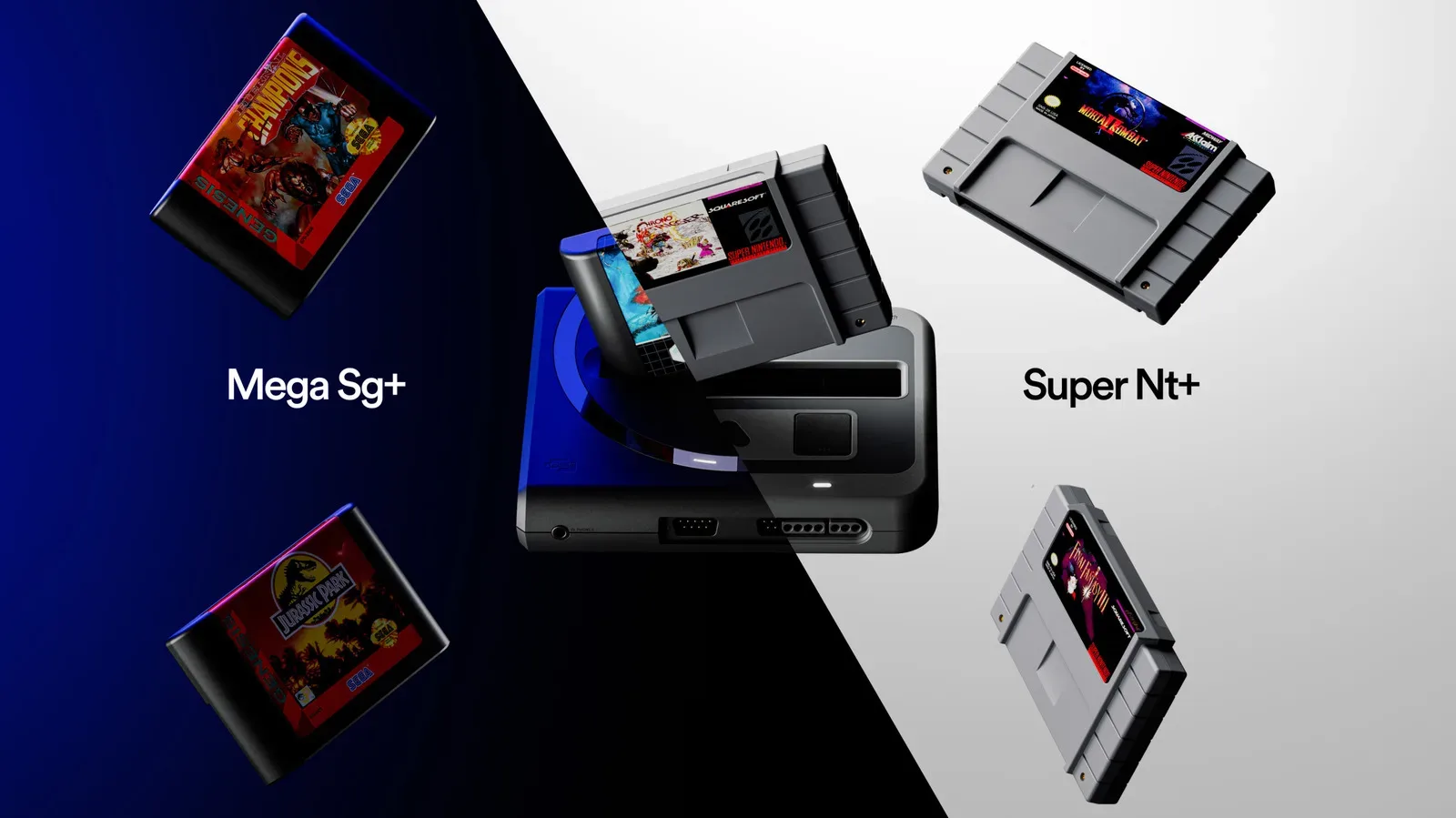
Analogue is returning to the defining 16-bit hardware rivalry with two updated cartridge consoles: the Super Nt+ for Super Nintendo games and the Mega Sg+ for Sega Genesis software. Both are priced at $220, with pre-orders scheduled to begin October 19 at 8AM PT and shipping expected to start in December.
The important word in that description is cartridge. These machines are built for people who already own original games, rather than players looking for an all-in-one digital library. The Super Nt+ and Mega Sg+ accept physical software, and Analogue says each system supports more than 2,200 games region-free. That makes the refreshed systems a potentially tidy route to using an existing 16-bit collection on a modern television, but it also means the console purchase is only one part of the budget.
No controllers are included. Buyers who do not already have compatible pads will need to add them separately; retro-styled 8BitDo M30 and SN30 controllers are listed at $30 each. That is a meaningful practical consideration when comparing a $220 console to alternatives that may bundle controllers but do not use original cartridges in the same way.
What FPGA means here
The Super Nt+ and Mega Sg+ are FPGA systems. FPGA is short for field-programmable gate array: a chip that can be configured to reproduce the behavior of particular hardware logic. In this case, the goal is to recreate the underlying functions of the original 16-bit console hardware rather than run a game through software emulation.
That distinction is central to Analogue’s pitch. Software emulation generally involves one system interpreting the behavior of another through an application. An FPGA-based design instead configures hardware logic for the target platform. The stated benefit is lag-free play on a modern display without requiring players to search for ROM files, which are digital copies of game data.
It is also worth separating that technical approach from the ownership model. FPGA does not turn the Super Nt+ or Mega Sg+ into subscription machines or digital storefronts. The intended experience remains physical: insert an original cartridge and play it on newer hardware. For collectors with working games but aging original consoles, that could be the appeal. For players starting with no cartridges at all, the hardware does not remove the need to build a compatible library.
That physical-media angle arrives as debates around game ownership continue well beyond retro gaming. The cartridge-first approach is a sharp contrast to an industry increasingly comfortable with digital distribution, a tension also reflected in the continuing discussion around disc-based ownership and digital-only hardware.
Wireless support is the headline upgrade
The most substantial change over the earlier Super Nt and Mega Sg is wireless controller support. Both new systems include Bluetooth and 2.4GHz wireless connectivity, plus a dedicated pairing button. The primary controller can also power the console on and off. Wired controllers remain supported, so an existing wired setup does not become obsolete.
Related coverage includes Analogue Super Nt+ and Mega Sg+ Bring Wireless Play to 16-Bit Cartridges.
Bluetooth and 2.4GHz are two different wireless methods, and their inclusion broadens controller choice. Bluetooth is a familiar standard used across many modern devices. A dedicated 2.4GHz connection generally relies on a compatible receiver or controller ecosystem. The practical takeaway is not that one connection method has been declared universally superior; it is that the consoles are no longer limited to a wired-only setup.
For a living-room installation, that may be the update with the greatest day-to-day impact. Original-style controller cables can be restrictive, especially when a console is placed farther from the couch to accommodate a modern TV arrangement. The ability to turn the unit on or off from the main controller also makes the setup feel less like a display piece that must be manually tended every session.
Still, prospective buyers should be precise about what is and is not in the box. Wireless capability is built into the consoles, but a wireless gamepad is not. Anyone planning to use an 8BitDo M30 with the Mega Sg+ or SN30 with the Super Nt+ should include the separate controller cost before deciding which setup suits them.
Ports, cartridge swapping and display limits
Both systems add USB-C power and a USB-A port. The USB-A connection can be used to connect CRTs or charge controllers. CRT, short for cathode-ray tube, refers to the older tube televisions and monitors commonly associated with the original console era. The inclusion matters for players who want a more period-appropriate display option while keeping the convenience of newer console hardware.
There is also an SD card slot, a new operating system and redesigned cases. No further role for the SD card is specified here, so buyers should avoid assuming extra features beyond the presence of the slot itself.
One deceptively useful quality-of-life change is cartridge hot-swapping. The Super Nt+ and Mega Sg+ allow a cartridge to be changed without shutting down the console first. For anyone comparing multiple games in a single session, that is a small friction-reducer. It should not be confused with a promise that a game’s state automatically carries over between cartridges; it simply removes the need to power the system down before exchanging one game for another.
Video output tops out at 1080p, and neither unit offers 4K output. That boundary is worth highlighting because 4K has become a default checkbox in modern hardware discussions. Here, the emphasis is not on chasing a 4K specification. It is on providing a modern-TV-friendly signal while focusing on hardware recreation and original cartridge support.
Mega Sg+ retains its wider Sega connections
The Mega Sg+ continues to include a Sega CD connector and ships with a Master System adapter. Those details distinguish it from a Genesis-only proposition. The Sega CD connector keeps the system tied to Sega’s CD-based add-on ecosystem, while the included adapter extends the machine’s reach to Master System cartridges.
That bundled adapter has real value for someone with games from both Sega eras, since it avoids making Master System compatibility a separate accessory decision. Conversely, it should not be treated as a broad statement that every Sega format or peripheral is supported; the stated compatibility specifics are the Sega CD connector and Master System adapter.
The Super Nt+ and Mega Sg+ therefore share a common approach—FPGA-based cartridge play, modern connectivity, wireless support and 1080p output—but serve different shelves. The Super Nt+ is the option for a Super Nintendo cartridge library. The Mega Sg+ is aimed at Genesis players and retains connections to Sega CD and Master System ecosystems.
Who these systems make sense for
These updates are most straightforward for players who have original cartridges and want a newer, cleaner way to use them. The hardware is region-free and covers a stated 2,200-plus games per console, while wireless connectivity and USB-C bring two conspicuously modern conveniences to formats rooted in the early 1990s.
The biggest caveat is equally straightforward: the console itself does not provide the games. It is not a replacement for cartridges, and it does not include a gamepad. A buyer beginning from scratch should account for the cost and availability of software and controllers in addition to the $220 system price.
For owners of an established SNES, Genesis, Sega CD or Master System shelf, the decision is more about priorities. If playing original cartridges through FPGA-based hardware on a current television, using wireless controllers and avoiding a power cycle during cartridge changes sounds appealing, the Super Nt+ and Mega Sg+ offer a focused refresh. If 4K output or an included controller is essential, the specifications make clear that these are not the machines designed around those goals.