Remaking the first Tomb Raider is not the kind of job that can be solved by simply increasing the polygon count and giving every bat enough fur to star in a shampoo commercial. The 1996 original is a landmark, but it belongs to a distinct era of action-adventure design: stark spaces, lonely exploration, obtuse secrets, elaborate platforming and the occasional moment when progress depended on realizing that a suspiciously plain wall was, in fact, a button’s best friend.
Tomb Raider: Legacy of Atlantis is attempting to bring that foundational adventure forward without sanding down its personality. Crystal Dynamics and Flying Wild Hog are developing the game, with Amazon Game Studios publishing. It is currently scheduled for February 12, 2027 on PC, PlayStation 5, Xbox Series X and Nintendo Switch 2.
The challenge is not merely technical. Lara Croft has changed dramatically in the three decades since her first expedition, and audience expectations have changed with her. Players now often expect more responsive combat, clearer traversal routes, richer environmental detail and accessibility options that prevent a single stuck puzzle from ending an evening’s plans. Yet the original game’s appeal was inseparable from the feeling of being dropped into an enormous, hazardous place and asked to work things out.
Early footage from the Damocles Trial, located in the second level, suggests that Legacy of Atlantis understands that contradiction. The project looks less interested in treating the original as a museum exhibit than in rebuilding its particular sense of scale, danger and architectural mystery. That is a fine line to walk when the floor tiles may be trying to introduce Lara to several enormous swords.
The Damocles Trial keeps its pointy identity
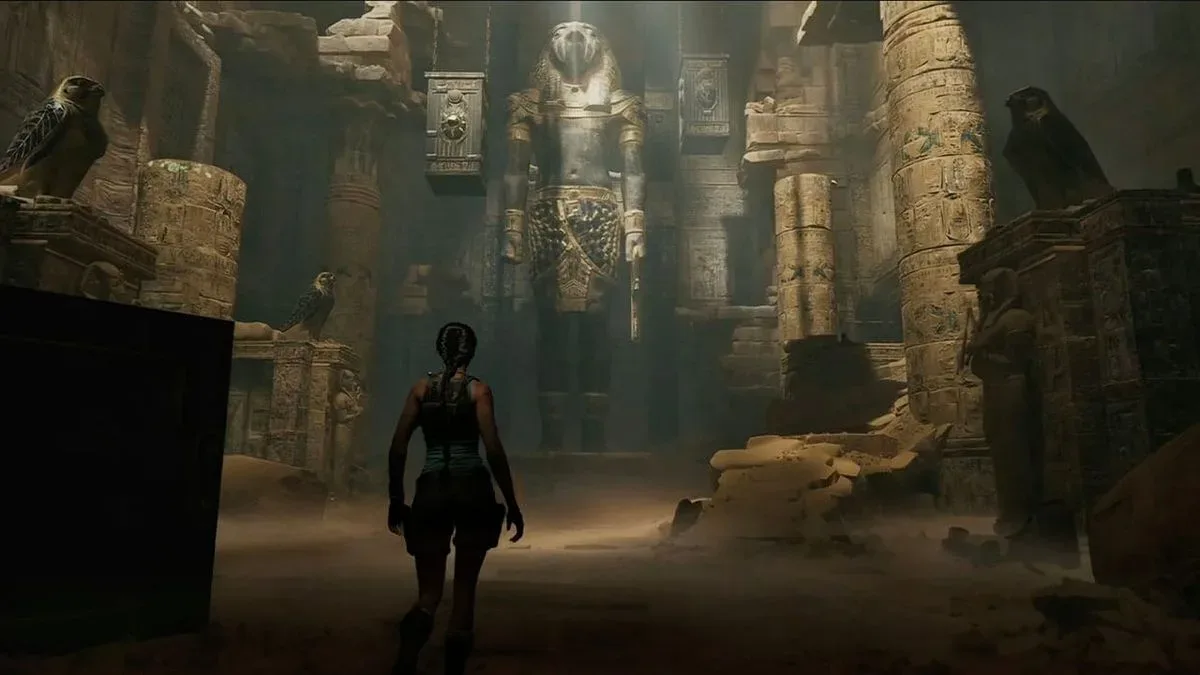
The Damocles Trial is built around the threat that gave it its name: giant stone swords suspended overhead, ready to crash down if Lara steps where she should not or lingers too long. The defining idea remains recognizable, but its presentation has become considerably more dramatic. The blades fall from far above, turning the chamber into a more imposing and theatrical death trap rather than a simple room with a stern opinion about foot placement.
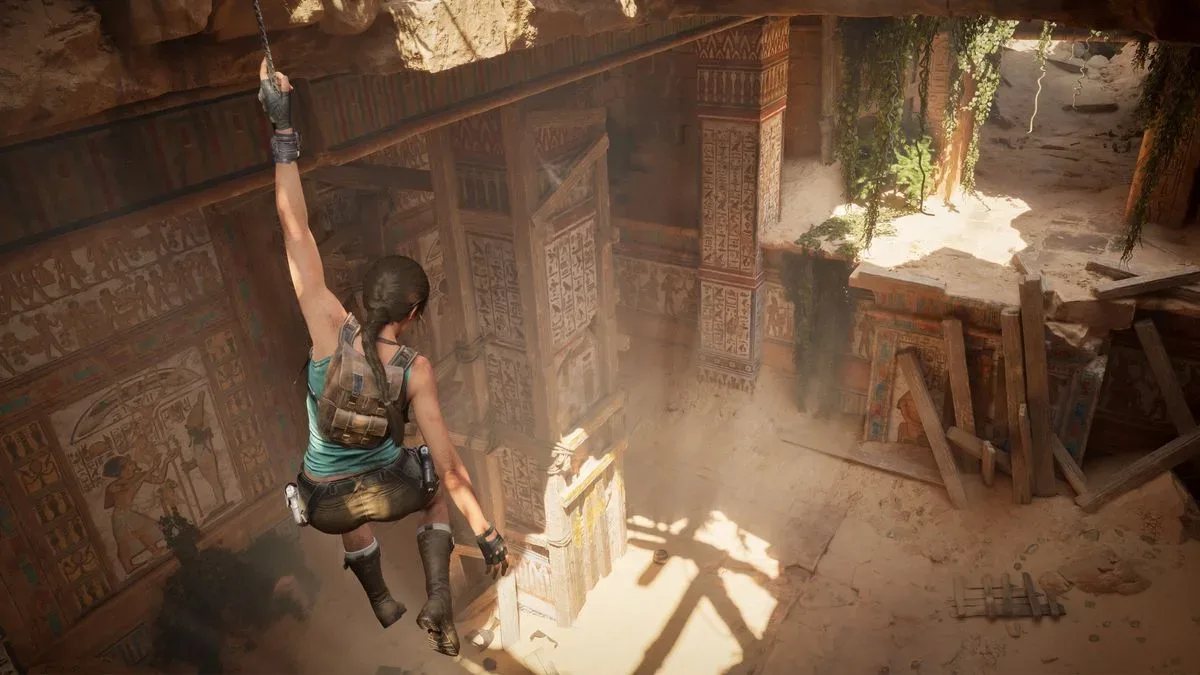
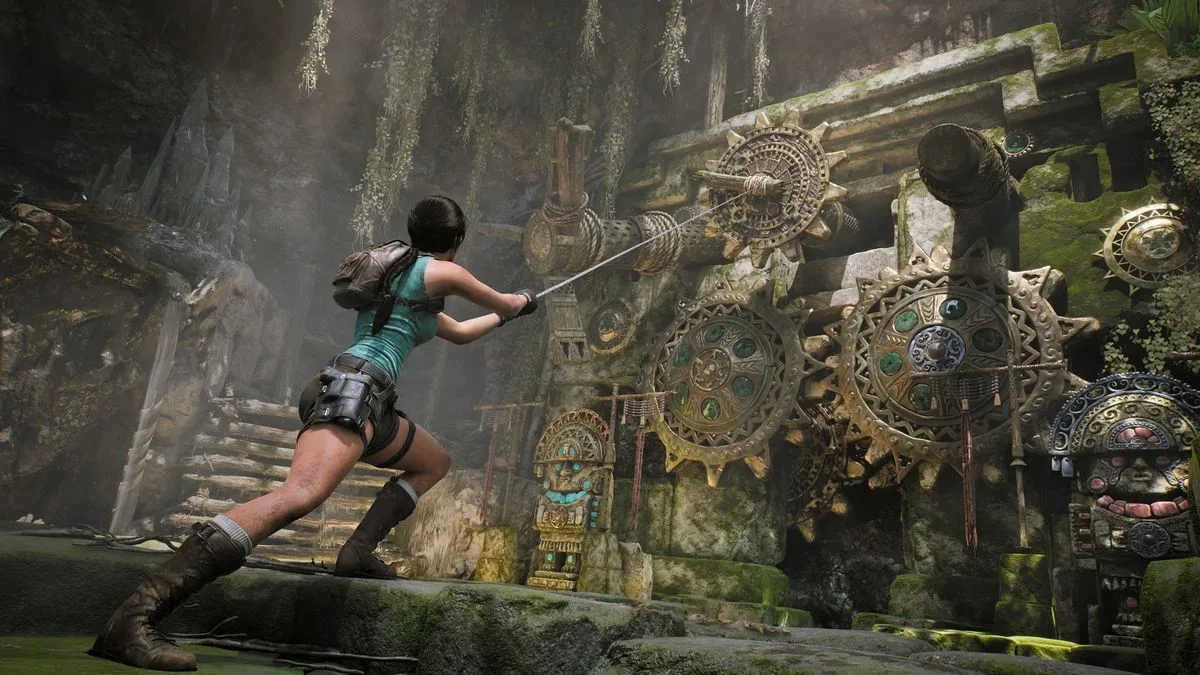
That approach seems central to the remake. Familiar locations are intended to remain familiar to returning players, while their grandeur should still register for newcomers with no 1996 muscle memory. This is important because classic Tomb Raider levels were rarely just hallways between fights. They were monumental mechanical spaces. A switch might alter a distant room. A ledge might exist only to make the player notice an even more distant ledge. The level itself was the puzzle, and also occasionally the building inspector Lara had apparently offended.
A modern remake can expand those spaces and make their threats more legible without transforming every room into a guided amusement-park queue. The Damocles sequence appears to retain the original trial’s theme while giving it a larger visual and physical presence. That is exactly the sort of update that could benefit a remake: the memory of the place stays intact, while the place gains the ability to intimidate someone who has never seen a PlayStation memory card.
Combat is faster, and the wildlife is less polite
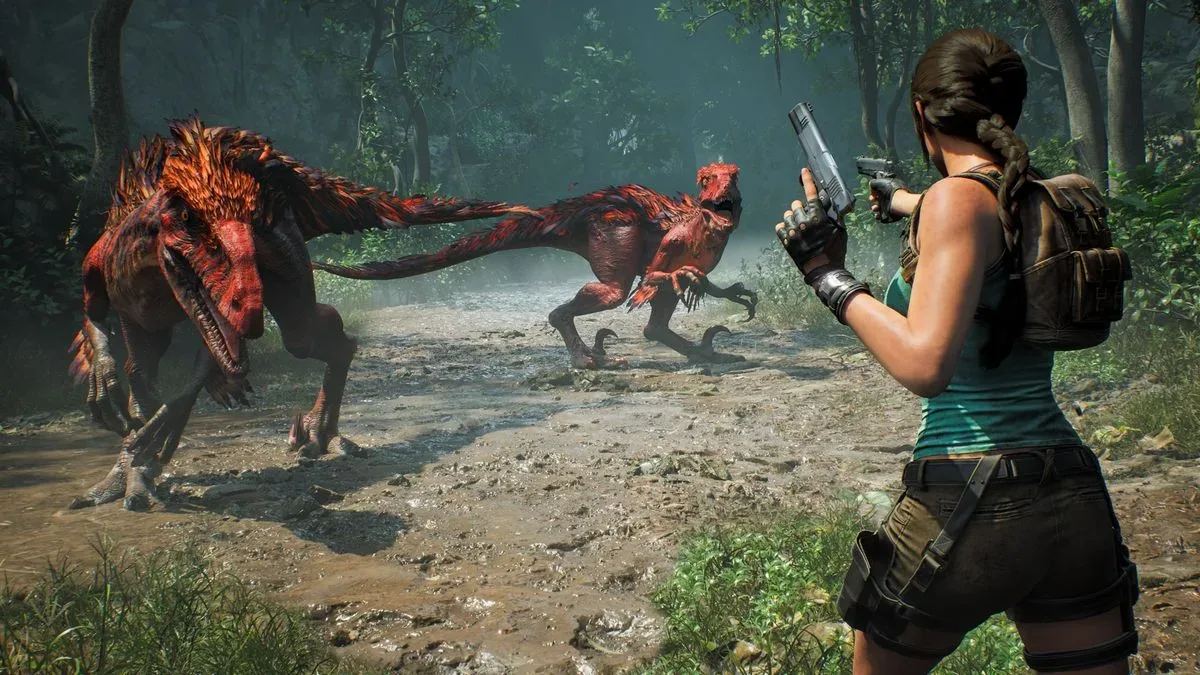
The showcased section begins with bats, a classic Tomb Raider nuisance elevated from a simple flying hazard into a less predictable swarm. Rather than behaving like a neat procession of targets, the creatures move with more erratic group behavior. Lara can thin the swarm with gunfire until the remaining bats disperse, but she can also take damage in the process.
That injury leads to one of the remake’s clearest modern additions: crafting. Lara can gather resources within a level and use them to make a healing balm. At a glance, crafting might sound like a feature imported from the standard action-game toolbox, with all the usual concerns about harvesting leaves while an ancient civilization waits patiently in the background. Here, however, its stated purpose is tied to the world itself. A handmade remedy fits the setting more naturally than discovering a modern medical kit in a sealed temple that supposedly has not welcomed visitors for centuries.
The idea does not automatically guarantee that the system will feel essential, restrained or enjoyable across a full game. It does, however, show a thoughtful attempt to replace an old convention with something that better suits the fiction. The value will depend on how frequently materials appear, how much menu management is involved and whether healing remains a tense decision rather than a routine between skirmishes.
The next danger is a leopard, another familiar threat that has received substantially more elaborate behavior. The animal can use the room’s geometry to break Lara’s line of sight, retreat through rocky gaps after taking enough damage, and return from an unexpected direction. The encounter asks Lara to keep moving instead of planting herself in one spot and firing until archaeology resumes.
To support that mobility, combat includes fast movement and Lara’s acrobatic dodge-cartwheels. There is also a Focus gauge that slows time temporarily, allowing a brief window to assess a hectic encounter. It is a conspicuously contemporary mechanic, but it may be a sensible bridge between old-school animal attacks and a newer combat model with more active enemy behavior. Lara has always been athletic; a system that rewards repositioning arguably fits her better than a cover-heavy shooting framework ever would.
Guidance is present, but the strongest tool is optional
The biggest question around a modernized Tomb Raider may not be combat. It is puzzle guidance. The original game’s reputation was built partly on the pleasure of deciphering spaces independently, and partly on the fact that some players spent a very long time staring at a lever that was not the correct lever. Modern games generally try to avoid that sort of stalemate, but too much help can drain a tomb of its mystery before the player has had a chance to be properly confused by it.
Legacy of Atlantis uses several layers of assistance. Lara may comment on what she is seeing, and environmental markings can subtly indicate an intended parkour route. Those forms of direction are fairly common and, based on what has been shown, do not appear designed to dominate the scene. A player can still look at a vast ruin, make their own plan and then discover that the ruin has a different plan involving gravity.
The more significant option is a Scanner. This tool can highlight the active or movable elements of a puzzle, which makes it far more direct than a lightly painted climbing surface or a nudge in dialogue. In a game trying to honor an adventure from 1996, it is an obvious anachronism. It also has the potential to become the kind of answer button that players activate reflexively, then wonder why every puzzle feels less satisfying.
Its optional status is therefore crucial. The tutorial is expected to explain that the Scanner can provide lore information as well as puzzle help, giving it a purpose beyond simply illuminating the correct object in fluorescent certainty. Players who prefer exploration with limited intervention can leave it alone; players who want to maintain momentum can use it when a solution becomes frustrating rather than intriguing. That is a better compromise than forcing either approach on everyone.
Optional assistance does not make design balance effortless. If puzzles are built around the expectation that the Scanner will be used, players declining it could face needlessly cryptic challenges. If the tool reveals too much too quickly, players using it may bypass the observation that gives a puzzle meaning. Still, making the feature elective acknowledges that there is no single modern audience. Some people want to interrogate every chamber themselves. Others have thirty minutes before dinner and would prefer not to spend twenty-nine of them wondering whether an ornamental urn is secretly a gear mechanism.
A remake’s success will depend on restraint
What has been shown so far makes Legacy of Atlantis look aware of the perils on both sides of the remake divide. Faithful geography, the Damocles concept, wild-animal threats and a focus on interconnected tomb spaces point back to classic Lara. Healing crafting, Focus slow motion, smarter foes, visual route cues and the Scanner acknowledge what players now commonly expect.
None of those ideas is inherently a betrayal of the original, nor is any one of them proof that the full game has solved the remake problem. The decisive factor will be restraint. The modern systems need to support the sensation of exploring a dangerous place rather than constantly explaining, decorating or interrupting it. A tomb should remain a place where curiosity matters. If every route is announced, every mechanism highlighted and every enemy encounter reduced to a tutorial-shaped arena, the resulting game may wear Lara Croft’s name while losing her earliest adventures’ defining atmosphere.
For players revisiting older hardware while waiting for Lara’s 2027 return, mapping a retro console’s connections before buying an HDMI adapter can prevent an avoidable setup detour. And because archaeology is always better when a second person is available to shout “try the other lever,” revisit the unwritten rules of couch multiplayer before handing someone the second controller.
For now, the most encouraging detail is not that Legacy of Atlantis has modern mechanics. It is that several of its most intrusive-looking conveniences appear to be optional. That leaves room for veterans to approach the rebuilt ruins with fewer signposts, while giving newer players tools to keep the expedition moving. If that balance holds beyond the Damocles Trial, Lara’s latest trip into her oldest territory could preserve the thrill of getting lost without making getting lost the entire game.