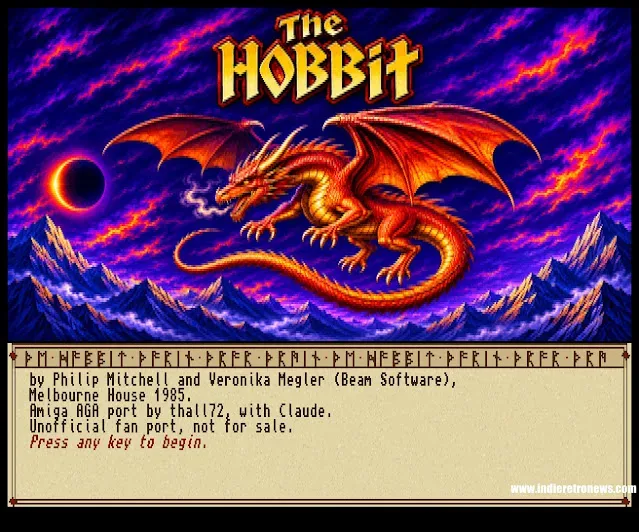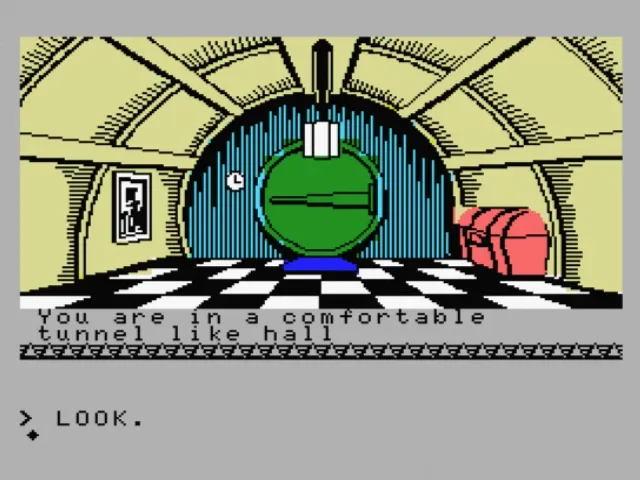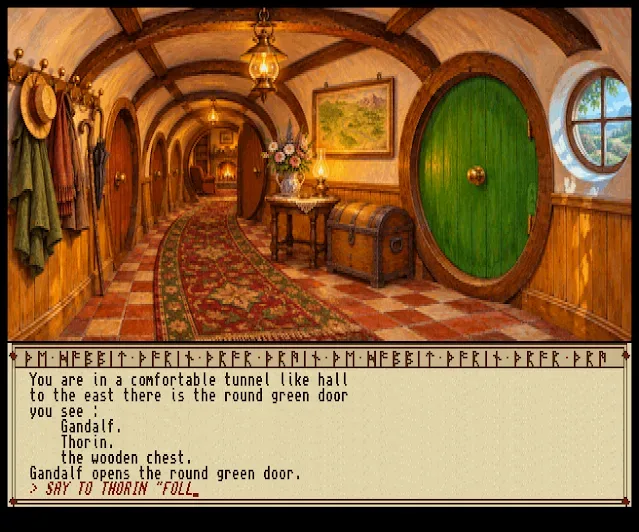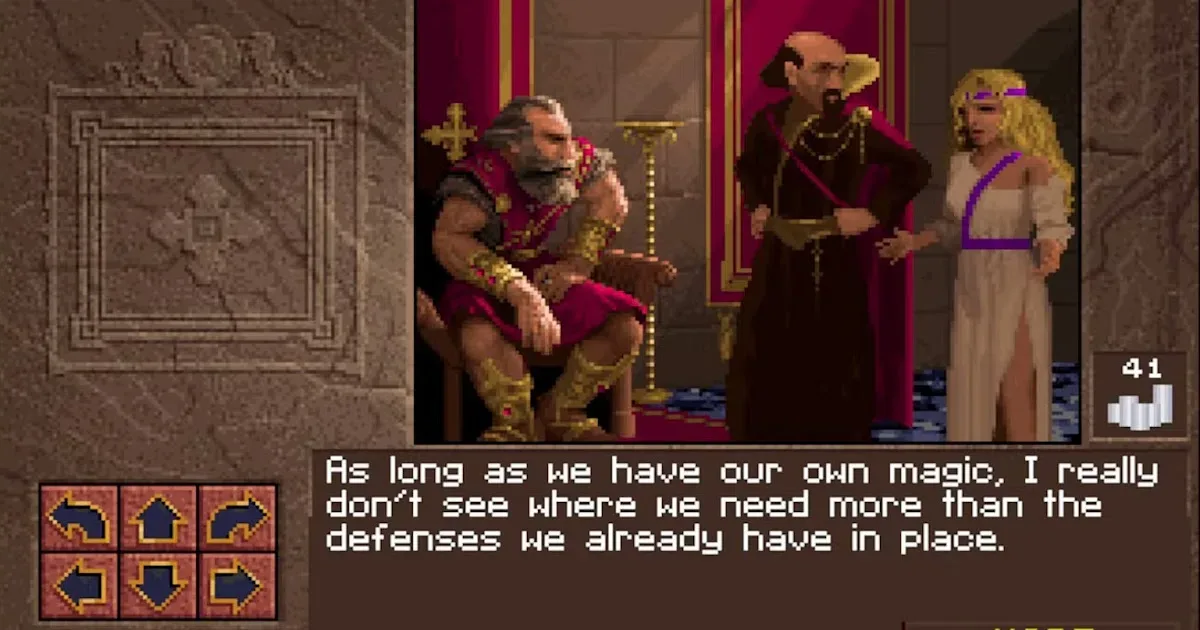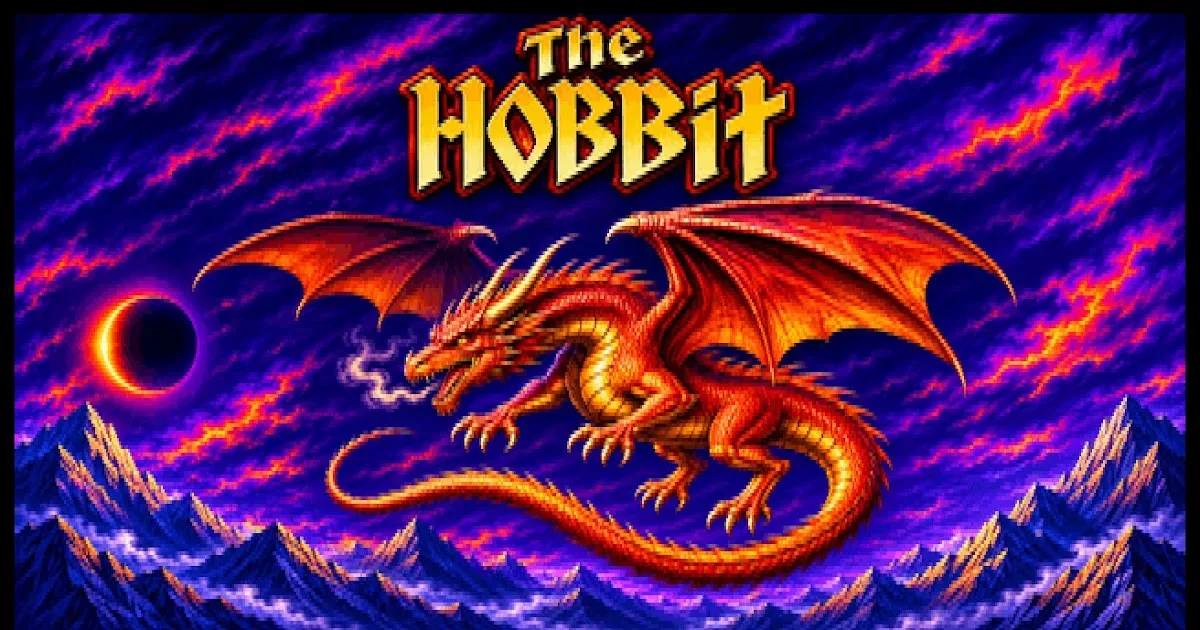
Middle-earth has taken an unexpected detour into the Amiga scene. Creator thall72 has released The Hobbit – Amiga AGA Enhanced Edition, a new version of Melbourne House’s 1982 text adventure built for the Amiga 1200 and other machines equipped with the Amiga Graphics Architecture, better known as AGA.
The project’s defining idea is straightforward: retain the identity of a foundational text adventure while imagining a more lavish 16-bit presentation for it. Its visuals were made with the help of AI, placing this release at the intersection of retro-computing preservation, fan-led reinterpretation and the still-contentious use of generative tools in game art.
It is not presented as a newly invented Hobbit game with a different premise. Rather, this is a reworking of the classic Melbourne House adventure, whose connection to J.R.R. Tolkien’s world remains central. For readers following the wider modern screen side of that world, The Rings of Power’s continuing Middle-earth story is a reminder of how many forms Tolkien-inspired storytelling can take. This Amiga release looks in the opposite direction: toward the computer-game language of the early 1980s, refreshed through a later 16-bit lens.
What “AGA Enhanced” means here
AGA is the graphics chipset associated with later Amiga hardware including the Amiga 1200. In practical terms, the name matters because it establishes the intended hardware class for this edition. This is not described as a generic port for every Amiga configuration; it is aimed at AGA-capable systems.
The “enhanced” portion is principally about the game’s visual treatment. Text adventures traditionally ask players to build much of a location, situation and character action in their imagination from written descriptions. An illustrated presentation can change the rhythm of that experience. It can give a room, landscape or encounter an immediate visual identity before the player begins parsing its prose and deciding on a command.
That does not mean imagery replaces the essential text-adventure structure. A text adventure is a game driven through written input and interpretation: the player describes an intended action, and the software responds with new text, changes in state, or both. The genre’s appeal often comes from testing verbs, objects and phrasing, then developing a mental map of the game’s world. A richer display can frame that process, but it is the interaction between language, player inference and game logic that remains the genre’s core.
A familiar Amiga ambition
The project draws inspiration from the way Magnetic Scrolls titles such as The Pawn and The Guild of Thieves raised the visual bar for interactive fiction on Amiga. That comparison is useful because it describes an aspiration rather than claiming these games share the same design or technology.
Those titles are remembered as examples of text-driven adventures receiving a presentation designed to feel at home on more capable home computers. Their significance to this project is the proposition that prose-led games need not look austere simply because their primary interaction is textual. An AGA version of The Hobbit applies that same broad philosophy: a classic adventure can remain dependent on writing while gaining an illustrated 16-bit atmosphere around it.
Related coverage includes The Hobbit Gets an AI-Enhanced Amiga AGA Edition for 16-Bit Systems.
That is especially fitting for a work rooted in fantasy. Tolkien’s settings are dense with visual associations, but early home-computer games frequently had to convey such worlds through words, limited graphics, or a combination of the two. An enhanced edition has an opportunity to make a particular interpretation of those locations visible. It also carries a responsibility: visuals are no longer neutral decoration once they guide how players imagine a place.
AI art is the edition’s biggest talking point
The release is explicit about AI-assisted graphics, and that detail is likely to be more divisive than the idea of an Amiga adaptation itself. “Built with the help of AI” is a description of the project’s production approach, not a claim that the game was automatically made or that its design should be judged independently of the results. It does, however, establish that generative tools were part of the visual pipeline.
For supporters, the attraction may be practical as much as aesthetic. Fan and hobbyist projects can seek a scale of illustration that would otherwise be difficult to create. In that view, AI assistance becomes a way to pursue an elaborate visual reimagining of an older game for a specialist platform.
For critics, AI-generated artwork raises questions that do not disappear because a project is retro-themed. Viewers may judge whether the images feel coherent, whether they suit the underlying game, and whether the methods behind them align with their expectations for fan-made releases. Those are legitimate discussions, particularly when the original game’s literary and software heritage is part of its appeal.
The important distinction is between confirmed information and assumption. This edition is described as using AI graphics. The available details do not establish a full asset-production workflow, the degree of manual revision, or every technical change beyond the stated AGA presentation. It would be premature to infer specifics that have not been provided.
Why an old text adventure still invites new versions
A 1982 text adventure may appear to be an unusual candidate for a visual overhaul, yet its format arguably makes reinterpretation particularly meaningful. In a heavily authored graphical game, the player is shown nearly everything. In interactive fiction, the written response leaves space between what the program says and what the player pictures. New art changes that space without necessarily changing the fundamental loop of reading, thinking and typing.
There is also a technical fascination in bringing an early game concept to a platform whose identity is strongly tied to audiovisual personality. The Amiga remains a natural home for projects that celebrate color, screen composition and the feel of 16-bit computing. Putting a text adventure there can be seen as an argument that platform character is not only about arcade action, scrolling backdrops or music; it can also shape how a literary game is presented.
For retro players, this may make the edition relevant even if they already know the original. The interest lies in seeing how a familiar design is framed for AGA hardware. For text-adventure fans, the more important question may be whether the added imagery supports the act of exploration instead of distracting from it. And for Amiga enthusiasts, it is another example of contemporary work being made with specific classic hardware in mind rather than treating that hardware solely as a museum piece.
What players should keep in mind
- Hardware matters: this edition is intended for the Amiga 1200 and other AGA-equipped Amiga systems.
- The foundation is a 1982 text adventure: prospective players should expect a prose-led adventure format rather than a modern action interpretation of Tolkien’s setting.
- The visual approach is AI-assisted: that is a stated characteristic of the release, and it will be a deciding factor for some players.
- Its inspiration is presentational: the cited Magnetic Scrolls games illustrate the project’s aim of pairing interactive fiction with stronger 16-bit visual flair.
The result is an intriguingly specific kind of retro project: not merely a return to an old game, and not simply a graphical remake detached from the platform it runs on. The Hobbit – Amiga AGA Enhanced Edition is built around a particular alternate-history question—what might this landmark text adventure have looked like had it received a more elaborate AGA-era treatment?
Whether that question is answered persuasively will depend on the final relationship between text, interface and art. But the premise itself has clear appeal. It respects the enduring pull of parser-era fantasy adventures while giving Amiga enthusiasts a fresh reason to look at a classic through the color-rich, unmistakably 16-bit character of AGA hardware.