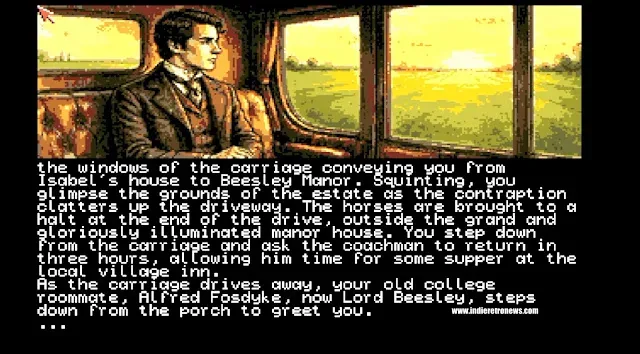
The Demon Jar; or, Fosdyke’s Folly is a newly spotlighted retro-style illustrated text adventure from developer Alan Pemberton, built around a compact Victorian horror story rather than an enormous maze of opaque riddles. Its premise has the proper ingredients for an unsettling evening: a summer night at the height of the Victorian age, a young gentleman called Oswald Stanley, and a planned visit to an old college companion that becomes something much darker when a murderous spirit enters the picture.
The game is intended for several classic and retro-computing platforms: Amstrad, Amiga, Atari ST, Commodore 64, Commodore Plus/4, and ZX Spectrum NEXT. That broad system list is a notable part of the project’s appeal. Rather than treating one vintage machine as the main event and the others as afterthoughts, The Demon Jar is positioned as a cross-platform adventure made for people who still enjoy loading up text-led fiction on the hardware—and modern recreations of the hardware—that defined different corners of home computing.
A small-scale horror story with player-led consequences
Oswald’s journey begins in recognizably genteel circumstances, but The Demon Jar wastes little time turning that setup toward supernatural danger. The game casts the player as Oswald and leaves his survival in the player’s hands. That is an especially natural fit for the text-adventure format, where progress comes from observing locations, considering objects and people, entering commands, and accepting that one apparently reasonable decision may have terrible results.
The available description presents the adventure as deliberately short. Experienced players of classic interactive fiction should therefore expect a game that can potentially be completed in one sitting, with comparatively direct puzzles instead of a prolonged campaign full of sprawling maps and dozens of intertwined inventory problems. “Straightforward” does not necessarily mean consequence-free, however. Horror games can make a brief journey feel tense when the stakes of a wrong action are immediate, and the game’s design specifically accounts for fatal errors.
It is also clearly framed as material for an older audience. The warning says it is not suited to children or to players of a nervous disposition. That is worth taking seriously: the title’s supernatural threat is not merely an atmospheric background detail, but a murderous evil spirit, and the intended effect is a chilling narrative rather than a cozy Victorian mystery.
Ramsave and Ramload get a useful second life
One of The Demon Jar’s most interesting mechanical choices is its treatment of familiar old-school commands. RAMSAVE and RAMLOAD are traditionally associated with saving and restoring data in the memory-oriented language of vintage home computing. Here, Pemberton has repurposed them as a practical UNDO system. A player who meets a fatal outcome can use the functions to roll the game state back and try another approach.
That decision preserves some period flavor while addressing one of the traditional frustrations of text adventures: discovering that an experiment was lethal, then having to replay a substantial section from an older save—or, in the worst cases, from the beginning. The approach is appropriately in-character for a game appearing on machines where those command names have historical resonance. It also makes the game’s threat more approachable. Players can engage with a hazardous situation without treating every risky verb as an invitation to lose all recent progress.
Command-driven adventures depend heavily on the relationship between player and parser. A well-placed rollback feature does not make that relationship effortless, but it changes the cost of curiosity. In a horror scenario, curiosity is often the whole point. Players may want to investigate a suspicious jar, enter an ominous room, or push beyond the safest apparent route precisely because the story promises a sinister turn. An undo-style option gives the game room to punish Oswald without making the player feel punished for participating.
Related coverage includes The Demon Jar Brings a Victorian Horror Tale to Amiga, C64 and Other Classic Systems.
For anyone returning to this form after years of mouse-driven games, small quality-of-life decisions can matter as much as the era-appropriate presentation. A keyboard remains the central tool for navigating a text adventure, so readers refining their desk setup may also find our guide to remapping underused keyboard keys for a faster Windows and gaming setup useful. The Demon Jar is designed around a much older computing tradition, but the simple pleasure of making a machine respond to deliberate key presses has not disappeared.
Built with DAAD Ready and Aventuras AD roots
The Demon Jar was made with DAAD Ready, a modern revival of the classic DAAD adventure-authoring approach. Stefan Vogt is credited with helping bring that system back into use. DAAD has deep connections to the European home-computer adventure scene, making it a fitting technological foundation for a release that reaches across so many period platforms.
The project’s multi-system ambitions are also supported by the Aventuras AD engine work dating to the 1990s. That underlying conversion effort helps explain how an adventure conceived for this family of machines can arrive across such a varied lineup. An Amiga, C64, Atari ST, Amstrad, Plus/4, and Spectrum NEXT do not share identical technical identities, display capabilities, memory arrangements, or communities. Supporting them all is not simply a matter of putting the same text on several disks or files.
The Amiga requirement is specifically described as an expanded setup, an important detail for prospective players. The information available does not define the exact memory or hardware configuration needed, so it would be premature to infer compatibility with every Amiga model. Still, including the Amiga among the target machines gives the game a welcome place in a platform library often associated with graphical adventures, action games, demos, and distinctive audio work, while text adventures demonstrate another enduring strength of the era’s computer culture.
Illustrations, AI assistance, and clear disclosure
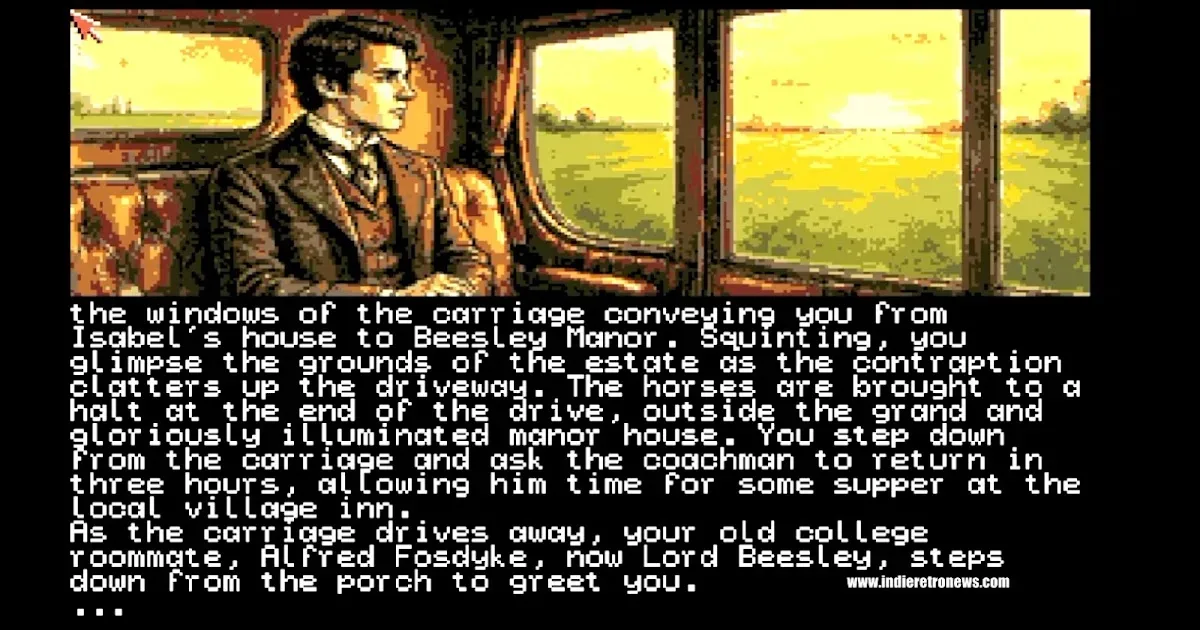
Although text is the heart of the experience, The Demon Jar includes bespoke graphics to illustrate its Victorian nightmare. The game’s materials disclose that those visuals were produced with assistance from AI tools, specifically naming Google Flow and ChatGPT. The disclosure is focused on graphics, and there is no stated basis to assume that the game’s narrative, design, programming, or puzzles were generated in the same manner.
That clarity is useful because retro releases often invite close attention to their production methods. Players care about how a game was written, drawn, converted, and tested—not only because of debates over AI-assisted work, but because the constraints and craft of historical platforms are part of their appeal. Here, the credits identify the graphics workflow as AI-assisted while also recognizing the people and tools behind the rest of the project.
David Walton and Andrew Ryals are credited for play-testing support. That may sound like a modest line in a credits roll, but testing has particular importance in parser-driven games. A puzzle can make perfect sense to its author and still fail to communicate a required clue, a useful interaction, or an expected command to everyone else. Testers help reveal dead ends, unclear wording, and unintended routes through a game whose story depends on the player understanding what can be attempted next.
A retro release that understands the format
There is a difference between using retro hardware as a visual costume and building a project around the strengths, habits, and limitations of its original forms. The Demon Jar’s short scope, illustrated prose, multiple vintage targets, DAAD Ready construction, and RAMSAVE/RAMLOAD-inspired undo method suggest a game that understands what makes the format distinctive. It leans into direct commands and narrative imagination while providing a contemporary-minded escape hatch for deadly decisions.
The title’s Victorian setting is equally suited to the form. Text adventures can make darkness, uncertainty, strange sounds, and unseen presences remarkably effective because the player completes much of the scene in their own imagination. An illustrated presentation can give crucial moments a visual anchor, but prose retains the ability to leave just enough outside the frame. With Oswald Stanley facing a malevolent spirit over the course of one bad evening, the game’s modest scale may be an advantage: a concise ghost story has little need for detours when every turn can press the danger closer.
For retro players who prefer their scares typed a command at a time, The Demon Jar; or, Fosdyke’s Folly offers a compact supernatural premise, historically minded tooling, and an unusually broad collection of target systems. Its stated warning and its undo-friendly design together paint a clear picture: this is meant to be a dangerous night for Oswald, but not an unnecessarily punishing one for the person at the keyboard.