For a retro-computing scene accustomed to names, logos and rights taking the scenic route through several decades of corporate history, a single photograph from Gamescom has landed with unusual weight. Retro Games Ltd has shared an image showing figures associated with Amiga, Commodore and the company itself posing with the forthcoming The A1200. It follows confirmation that The A1200 will carry official Amiga branding.
On its own, a show-floor photo does not rewrite the long and complicated history of the Amiga name. Yet the combination of that image and the product-branding announcement is a meaningful signal: the people and companies attached to these storied labels appear to be publicly aligned around a new licensed machine. In a hobby where the wording on a box can be every bit as scrutinized as the ports on its rear panel, that is very much the kind of news that makes collectors sit up, adjust their floppy-disk collection, and whisper, “Well, that’s not nothing.”
The A1200 is being presented as an Amiga product
Retro Games Ltd has said that its upcoming The A1200 is officially an Amiga product. The company tied that status to a recently announced arrangement involving Mike Battilana and Amiga Corporation, describing the Amiga brand as entering a clearer, more unified future.
The key practical point is the licensing. Companies including Retro Games Ltd and Commodore International are now able to use the Amiga name on products under license. That makes The A1200 more than a device inspired by a beloved home computer: Retro Games Ltd is presenting it with official Amiga identification.
There is an important contrast with the company’s earlier Amiga-related release, The A500 Mini. Although that system was based around the Amiga experience, it could not use the Amiga name. The difference is easy to underestimate until one considers what a brand means in the retro hardware world. A faithful-looking keyboard, a familiar beige silhouette, and a stack of era-appropriate games can create the atmosphere. Official branding, however, addresses the question of lineage directly.
That does not automatically answer every question enthusiasts may have about The A1200 itself. The available information here confirms its branding status, but does not establish a price, release date, technical specification, included software list, regional plans or final feature set. Those details should remain separate from the confirmed news. What is known is that Retro Games Ltd’s next A1200-themed system will be able to wear the Amiga name.
Why the Gamescom image matters
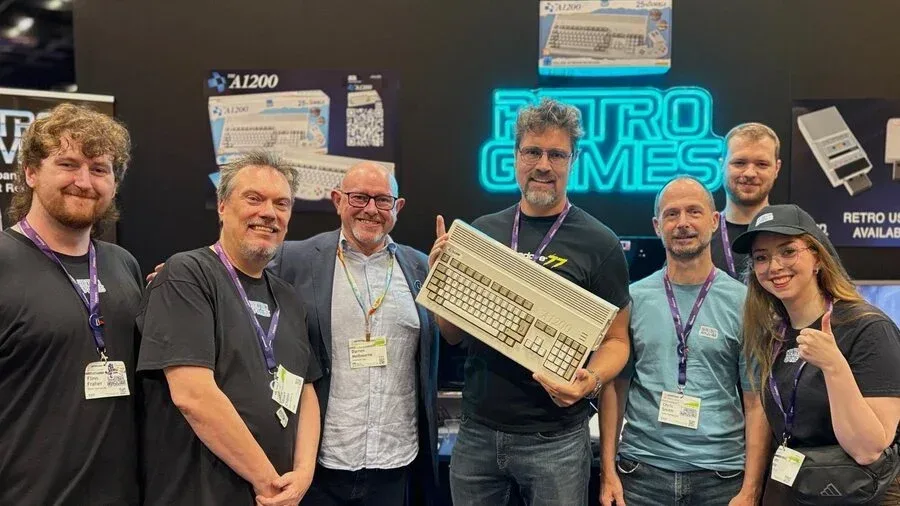
The later Gamescom update gave the branding news a particularly striking visual companion. Retro Games Ltd described its team being at the event alongside the CEO of Amiga Corporation, the CEO of Commodore, and a joint CEO of Retro Games, each shown with a The A1200 unit. The company added the teasing phrase, “No spoilers,” which naturally leaves plenty unstated.
The people identified in connection with the photo include Commodore International CEO Christian Simpson and Amiga Corporation’s Mike Battilana. Their appearance around the same upcoming product is notable because Amiga and Commodore have spent a long time as related names with separate histories and complicated ownership paths.
Related coverage includes The A1200 Gains Official Amiga Branding as Key Figures Meet at Gamescom.
It is worth being exact about what the photo demonstrates and what it does not. It demonstrates a public moment of cooperation or at least shared presentation around The A1200 at Gamescom. It supports the idea that bridges are being built around the Amiga brand. It does not, by itself, reveal further products, acquisitions, technical details or corporate plans. The “no spoilers” note is a tease, not a specification sheet.
Still, retro communities do not often get a cleaner symbolic image than executives connected with brands whose relationship has been tangled for years, all holding the same forthcoming machine. It is a little like finding three old rival save files peacefully sharing one memory card. The save data may be complicated, but the screenshot is memorable.
A name split by history
The emotional charge around this announcement comes from the history behind it. Amiga and Commodore became inseparable in the minds of many users during the original home-computer era, but the brands did not remain joined after Commodore’s collapse in the 1990s. The Amiga name was separated from Commodore, and the rights connected to both brands then followed a difficult path.
That separation helps explain why official brand use is more than cosmetic. For longtime fans, “Amiga” is not merely a convenient label for a computer style or a library of software. It represents a specific cultural and technical identity: a machine family, an era of games and demos, a community, and an enduring expectation that the name should appear with care. Commodore carries comparable historical gravity, even where the present-day business arrangements differ from the memories attached to the original company.
As a result, any agreement that enables licensed use of the Amiga name is likely to be examined closely. Enthusiasts can welcome the alignment while still wanting clarity about what it covers and where it leads. That is not negativity; it is what happens when a platform’s history has taught its audience to read every label, press release and product photo like a treasure map with half the corners missing.
What this could mean for retro hardware fans
For potential buyers and collectors, the immediate significance is straightforward: The A1200 will arrive associated with the official Amiga name rather than simply evoking the original system from a respectful distance. That may matter to those who prize authenticity in a display collection, and to players who want the branding to match the heritage being celebrated.
It also gives Retro Games Ltd a more direct way to frame its work. The company can position The A1200 as part of an authorized Amiga future while still celebrating what made the original hardware special. The language used around the announcement emphasizes both audiences: people discovering the Amiga experience for the first time and those who have carried its memories forward for decades.
There is, however, a sensible distinction between brand significance and product judgment. An official name can be important without settling questions about emulation, controls, connectivity, software support, build quality or value. Those will depend on future confirmed information and, eventually, the machine itself. Anyone preparing a modern setup will still need to think through practical basics such as displays and connections; our retro console HDMI adapter checklist is a useful reminder that “it has HDMI” and “it works cleanly with your setup” are not always the same thing.
A carefully positive moment, with details still to come
Retro Games Ltd’s Gamescom post encourages excitement without actually filling in the remaining blanks. The A1200 was visible, key figures were present, and the official Amiga status has been stated. Beyond that, the message was deliberately restrained. The public has a photograph, an endorsement of a more unified brand future, and a teaser that suggests there may be more to discuss later.
For now, that is enough to make this a consequential moment in Amiga history. The public presentation of Christian Simpson, Mike Battilana and Retro Games representatives around The A1200 does not erase the decades that made brand ownership so convoluted. But it does provide a rare image of alignment after those decades. The upcoming machine is set to carry the Amiga name, and the people standing with it at Gamescom made that change impossible to miss.
Sometimes retro news is a new shell color. Sometimes it is a fresh cartridge dump. And sometimes, unexpectedly, it is a corporate-family photograph involving names that spent years sitting at different tables. The A1200 announcement appears to be the latter: a branding development with real historical resonance, even as the most important product details remain under wraps.