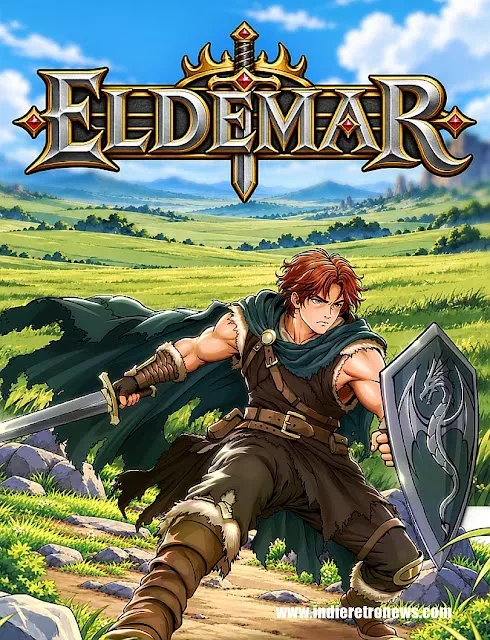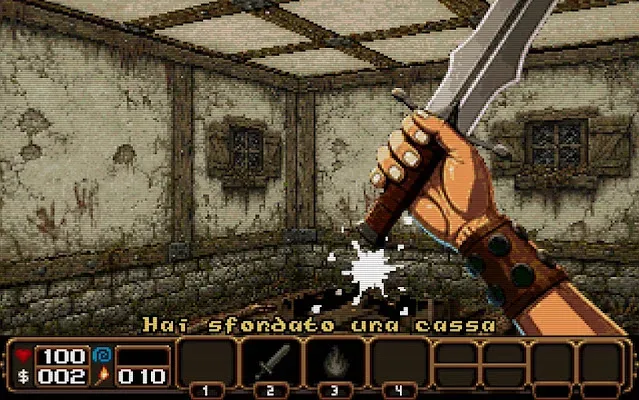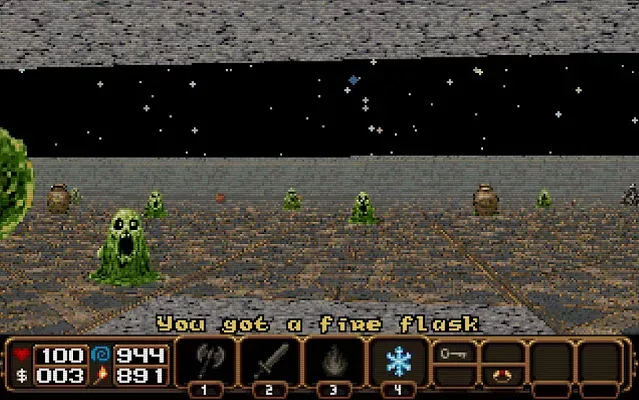
Classic Amiga hardware is the intended home for Eldemar, a first-person fantasy action RPG now seeking crowdfunding support. Darkage Software’s project is being led by programmer Paolo “Mod3m” D’Urso and graphic artist Christophe “TenShu” Romagnoli, with Allister Brimble attached to the audio work.
The headline technical point is as important as the fantasy setting: Eldemar is described as a native AGA Amiga game written from scratch in raw 68k assembly language. The stated target machines are the Amiga 1200, Amiga 4000 and Amiga CD32. In other words, the project is positioned as software made to run on the original family of machines rather than a modern game dependent on an emulation layer.
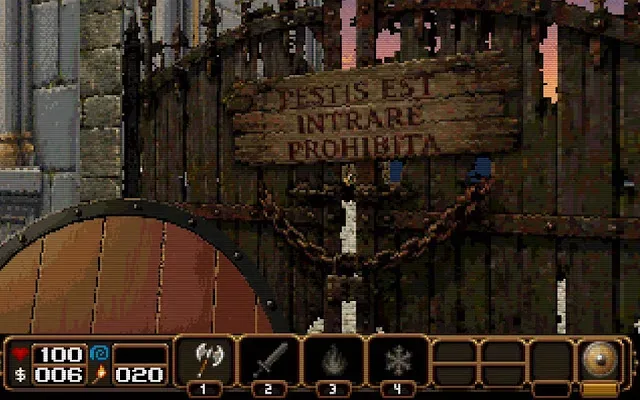
That distinction matters to the audience this campaign is trying to reach. The Amiga still has an active enthusiast scene, but creating a new game within the realities of its original hardware means deciding exactly what is essential: movement speed, responsive combat, readable environments, memory use and a presentation that remains viable across different configurations. Eldemar’s plans combine those constraints with a relatively ambitious first-person format, including hand-drawn stages, exploration, shops and an automap that players can unlock.
A fantasy journey built around exploration and reflexes
Eldemar’s design is described as blending two broad ideas: the open-ended exploration associated with The Legend of Zelda and the immediate, real-time pressure of Doom. That is a useful shorthand for the proposed structure, but it should not be read as a promise that Eldemar will replicate either game. The supplied details point instead to a first-person fantasy adventure where navigation and combat are both central.
The route begins in woodland around the village of Cerro, continues through burial mounds and old crypts, and eventually reaches the city of Nharuk. Those locations suggest a progression from outdoor exploration into tighter, more hazardous interiors. Crypts and burial mounds are particularly natural spaces for a first-person game: corridors can create tension, restrict sight lines and make an enemy encounter more immediate without requiring vast maps.
Players are expected to fight with swords, axes, bows and a magical gem weapon. Melee weapons imply close-range risk, while a bow introduces a ranged option; the gem weapon appears to give the fantasy arsenal a more distinctive magical component. No further systems details have been set out, so it is not yet clear how weapons will differ in practice, whether any will be limited by resources, or how character progression will work. What is known is that quick reactions are part of the intended experience.
The planned game comprises nine hand-drawn levels across three graphical environments. “Hand-drawn” speaks to the artwork and level presentation rather than procedural generation: these are designed spaces, not randomly assembled dungeons. Nine levels also gives the project a defined content target, which is useful in a crowdfunding context where the scope of an old-hardware game can otherwise become difficult to pin down.
What native AGA and 68k assembly mean here
AGA, short for Advanced Graphics Architecture, is the graphics chipset used by the later Amiga models named as Eldemar’s targets. The project’s emphasis on native AGA support means it is built around the characteristics of that platform, instead of treating the Amiga as a nominal destination for a game designed primarily around newer systems.
Related coverage includes Eldemar Brings a New First-Person Fantasy RPG to Amiga Hardware.
The 68k reference concerns the Motorola 68000-family processor architecture associated with these Amigas. Assembly language is a low-level way of programming that gives developers close control over a machine’s operations and memory use. That does not automatically make a game better, and it does not eliminate the challenge of finishing one. It does, however, explain why Eldemar is framed as a purpose-built Amiga production rather than a modern conversion.
For players, the practical result is compatibility intended for real systems. Eldemar is said to boot on an unexpanded Amiga 1200 with 2MB of chip RAM. Chip RAM is memory shared by the Amiga’s custom hardware, making it a key resource for visuals and other data the chipset needs to access. A base Amiga 1200 configuration is therefore not merely an afterthought in the stated plan; it is part of the baseline target.
At the same time, the project proposes optional visual improvements for more capable setups. Additional memory or an RTG graphics card is said to unlock higher-resolution sprites and more detailed textures. RTG, or retargetable graphics, refers to graphics-card support beyond the Amiga’s native display modes. This approach potentially offers two ways to play: a version that respects the baseline hardware, and a presentation with enhanced assets for owners who have expanded their systems.
There is an important caveat for prospective backers: the available information identifies the enhancements in broad terms, but does not establish their exact resolutions, their performance impact or which memory configurations will benefit. Anyone considering the project for a particular machine should treat the base Amiga 1200 compatibility as the concrete claim and wait for detailed requirements on the enhanced modes.
Maps, merchants and language support
Eldemar is planned to include an unlockable automap. In a first-person dungeon-focused game, an automap is an on-screen representation of explored space. Making it unlockable, rather than immediately available, means orientation may itself be part of the early-game challenge. The precise unlocking condition has not been detailed, but the system could give players a tangible navigation reward as they advance.
Interactive merchants are also part of the design. Shops can serve several purposes in an action RPG: they can make a settlement feel functional, give players an outlet for resources and create a deliberate pause between combat sequences. The campaign information does not specify what merchants will buy or sell, or whether their inventories change, so those mechanics remain unknown. Still, their inclusion indicates that the journey is not envisioned as a sequence of fights alone.
The game is also planned to have full translations in six languages. That is a notable accessibility and preservation consideration for a physical retro release. Text-heavy fantasy games can become much harder to approach when players cannot comfortably read their instructions, dialogue or item descriptions. The languages themselves have not been named, so it would be premature to assume which regions are covered.
Brimble’s role and the campaign’s stretch goals
Allister Brimble is handling the project’s audio. The campaign also identifies an entirely original musical score by Brimble as a stretch goal. That wording creates a distinction worth keeping clear: his involvement with audio is part of the project description, while a full original score is presented as contingent on the campaign reaching the relevant goal. It should not be treated as guaranteed until that milestone is achieved and confirmed.
Other proposed stretch goals include four bonus levels and full-motion video sequences. Stretch goals are additions tied to crowdfunding performance, not part of the confirmed core package. They can make a campaign more appealing, but they also expand the work still required. Eldemar’s established base plan is nine levels in three environments; the four extra levels belong to the conditional tier.
The team says its engine is already functional on authentic hardware and that the focus is now on completing the remaining content. That is encouraging context for a hardware-specific project, because it indicates the fundamental technology has progressed beyond a purely conceptual pitch. It is not, however, the same as a finished game. Artwork, levels, balancing, localisation, packaging and the campaign’s optional goals all remain consequential parts of delivery.
Physical editions are part of the pitch
Eldemar is planned as a physical release as well as a game. Backers are being offered a standard jewel-case edition and a limited Big Box edition. Both are described alongside a printed manual and a physical map scroll, underscoring the project’s aim to feel at home with the boxed software traditionally associated with the platform.
For potential supporters, those formats should be weighed separately from the game itself. The key decision is whether the intended first-person RPG and its target hardware fit their interests; box style, manual and map are additions to that experience. The campaign details provided do not establish quantities, pricing, shipping arrangements or an ultimate delivery date, so those practical questions should not be inferred from the existence of the editions.
There is a wider context for this kind of release: new work for legacy systems tends to depend on a careful balance between technical authenticity and modern production expectations. Eldemar is attempting that balance with base Amiga 1200 support, optional graphical upgrades, translated text and a boxed presentation. Another recent example of continuing Amiga development can be seen in an Amiga conversion update that addressed joystick controls and combat tweaks, though the two projects have different goals and designs.
For now, Eldemar’s clearest promise is a deliberately native fantasy action RPG for AGA-era Amiga machines: nine designed levels, a journey from Cerro’s woods to Nharuk, real-time weapons, merchant interactions and an automap system. The potential bonus levels, FMV and complete original score remain campaign-dependent additions. That separation between the established game plan and the stretch-goal ambition is the most useful lens through which to view the Kickstarter.