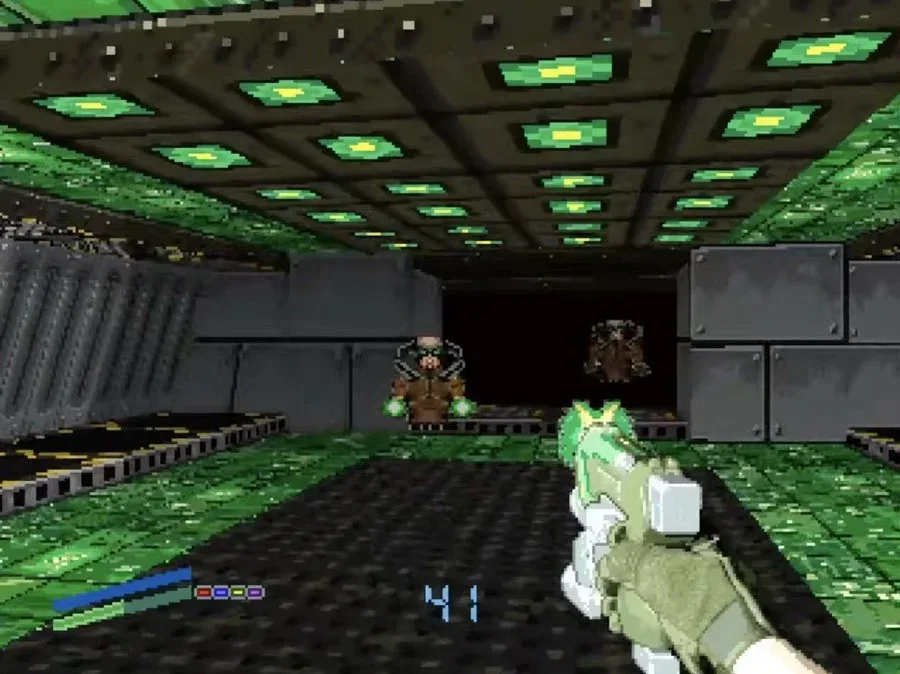
The 3DO is preparing to receive a distinctly unexpected visitor: Terminus, a new first-person shooter from Retro Love Letter that sends a space pirate into a monster-infested spacecraft. The project is currently in testing, and its developer intends to produce a physical release in the future.
For a machine commonly filed under “interesting detour” in console history, a fresh shooter designed around its original hardware is a wonderfully specific kind of rebellion. Terminus is not merely using retro imagery on current platforms. It is being developed for the 3DO family itself, with NTSC and PAL support planned, a custom-built engine, digitised assets, and a design that aims to make the journey through its doomed starship feel continuous rather than chopped into isolated stages.
Retro Love Letter’s setup has the clean, efficient menace of a classic genre opener. The player controls a space pirate who intercepts a distress beacon from a nearby vessel. Seeing the possibility of an easy score, the pirate investigates. Naturally, this is not a quick in-and-out salvage job. The crew has become monsters, and the ship is now a very poor place to be standing still.
The premise places Terminus in the long shadow of 1990s first-person shooters, with its visual and mechanical touchstones including DOOM and Duke Nukem 3D. There is also a more platform-specific influence: Retro Love Letter has cited the 3DO horror shooter Killing Time as part of the inspiration behind the game’s technology and approach. That combination makes sense for a project built for a console whose library has always attracted players willing to dig beyond the era’s biggest commercial winners.
A modern game for a famously unusual machine
The 3DO’s original concept was unusual even before its games arrived. Rather than being sold as one standardized console from one traditional platform holder, the 3DO format was licensed to manufacturers that could produce and market their own hardware. The strategy was closely associated with Trip Hawkins, founder of Electronic Arts and chief executive of The 3DO Company.
That idea gave the system an identity unlike the simpler brand-to-box relationships represented by its rivals. It was heavily promoted during the early 1990s and garnered substantial attention before its commercial momentum faded amid fierce competition. Sony, Sega and Nintendo ultimately dominated the wider contest for players’ living rooms, while the 3DO became a smaller historical chapter rather than the next universal entertainment format.
Its afterlife has been much more interesting than a simple footnote, however. Collectors have kept the hardware in circulation, while developers continue to create homebrew software, demonstrations and games that explore what the platform can still do. Terminus joins that ongoing effort, and it does so with ambitions that go well beyond a tiny technical showcase.
The developer says the game is constructed around 3D quad-based polygons and digitised artwork. Its engine uses a sector-based structure comparable in broad terms to the approach associated with DOOM. One key target is the absence of perceived loading between areas: players should be able to move across multiple ship maps without an obvious level-transition interruption. For a claustrophobic horror setting, that matters. A seamless route through corridors and compartments can make the spacecraft feel like one connected, hostile location instead of a collection of separate missions.
Handmade art, physical models and a custom engine
Terminus is being built with an explicitly hands-on production method. Retro Love Letter says its engine was programmed from scratch without AI. The project’s textures were made by a pixel artist, while weapons and other game objects were digitised from custom 3D-printed models and screen captures generated through 3D-modelling software.
That workflow is especially fitting for an early-3D console project. Digitised visuals were a familiar part of the technological vocabulary around games of the period, but Terminus is not simply attempting to imitate a 1990s game from a distance. The developer is adapting physical models and digital captures to fit a machine with its own constraints, then combining them with polygonal spaces and a new engine intended to run on real hardware.
Retro Love Letter reports that Terminus reaches approximately 30 frames per second for most gameplay on original hardware. That is a performance claim rather than an independent measurement, and the project remains in testing, so the final result could change before release. Still, the stated target highlights an important distinction: this is designed as a functional 3DO game, not a video demonstration dressed in the aesthetics of one.
PAL compatibility is also planned, although PAL testing has so far been conducted through emulation. NTSC and PAL territories historically brought different timing and display considerations, so it is useful that the developer has identified the status of both versions rather than presenting compatibility as a completed certainty.
A Silent Hill connection in the voice cast
Terminus has another major genre connection in its cast. Thessaly Lerner, known to many horror-game fans as the voice of Lisa Garland in the original Silent Hill, is set to contribute voice talent to the project. Lisa remains one of the most memorable characters from Konami’s landmark psychological-horror game, making Lerner’s participation an especially notable fit for a story about a seemingly routine job that becomes an encounter with transformed crewmates.
Musician Ed Wilson is creating the soundtrack. The game also uses 3DO development tools from trapexit. Together, those details suggest a production that is not treating the platform as a novelty accessory. Terminus is assembling voice work, music, art pipelines and bespoke programming around the particular demands of an older console.
There are still sensible reasons to keep expectations tied to what has been confirmed. No release date has been announced, no price has been provided, and the physical edition remains a future plan rather than a product with confirmed ordering details. The available information does not establish a final list of supported hardware models, the full scope of the campaign, or whether further distribution options will accompany the planned physical version.
For collectors hoping to play it on an original setup, the usual practical questions will matter once the release gets closer: which 3DO hardware variant is being used, how the game behaves on a given display setup, and whether a modern television connection introduces issues of its own. Those preparing any vintage system for new software can start with this checklist for mapping a retro console’s connections before buying an HDMI adapter.
Why Terminus stands out
New retro releases can take many forms. Some are compact arcade-style projects. Others are experimental demos designed to reveal an overlooked graphical trick. Terminus appears to be aiming for something more expansive: a narrative setup, a traversable setting made of several connected maps, professional voice involvement, an original soundtrack, and technical work tailored to a platform that has never lacked for quirks.
The 3DO’s reputation tends to be built around contradiction. It was promoted as a major step forward, but it did not secure the long-term place its early marketing promised. It has a library remembered as much for curiosities as classics, yet it remains compelling enough to sustain collectors and a development community decades later. A new science-fiction horror shooter is therefore an appropriate addition to its story. It is ambitious, a little improbable, and difficult to discuss without wanting to see how far it can push the hardware.
For now, Terminus is a project to watch rather than a finished release to judge. What is known is appealing: a space-pirate rescue-or-looting mission gone wrong, monster-filled ship interiors, an engine developed from the ground up, digitised assets built from physical and rendered materials, and Thessaly Lerner’s involvement. If Retro Love Letter can carry those pieces through testing and into its planned physical edition, 3DO owners may soon have a new reason to dust off a console that refuses to stay quietly in the past.