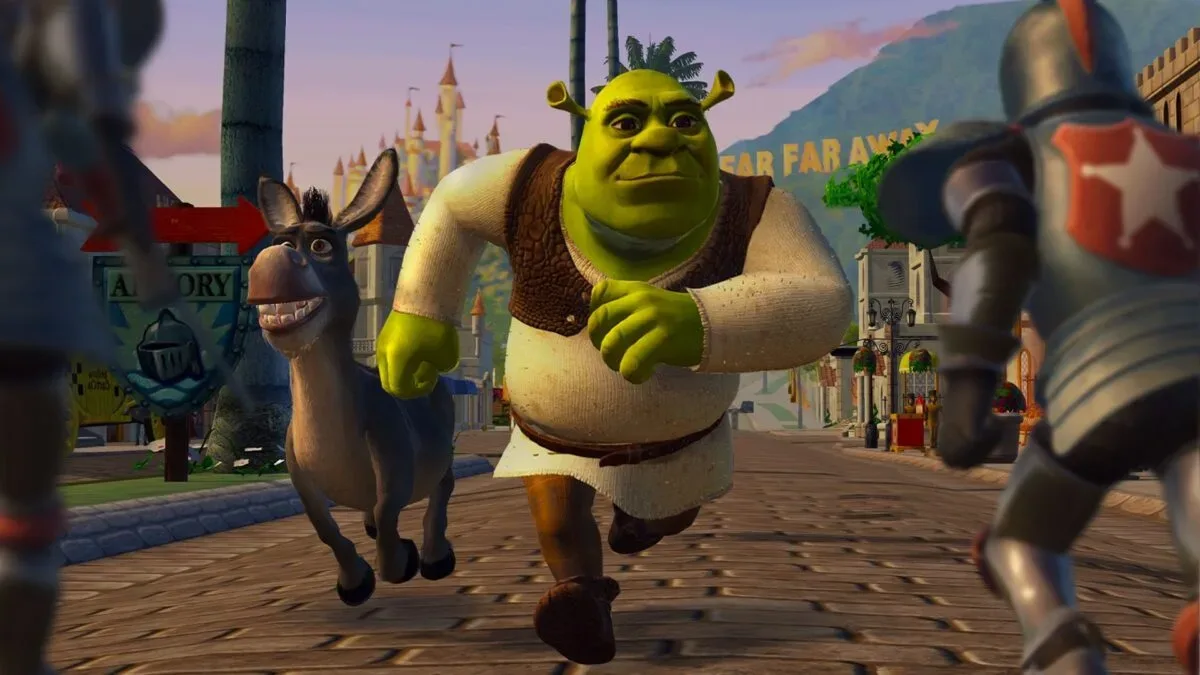
Shrek 2: Remastered appears to be on the way, with an early Xbox store listing providing the clearest look yet at a modern return for the 2004 platformer. The listing surfaced ahead of a formal announcement and was accompanied by screenshots, a pre-order trailer, and feature details. It follows an earlier appearance of the game in a Steam and Exophase achievement-data leak.
The revealed version is described as a remaster rather than a ground-up remake. Its stated upgrades include better textures, an enhanced user interface, and 4K resolution, while its biggest functional additions are Photo Mode, Cheat Mode, and support for both local and online co-op. The listing does not provide a release date, and it does not settle every question about platforms or the exact scope of the work. Still, the presence of store art, screenshots, trailer material, and pre-order messaging strongly suggests that an official reveal may be close.
A 2004 co-op platformer gets a modern pass
The original Shrek 2 game primarily adapts the 2004 film, while also including material beyond the movie to expand its game-length adventure. Its four-player cooperative structure is a central part of the project’s identity, and that structure is clearly being preserved in the remaster.
That matters more than a standard visual upgrade. Many older licensed games are remembered as solo nostalgia objects: something people rented, borrowed, or played through once. A game built around multiple players has a different opportunity in a re-release. It can serve both people revisiting a familiar movie tie-in with longtime friends and families introducing it to new players around the same screen.
The newly listed online co-op support expands that possibility beyond a single household. Local co-op means players share one physical space and setup; online co-op means participants can join from separate locations through an internet connection. The difference is practical rather than cosmetic. A group that once needed to gather around one console may now be able to coordinate a session despite distance.
Online play also makes the remaster more than a preservation release. Preserving an older game’s characters, levels, and basic design is one goal. Making its multiplayer premise easier to use in contemporary circumstances is another. If the final release delivers online co-op as described, that feature may be among its most consequential upgrades—not because it changes the original premise, but because it lets that premise work for the way people now arrange multiplayer sessions.
What the announced upgrades actually mean
“Remaster” can cover a wide range of projects, so it is worth separating the confirmed items from assumptions. The listing identifies improved textures, an enhanced UI, and 4K resolution. It also identifies Photo Mode and Cheat Mode. Those are concrete feature claims; they do not, on their own, establish that levels, controls, combat, camera behavior, or underlying game systems have been redesigned.
Better textures and 4K resolution
Textures are image surfaces applied to objects and environments. They help define the appearance of clothing, stone, wood, grass, faces, props, and other visual elements. Better textures generally point to sharper or cleaner visual detail, especially when viewed at higher display resolutions.
4K resolution refers to a much larger image output than older standard-definition presentations. In simple terms, it gives a game more pixels with which to present its image. That can make the visual presentation appear clearer on compatible displays, but resolution alone does not describe every aspect of a remaster’s graphics. Lighting, animation, models, effects, frame rate, and art changes are separate considerations, and none of those should be assumed here without further details.
For a game associated with an early-2000s film aesthetic, visual cleanup can be especially noticeable. The familiar character designs and fairy-tale locations have to withstand larger screens and more demanding displays than the game originally faced. The currently listed upgrades indicate an effort to improve legibility and presentation, but the trailer and screenshots—not broad promises about an all-new game—are the appropriate basis for judging the work until additional information arrives.
An enhanced UI
UI is short for user interface: the menus, prompts, meters, icons, selection screens, and other information a player uses to navigate a game. An enhanced UI may sound modest compared with 4K output, yet it can have an outsized effect on day-to-day usability. Players spend time with menus when setting up multiplayer, changing options, tracking objectives, or interacting with inventory-like systems and game prompts.
The listing does not specify precisely how the interface has changed. That leaves open questions about menu layouts, readability, accessibility options, and whether the interface has been adjusted specifically for the remaster’s new online component. For now, the safe takeaway is limited but useful: the presentation layer between player and game is receiving attention alongside the graphical refresh.
Photo Mode and Cheat Mode
Photo Mode is a feature that generally allows players to frame and capture in-game images. Its inclusion makes sense for a remaster that is explicitly highlighting improved visuals. It offers a way to pause the action and focus on character scenes, environments, or multiplayer moments without treating a standard screenshot as the only option.
Cheat Mode, as the listing describes it, allows players to modify the game. The exact modifications are not detailed, so it would be premature to promise specific effects, unlocks, settings, or gameplay rules. Even so, its presence signals a more playful, player-directed layer than a straightforward visual cleanup. Depending on its final implementation, this could be useful for returning players who want to revisit portions of the game differently, as well as groups looking to make repeat sessions less rigid.
Neither feature needs to alter the main story to be worthwhile. Photo Mode supports sharing and personal keepsakes; Cheat Mode can encourage experimentation. In a title remembered partly for cooperative play, both have the potential to make the remaster feel less like a one-and-done trip through a licensed adventure and more like a social game players can revisit.
Why the timing makes sense, even without a stated reason
No official rationale has been attached to the listing, but the timing naturally invites attention because Shrek 5 is expected next year. A return for a game based primarily on Shrek 2 gives the wider franchise a game presence while interest in the characters is likely to rise again.
That does not make the remaster merely a promotional artifact. The early information points to a release that keeps the original game’s co-op foundation while bringing it to modern consoles with contemporary conveniences. The combination is logical: recognizable characters, an existing film connection, and multiplayer that can work both locally and online.
It also fits within a broader appetite for older games that can be made easier to revisit without being rebuilt into something unrecognizable. Hardware reissues and modernized access to older games remain part of the gaming conversation; for example, the recent focus on new ways to use classic 16-bit cartridges shows how convenience features can shape retro-minded products. Shrek 2: Remastered approaches that same broad impulse from the software side: preserve a known game, improve the way it presents and connects players, and make it viable on current hardware.
What remains unconfirmed
The leaked listing is informative, but it is not a replacement for a full announcement. Most importantly, there is no release date in the materials described so far. A pre-order trailer indicates commercial plans are advancing, but it does not establish when players will be able to buy or play the game.
There are other gaps as well. The available description confirms local and online co-op, but does not explain technical details such as how online sessions are organized, whether every original mode is included, or what player-management options will be available. It cites 4K resolution and upgraded textures, but does not provide a complete accounting of visual or performance enhancements. Cheat Mode is confirmed in name, though its exact menu of options remains unknown.
Those distinctions are important because a remaster is best judged by specifics. “Modernized” can mean anything from an interface and resolution update to extensive mechanical changes. Right now, the evidence supports a more focused picture: the 2004 co-op platformer is being revived with visual enhancements, a refreshed interface, picture-taking and game-modifying modes, plus both couch and internet-enabled multiplayer.
The key detail is the four-player foundation
The trailer and store-page material make it clear that the remaster is not discarding the original game’s group-oriented identity. That is likely the most compelling part of the package. Better textures and 4K support can make an old licensed game look more at home on a new television, while the UI updates can make it easier to navigate. But cooperative play is what turns the release into a possible shared event.
For returning players, that could mean reconnecting with friends or siblings who remember the original. For newer players, it offers a way to encounter an older platformer as a group rather than as a historical curiosity. And for households already looking ahead to the next film, local co-op provides a particularly direct path into the game’s cartoon-fantasy world.
Until a formal announcement fills in the missing release and platform details, Shrek 2: Remastered should be treated as an imminent but still incomplete picture. The early listing has, however, established the essentials: the game is real enough to have screenshots, a trailer, and a feature list; it is being handled by Aspyr; and it is planning to bring a four-player 2004 adaptation back with modern visual presentation and online play.