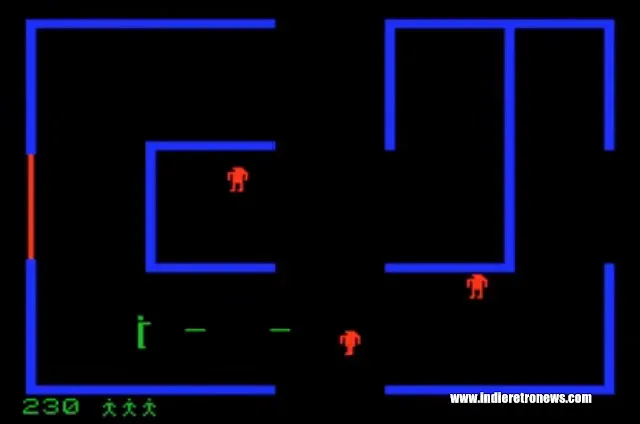
Berzerk, the arcade maze shooter originally released by Stern Electronics in 1980, has returned as the second entry in the MSXDev26 competition. Developed by Pixel Forge, the new MSX version keeps the premise sharply focused: guide a lone humanoid through a chain of hostile rooms, shoot the robots closing in, locate an exit and try to keep a score climbing for as long as possible.
That description sounds simple because it is simple. The tension comes from how little room the design leaves for comfort. Each room is both a battlefield and a route onward. Robots create immediate danger, exits offer relief, and the choice to stay for more points can become a bad one very quickly. Pixel Forge’s take is described as notably faster than an earlier Aackosoft version from the 1980s, with PSG sound samples accompanying the action.
Most importantly, the familiar threat of Evil Otto remains central to the game’s rhythm. The invincible, smiling pursuer appears when a player spends too long in a room. He changes the objective from aggressive score-chasing to immediate escape. There is no victory in clearing a screen if the delay turns the route out into a trap.
A classic arcade structure built around leaving
Berzerk’s enduring trick is that shooting enemies is not the sole measure of success. In many shooters, removing every opponent is the natural endpoint of an encounter. Here, surviving and finding the next doorway matter just as much. A player may be capable of eliminating the robots currently on screen, but that does not guarantee it is the wise move.
For more context, explore Paramount-Warner Settlement Wins Guild Support, but Consolidation Critics Remain Unmoved.
The rooms are interconnected, so movement between them is part of the challenge rather than a transition between set pieces. An exit is a strategic resource: it creates an escape route, but it also asks the player to recognize when to take it. This gives the game a strong push-your-luck quality. More time in a room can mean more robot kills and a bigger score; it can also invite the exact enemy that cannot be defeated.
That is why Evil Otto is more than an extra enemy. He is a pressure system. Invincible means the normal solution—shooting the threat—is unavailable. The player must instead alter position, prioritize a path out, and make decisions under mounting urgency. The grin matters because it makes the pursuer instantly recognizable, but the mechanical point is harsher: Otto punishes hesitation.
What the new MSX entry changes
Pixel Forge’s version is positioned as a modern take on the arcade formula rather than a quiet archival recreation. The reported increase in speed is meaningful for this kind of design. A faster game reduces the time available to line up shots, assess robot movement and commit to an exit. Since Berzerk already turns rooms into compact survival puzzles, added pace can make every decision feel less theoretical and more immediate.
Related coverage includes Pixel Forge’s Berzerk Brings Arcade Pressure to MSXdev26.
The other highlighted change is audio. The port uses crisp PSG sound samples. PSG, short for programmable sound generator, refers to the sound hardware approach associated with producing electronic game audio. In practical terms, the claim is not that sound rewrites Berzerk’s rule set; it is that the new version gives its arcade panic a more pronounced sonic presence. For a game driven by rapidly escalating danger, clear audio can help sell the tempo and make each moment of pursuit feel more urgent.
The comparison point is Aackosoft’s older MSX adaptation. That earlier effort remains part of the machine’s history with the game, but Pixel Forge’s entry is characterized as substantially quicker and more intense. The distinction matters for players who know the old release: this is not merely Berzerk appearing again on MSX, but a version intended to sharpen the sensation of being pursued through those robot-filled rooms.
Why the original loop still works
There is an appealing clarity to Berzerk’s rules. The player is under attack. Robots need to be shot or avoided. A doorway offers a way forward. Staying too long brings an unstoppable consequence. The game does not need a complicated objective list to generate suspense because its systems collide naturally.
Score is the temptation. Survival is the requirement. Escape is the answer.
Those competing priorities create the kind of arcade drama that can emerge in seconds. Entering a room may initially look manageable, only for advancing robots to narrow the safe space. The player who sees a chance to accumulate points has to weigh that opportunity against the possibility that the room is about to become untenable. Once Otto arrives, that calculation is over: the only sensible priority is getting out.
Pixel Forge’s faster approach should amplify that relationship. Greater speed does not inherently mean greater difficulty in every game, but it does raise the cost of indecision in a maze shooter. The more quickly enemies advance and the more frantic the action feels, the less practical it becomes to treat each room as a slow cleanup exercise. Players are pushed toward reading routes and reacting decisively.
Practical expectations for players
The most useful mindset for Berzerk is not “defeat everything,” but “keep a safe way through.” The new entry’s stated emphasis on relentless rooms and a more nervous pace suggests that survival habits should matter more than stubbornly maximizing kills.
- Look for the exit early. Knowing where the next room is helps prevent a last-second scramble if the current room turns hostile.
- Treat robot kills as a means, not the mission. Shooting creates space and adds points, but it should not automatically delay an escape.
- Do not plan around defeating Evil Otto. His invincibility is the entire point of the threat; when he appears, movement and exit selection matter more than firepower.
- Respect the pace. A faster version leaves less room for hesitant adjustments. Commit to a route when a safe opening appears.
These are not secret tactics or new rules claimed for the port. They follow directly from the game’s premise: hostile robot rooms, interconnecting exits and an invulnerable pursuer that arrives when players linger. Berzerk’s challenge is built to make a greedy decision feel attractive just before it becomes dangerous.
MSXDev26 gets a high-pressure arcade entry
As the second game in MSXDev26, Pixel Forge’s Berzerk brings an unmistakably arcade-minded entry to the competition. Its appeal is not rooted in an elaborate reinvention of the 1980 original’s objective. The hook is the opposite: a direct, unforgiving chase for survival, pushed harder through faster action and refreshed sound.
For retro players, the project also highlights how ports can revisit a familiar game without changing its identity. The humanoid is still isolated in a maze. The robots are still a constant problem. The score still invites risk. Evil Otto is still the dreadful deadline that makes any room feel temporary. What changes is the presentation of that pressure on MSX, and the claim that this version is far more frantic than the machine’s older Aackosoft adaptation.
Further details on the competition entry are available in this MSXDev26 Berzerk report. For now, the core promise is admirably uncomplicated: enter the maze, blast robots, make the exit, and do not give Evil Otto enough time to turn a score run into a panic run.