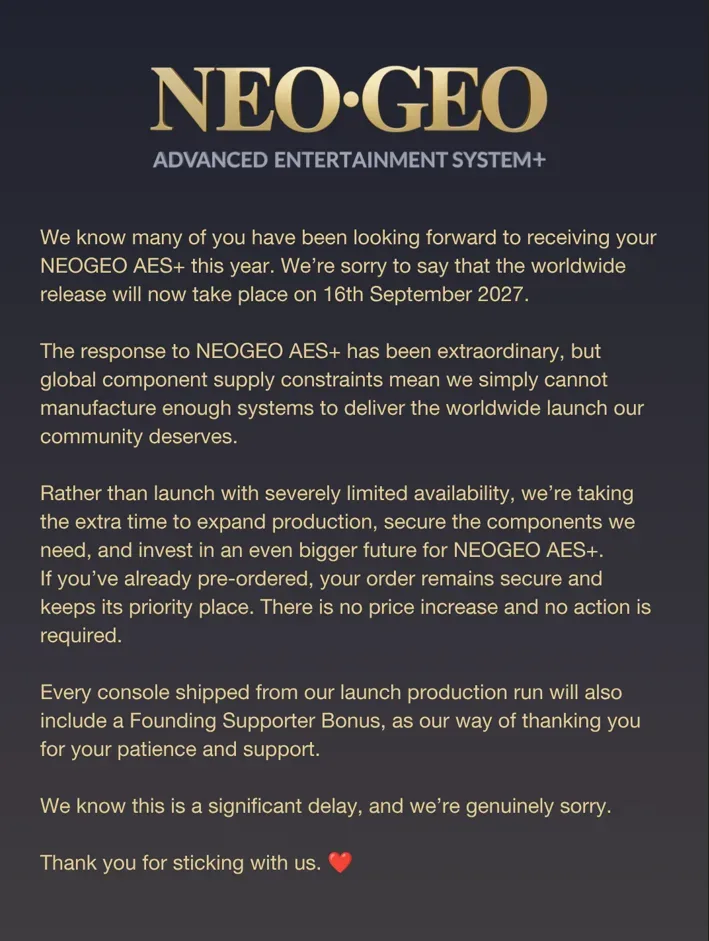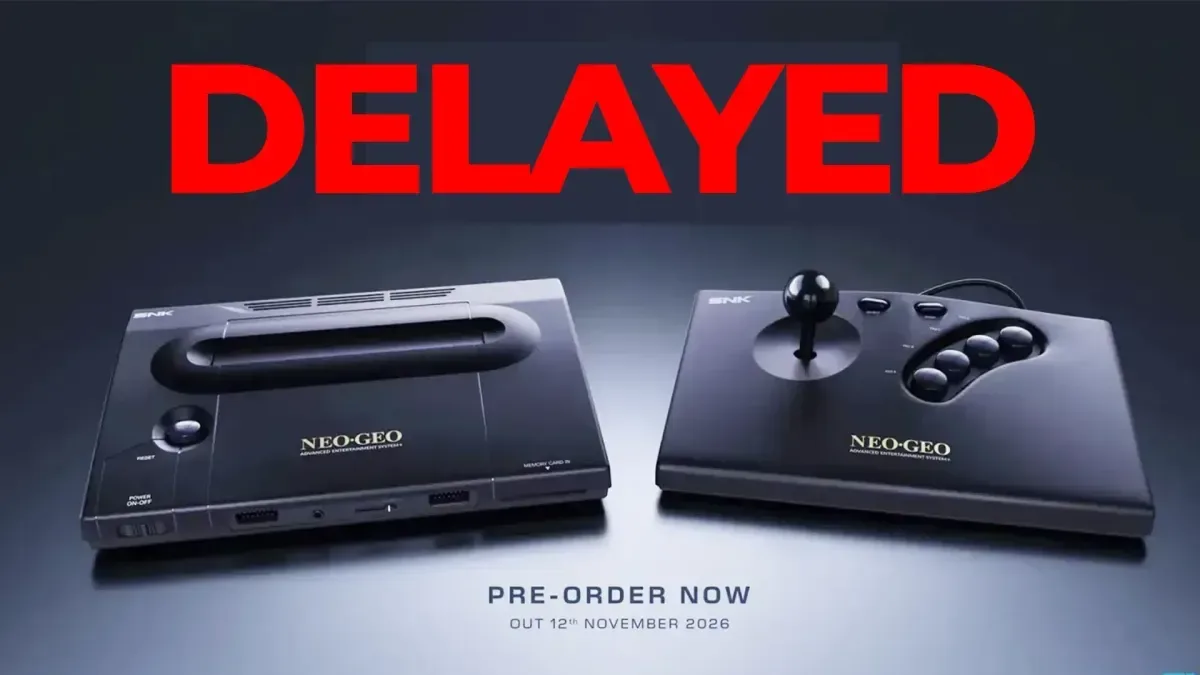
The NEOGEO AES+ will now launch on September 16, 2027, moving the console back by a full year from its prior timetable. It is an unusually long wait for a system that has already been publicly displayed at events, including plans for a Tokyo Games Show appearance later this year. Still, the revised plan is not presented as a quiet retreat: NEOGEO and Plaion say the change follows a level of response that outstripped their original expectations.
For collectors who secured an order early, the immediate practical details are straightforward. Pre-orders will stay open, and people with existing orders are expected to retain their place in the shipping queue. That matters when a launch shifts from a limited initial run toward a broader worldwide manufacturing plan. A buyer who took the early leap should not, in theory, be pushed behind a new wave of orders simply because the calendar changed.
A one-year delay with a production explanation
The stated reason for the delay is demand. Plans are being expanded to increase manufacturing capacity and obtain the components needed for a larger global release. That is a more encouraging explanation than a product cancellation or an unspecified technical problem, but it does not make twelve additional months feel brief for the people who have already committed to a console.
Retro hardware occupies a peculiar space: it is both a gaming device and an object people expect to display, preserve, and discuss for years. A release tied to the NEOGEO name naturally attracts enthusiasts who care about the shape of the hardware, the controller feel, the game library, edition differences, and whether the physical product arrives with the polish its heritage suggests. Demand above projections is an enviable problem, but scaling a niche, premium-leaning hardware launch can be complicated.
Component planning is especially important because every additional unit is not merely another box. It requires consistent parts, assembly capacity, testing, packaging, logistics, and enough supporting stock to make a worldwide debut function as more than a sequence of tiny restocks. A company can either ship an undersized first batch and spend months managing shortages, or pause, build a more substantial plan, and ask its earliest customers for patience. NEOGEO and Plaion have chosen the latter route.
What current pre-order holders should know
Existing customers have two confirmed reassurances: their orders remain in place, and their shipping priority is meant to carry over. The latter point is essential, because a prolonged delay can create understandable concern that later buyers may receive consoles first once production grows. Preserving the original order queue acknowledges the value of early support.
There is also a new benefit for everyone receiving a console from the launch production run, described as a Founding Supporter Bonus. The reward depends on the edition ordered:
- Standard Edition: a free NEOGEO AES+ Gamepad.
- Anniversary Edition: a free NEOGEO AES+ Gamepad.
- Ultimate Edition: a voucher for 30% off a future NEOGEO AES+ game.
The distinction is worth noting. Standard and Anniversary buyers receive an additional physical controller, while Ultimate Edition owners are being offered a discount to use on a later game purchase. Neither changes the newly announced launch date, but the bonuses are clearly intended to recognize buyers who remain attached to the first production wave through the expanded wait.
Related coverage includes NEOGEO AES+ Delayed to September 2027 as Launch Plans Expand.
An extra gamepad has an obvious appeal for a platform rooted in social, competitive, arcade-style play. A future-game discount gives Ultimate Edition owners flexibility, although its ultimate value depends on which games become available and what a particular buyer had planned to purchase. In both cases, the offer applies specifically to consoles in the launch production run, making that original queue position more meaningful than just a timestamp on an order confirmation.
Why a longer runway could matter for collectors
A delay is frustrating by definition, particularly when it reaches a year. Yet the updated manufacturing window could have a meaningful upside if it helps the project avoid the familiar frustrations of boutique hardware releases: inconsistent availability, staggered regional fulfillment, thin controller stock, or a situation where the system exists but the ecosystem around it struggles to keep pace.
For collectors, completeness is often part of the appeal. That means the console itself, the packaging, controllers, future games, edition-specific material, and a sensible plan for keeping everything in good condition. The longer wait may give prospective owners extra time to decide how the AES+ fits into a collection rather than treating it as a fleeting launch-day impulse. Those preparing a dedicated display or shelf should also consider practical basics such as ventilation, cable access, and avoiding cramped stacks of boxed hardware. Our guide on giving retro consoles room to breathe with safe shelf placement covers principles that apply well beyond PS2, GameCube, and Wii collections.
There is a balance to strike, though. Preserving a sealed box may be important to some owners, but electronics still deserve stable storage conditions. Keep systems away from sustained heat, moisture, direct sunlight, and overly tight shelving. If the AES+ becomes a centerpiece item, it should be treated like the hardware it is, not simply like a decorative collectible. The physical presentation may draw people in, but long-term enjoyment depends on a system being stored and used responsibly.
The early signs were uneven
Before the formal confirmation, some customers in Japan had reportedly received emails in July indicating that the product was moving into the following year. The message did not appear to reach every customer, which created uncertainty around whether the delay was real or whether the communication had been sent inconsistently. The newly confirmed September 16, 2027 date resolves the central question: the schedule has indeed changed.
That earlier confusion is a reminder that major hardware changes need clear, universal communication. With pre-orders involved, buyers need a firm date, a clear explanation of whether their order remains valid, an understanding of queue treatment, and exact details on compensation or bonuses. The current update covers those essential areas more directly: the launch is delayed, demand and supply expansion are the cited drivers, orders remain active, early queue positions are protected, and launch-run incentives have been defined by edition.
A bigger launch can be worth waiting for—if the plan holds
The new date places the NEOGEO AES+ release a long way off, and there is no avoiding the scale of that wait. A year is plenty of time for anticipation to turn into skepticism, especially for anyone whose money has already been tied to a pre-order. The Founding Supporter Bonus softens that frustration, but it does not erase it. Buyers will understandably watch for steady updates as the expanded manufacturing plan takes shape.
At the same time, the reason given for the shift points to genuine enthusiasm for the product. A launch that exceeded forecasts can be a signal that the audience for dedicated retro hardware remains highly engaged. The challenge now is converting that interest into a reliable rollout that treats early supporters fairly and ensures the extra production capacity actually translates into a stronger worldwide launch.
For now, the headline details are settled: NEOGEO AES+ pre-orders remain open, existing buyers hold their queue priority, launch-run systems carry new edition-based bonuses, and the target release date is September 16, 2027. The next year will determine whether the extended timetable becomes a painful detour or the foundation for the more complete launch that the increased demand appears to require.