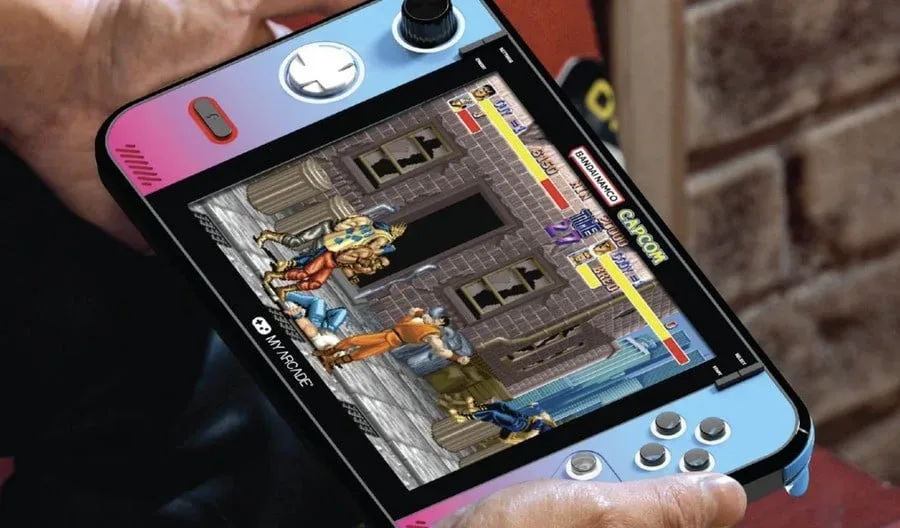
The Gamestation Retro Go has finally moved out of the retro-hardware waiting room. My Arcade has confirmed an October launch window for its large-format portable, a system built around officially licensed Capcom and Bandai Namco games. A GameStop product listing narrows that window further, naming October 31 as the release date and placing the handheld at $199.
That date and price come from the retailer listing rather than a separately detailed full product rollout, so prospective buyers should treat October 31 as the most specific currently listed target. The broader point is clearer: the Retro Go, originally expected during 2025, has been delayed into 2026 and is now approaching release.
For people who grew up choosing between a frantic round of Galaga, an ill-advised attempt at Street Fighter II, and one more go at Pac-Man, the appeal is easy to understand. The more intriguing aspect is not just that My Arcade is putting old games in a portable plastic rectangle—an industry that has perhaps made a few of those—but that it is combining catalogues associated with both Capcom and Bandai Namco in one officially licensed machine.
A handheld assembled from arcade royalty
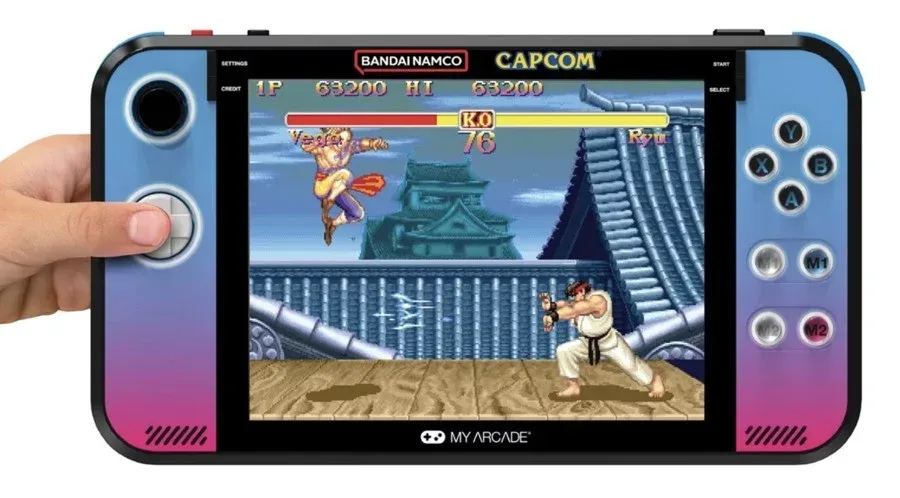
My Arcade announced the Gamestation Retro range at CES in January 2025. The Retro Go is its handheld entry: a Switch-shaped portable with an 8-inch high-resolution display and a built-in rechargeable battery. It is said to include more than 100 classic arcade and home-console games.
The disclosed game selection includes names that need no dramatic orchestral reveal:
- Pac-Man
- Galaga
- Pole Position
- Dig Dug
- Street Fighter II
- Mega Man
- Final Fight
- 1942
That is a wide-ranging group before the full 100-plus-game library is even considered. It spans the maze-chase fundamentals of Namco’s arcade history, driving and fixed-shooter staples, and Capcom’s fighting, platforming, scrolling-brawler, and vertical-shooter pedigree. In collector terms, it is less like buying a device devoted to one shelf of history and more like cramming several very loud arcade corners into a single travel bag.
The fact that these publishers sit together matters. Licensed retro devices often divide their software by rights holder, resulting in separate models aimed at separate fandoms. That approach makes commercial sense, but it can turn collecting into a decision between the publisher whose games a buyer wants most. The Retro Go’s stated library instead aims to let Capcom and Bandai Namco coexist on one device.
It is not the first time multiple publishers have appeared on one preloaded retro product. Retro-Bit’s Generations micro-console, released in 2016, included games tied to Capcom, Irem, Jaleco, and Data East. Still, a portable that brings together these particular Capcom and Bandai Namco lineups has a distinct appeal, especially for arcade-focused players who do not want to swap hardware simply to change publisher eras.
Related coverage includes My Arcade's Gamestation Retro Go Targets October Launch, With $199 Listing.
The shape, the screen, and revised controls
The Gamestation Retro Go closely resembles My Arcade’s Atari Gamestation Go in overall concept, but it uses a different control arrangement. The Retro Go’s button layout has also changed somewhat since its first public appearance. That revision is worth noting, even if the exact implications will depend on the final hardware.
Controls are not a trivial footnote on a portable designed around arcade classics. A traditional gamepad is asked to cover a lot of genres here: directional precision for maze games, rapid input for shooters, clean combinations for fighting games, and comfortable repeated presses for brawlers and platformers. An 8-inch screen suggests a device intended to make those older games feel less cramped than they can on smaller handhelds, while the rechargeable battery means the Retro Go is designed to be used away from a television and power outlet.
There is, however, a meaningful distinction between a promising feature list and a proven final device. The available details establish the screen size, rechargeable battery, licensed software approach, and altered controls, but they do not settle every practical question a careful buyer might ask. That includes the final complete game list, battery endurance, display specifications beyond the high-resolution description, and how the finished controls will feel across different genres. The October launch should bring more clarity, but those details have not been established here.
Anyone assembling a wider retro setup should also remember that handheld convenience and television play solve different problems. For legacy consoles being brought back to a modern screen, our guide to mapping a retro console’s connection before buying an HDMI adapter is a useful reminder that “retro gaming” can involve more cables, standards, and surprises than a neat handheld avoids.
The Retro Go is one part of a three-device plan
My Arcade’s wider Gamestation Retro initiative includes two other machines: the Gamestation Retro Pro and the Gamestation Retro Mega. Both were announced alongside the portable and remain on the way, though the October update specifically establishes timing for the Retro Go.
The Retro Pro is described as a premium retro console with 1080p output and wireless controllers. It is the living-room-oriented sibling in the lineup, intended for players who want the licensed Capcom and Bandai Namco material on a television rather than an eight-inch portable panel.
The Retro Mega takes an even more physical route. It is a tabletop arcade cabinet with classic wood construction, a 10.1-inch display, a mechanical joystick, and action buttons. If the Retro Go is the option for someone who wants Mega Man or Dig Dug in their hands, the Mega is positioned as the version for someone who wants a small dedicated cabinet occupying a very intentional patch of furniture.
These three formats show a sensible understanding of retro audiences. Some want compact portability. Some want HDMI output and wireless pads. Some want a joystick and a cabinet-like ritual, even if the cabinet itself is tabletop scale. The shared software identity is what ties them together: more than 100 games drawn from two major publishing legacies, delivered in hardware formats meant for different rooms and habits.
From a 2025 plan to an October target
When the range was first revealed in 2025, it was expected in the third quarter of that year. The Retro Go did not arrive on that schedule. It was subsequently identified as a 2026 release, and the latest update now puts it in October. The GameStop listing’s October 31 date and $199 price provide the clearest retailer-specific details presently attached to the handheld.
Delays are frustrating, particularly with nostalgia hardware where the announcement itself can make a familiar game library feel newly tangible. But the extended timeline also distinguishes the confirmed October plan from the earlier 2025 expectation. Buyers following the Retro Go should use the new window, rather than the old third-quarter 2025 projection, as the relevant benchmark.
At $199, the Gamestation Retro Go is not being framed as a throwaway mini novelty. Its case will rest on the final execution: the breadth of its complete game selection, the quality of its screen and controls, and the value of having Capcom and Bandai Namco titles officially gathered together. What is established now is the core proposition and its target: an 8-inch rechargeable handheld with more than 100 preloaded classics, heading for October, with an October 31 retailer listing at $199.
For now, that leaves the device in a much better state than vague future-tense limbo. The Retro Go has a month, a listed day, a listed price, and an unusually strong roster of arcade heritage waiting behind its buttons.