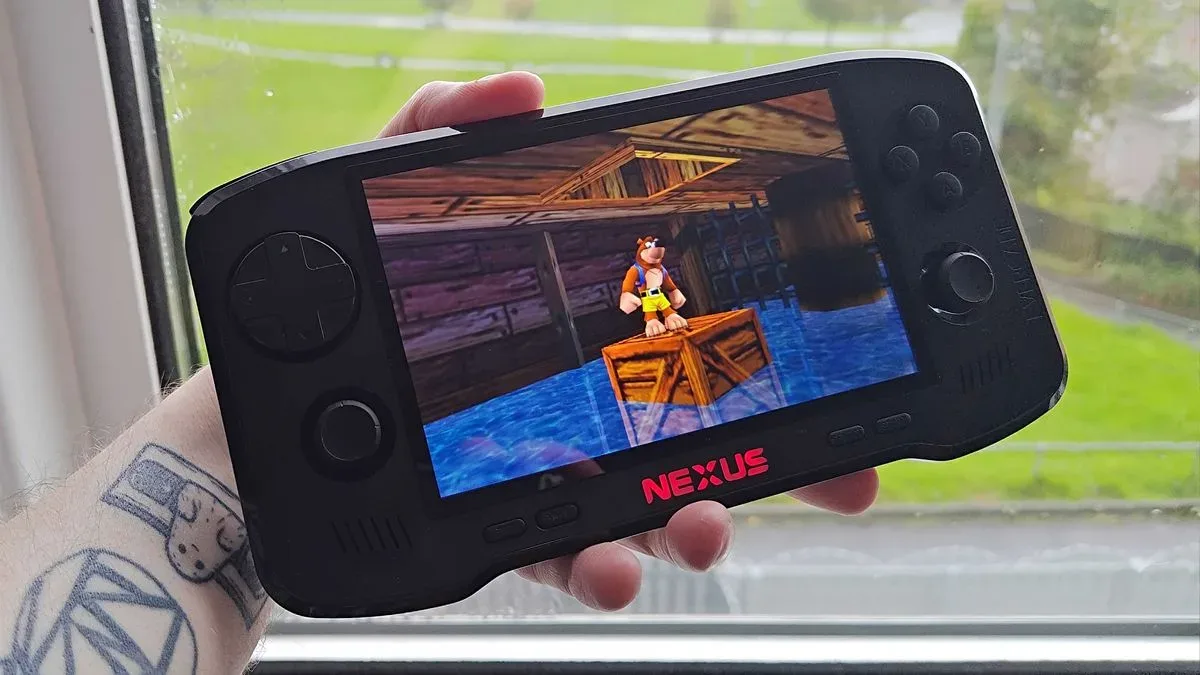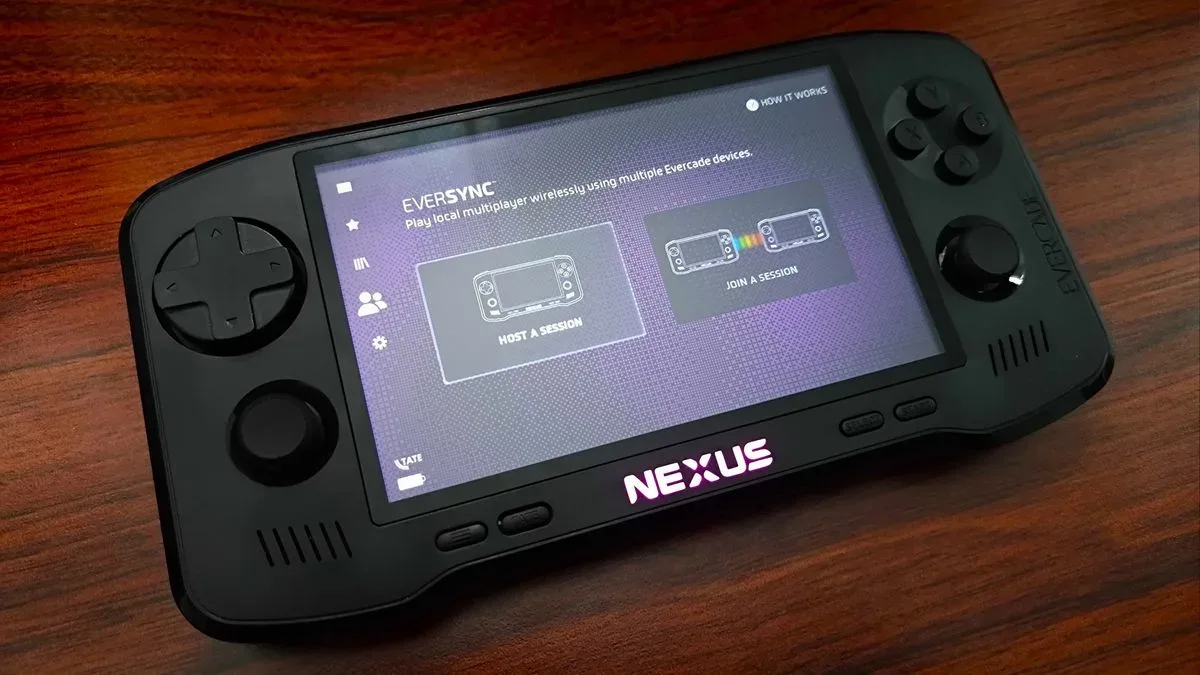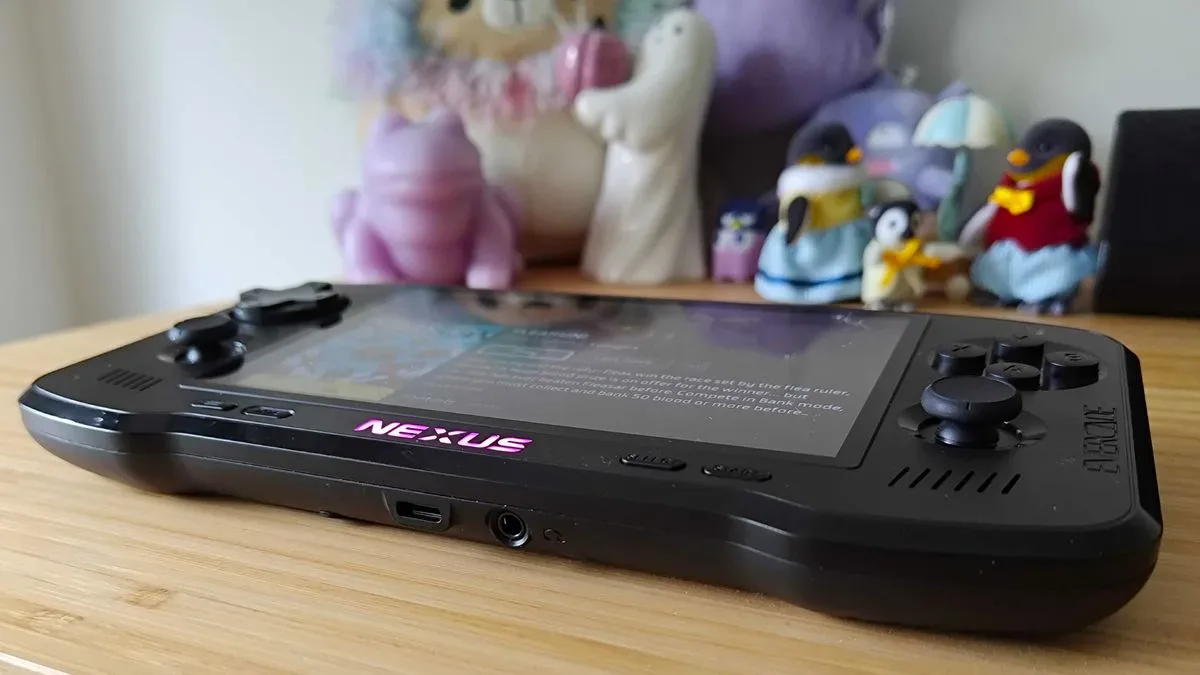
The Evercade Nexus is Blaze’s most ambitious attempt yet to turn a cartridge-focused retro platform into a handheld that feels at home with early 3D games. At $199.99 / £169.99, it arrives with a 5.89-inch IPS display, dual thumbsticks, Bluetooth audio, Wi-Fi-based local multiplayer and continued support for Evercade’s physical cartridge catalogue of more than 750 games.
The headline is not merely that a new handheld exists. It is that Banjo-Kazooie and Banjo-Tooie are being used to demonstrate a different direction for Evercade: officially licensed, enhanced software designed around the company’s hardware rather than a device built chiefly to let users configure their own emulators. Those games are native ports made using original source code, with widescreen presentation and 60fps performance described for the new hardware.
That distinction is the Nexus’s central appeal and its central limitation. It offers a more curated, physical-media route into retro gaming than many Android- and Linux-based handhelds, but it also carries some software and convenience shortcomings that feel conspicuous at its price. The result is Blaze’s strongest handheld to date, especially for players already invested in Evercade cartridges, without becoming a universal answer to every retro-handheld need.
A larger Evercade designed for the jump to 3D
Evercade’s previous hardware has covered several niches: portable systems, a home console, a compact arcade unit and budget-focused Super Pocket devices. Nexus is the first portable in the range built with a clear focus on the control demands of early 3D console games. The addition of two analogue sticks matters most here, even if the hardware is not trying to chase every later console generation.
Its specifications put the design in context:
- Display: 5.89-inch IPS panel at 840 × 512
- Processor: 1.5GHz quad-core
- Memory: 512MB RAM
- Battery: 5,000mAh, with a claimed runtime of more than five hours
- Charging: USB-C
- Dimensions: 215mm × 111mm × 34mm
- Weight: 410g
Its broad shape puts a large screen at the center, with substantial side sections intended to give players somewhere to hold. At 410g, it sits above a lightweight handheld but below the bulk of many PC gaming portables. There are no pronounced rear grips, so the Nexus is closer to a solid slab than a controller-shaped device. That is a meaningful ergonomic trade-off: its size gives early 3D games room to breathe on screen, but its form is less naturally accommodating than hardware with deeper palm contours.
The IPS designation means the screen uses a liquid-crystal panel with broad viewing angles rather than an OLED panel, where each pixel produces its own light. IPS is a sensible, established screen technology, but it will be one of the areas buyers compare against similarly priced modern handhelds. For Evercade’s target catalogue, the larger panel and elevated brightness are the more important upgrades, particularly when moving beyond 2D arcade and console games.
Controls make sense for early 3D, with caveats
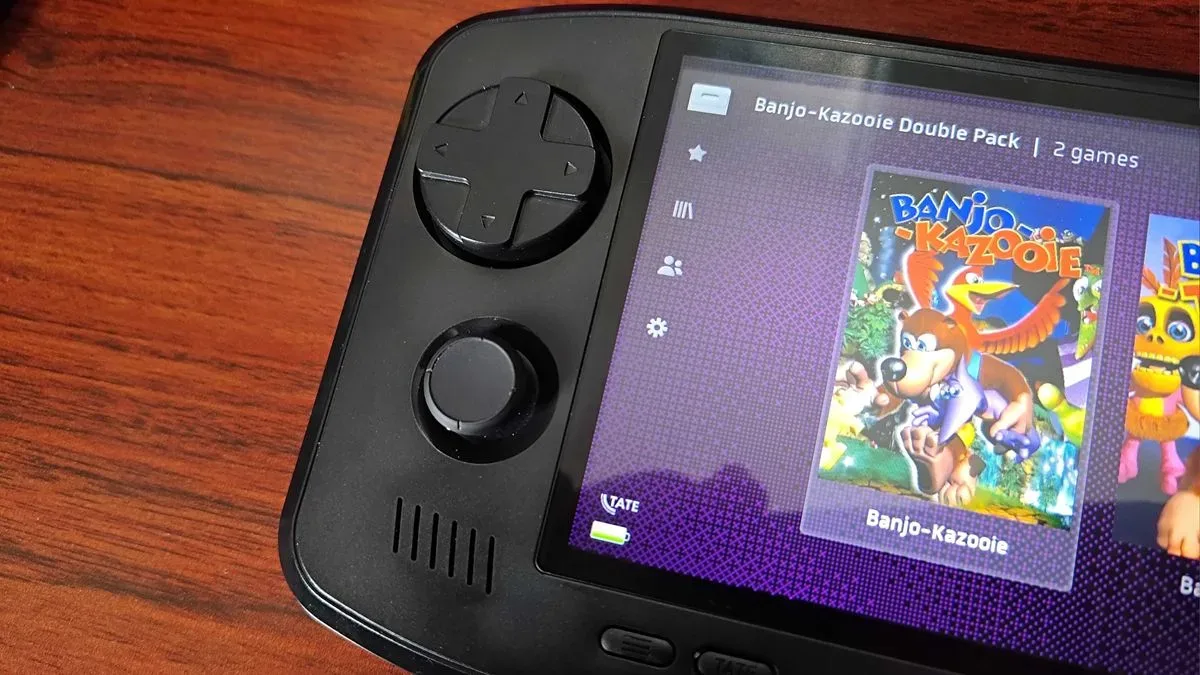
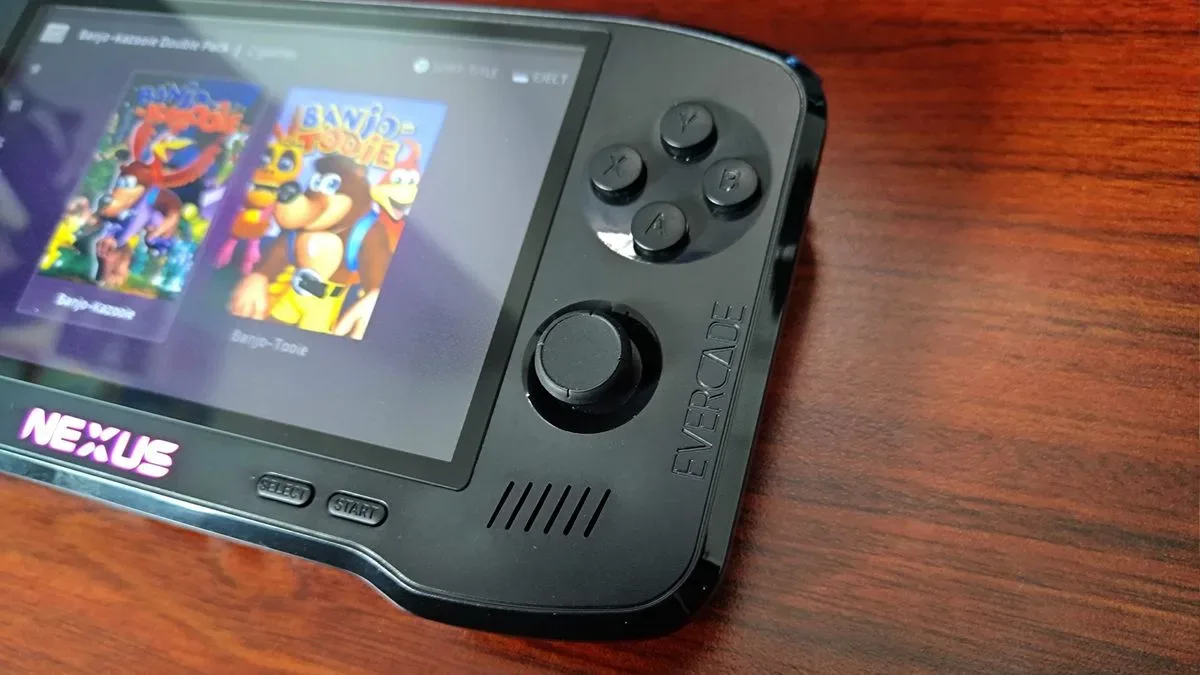
The Nexus has small, Switch-style thumbsticks rather than large controller-sized modules. Their placement below the face buttons makes the device less ideal for games requiring constant use of both sticks, while the gap between the sticks and upper shoulder controls can make bumpers and digital triggers more of a reach.
Related coverage includes Evercade Nexus Review: Blaze's Most Capable Handheld Yet Takes Physical Retro Gaming Into 3D.
That layout is easier to understand when viewed through the lens of the games Blaze is bringing in. Early 3D platformers often centered movement on one analogue stick and used shoulder buttons for camera adjustments. In Banjo-Kazooie, the L and R buttons provide a more period-appropriate way to handle the camera than leaning heavily on the right stick. The second stick still adds flexibility, but the overall arrangement is better suited to 1990s-style 3D design than it would be to a library dominated by modern dual-stick games.
Buyers should also note that the sticks use conventional potentiometer technology rather than hall-effect sensors. A potentiometer detects position using a physical electrical contact. Hall-effect sticks detect magnetic fields instead, avoiding that contact and potentially reducing wear-related drift. Hall effect has become a commonly requested feature in portable gaming hardware, so its omission will matter to players seeking the most future-proof controls.
Elsewhere, the controls follow familiar Evercade ideas. The face buttons use tactile membrane switches, while the D-pad is larger and taller than the one used on earlier handheld models. Its floating pivot has been widened, though it can still be pressed in the center and may feel stiff from that position. The triggers are digital, meaning they register as on/off buttons instead of measuring how far they are pulled. That is adequate for the existing catalogue but less versatile than analogue triggers for systems or games that expect gradual acceleration or braking.
There is still a dedicated TATE button for vertical arcade titles. “TATE” refers to a vertical screen orientation, useful for portrait-format shooters. Nexus does not retain the optional grip arrangement and extra left-side A and B buttons seen on another Evercade portable, however, so vertical play is a more straightforward handheld setup rather than a purpose-built arcade-control solution.
Wireless additions are welcome, but depend on the audience
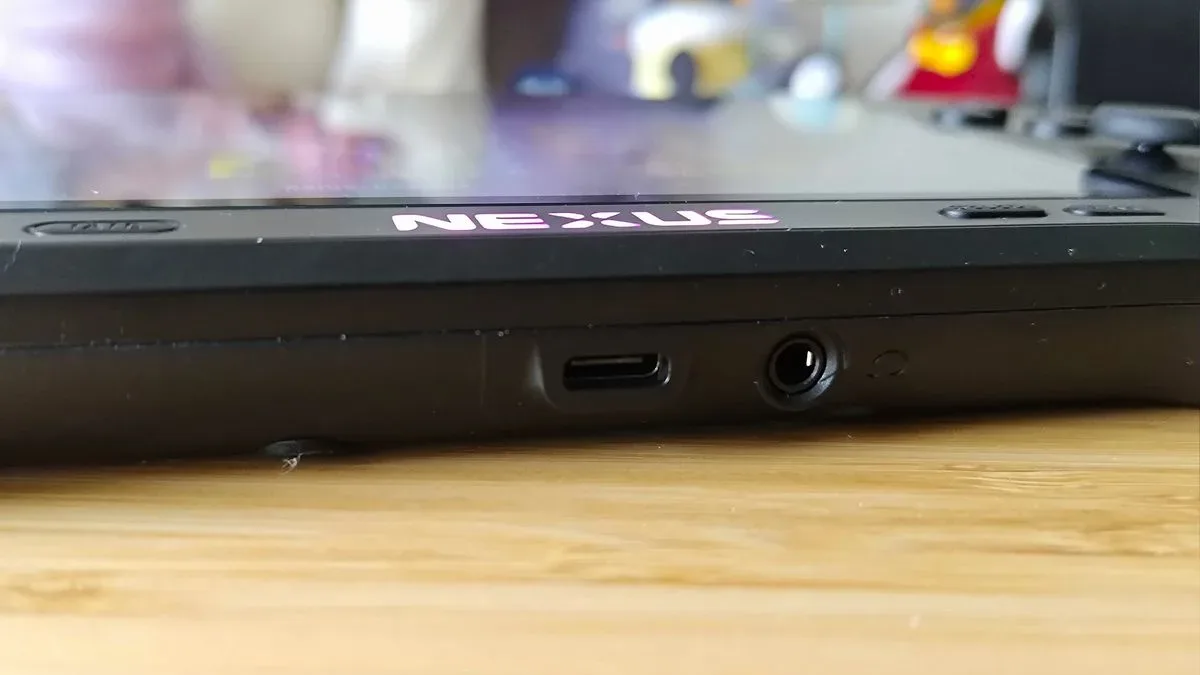
Nexus introduces Bluetooth audio and Eversync, a local wireless multiplayer feature. Bluetooth is a practical addition for players who increasingly use wireless headphones, even though the handheld retains a 3.5mm headphone jack for wired listening. Its presence is complicated by the system software: audio and other global settings are not always readily accessible once a cartridge game is running.
Eversync is potentially more distinctive. It is designed to let compatible Nexus systems play multiplayer cartridges together locally, taking an idea familiar from contemporary portable consoles and adapting it to Evercade’s physical-library model. The feature’s usefulness, naturally, depends on other people owning Nexus hardware and compatible games. For a household or friend group that adopts the device together, it could add real value. For a solo owner, it may remain an option that rarely leaves the settings screen.
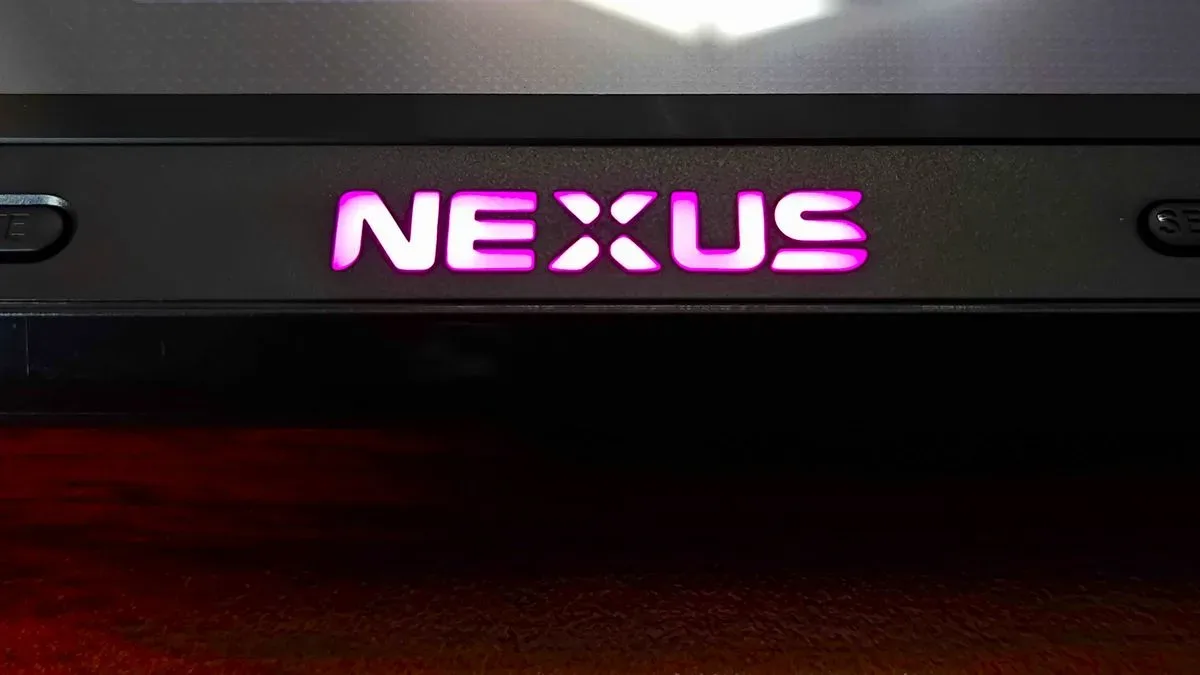
A customizable RGB logo also functions as a battery indicator. It is a nice visual flourish rather than an essential upgrade, but it is part of a broader effort to make Nexus feel like a dedicated current-generation Evercade system rather than an incremental revision.
The missing features are hard to ignore
Nexus uses USB-C for charging, but it does not offer HDMI video output. That means it cannot double as a simple living-room console or be docked for TV play with a wireless controller. Blaze has previously moved away from handheld video output after historical issues, but its absence is easier to question on a $199.99 device with dual sticks and wireless capabilities.
More consequential for everyday portable use is the lack of a sleep mode. A sleep or suspend function preserves the current state of a game in memory so a player can press the power button, set the machine aside and resume later. Nexus requires a full shutdown and startup between sessions instead. That is especially awkward for a handheld, where quick interruptions are part of the format’s appeal.
The issue is not simply that Nexus uses cartridges. Other portable systems using physical media have supported suspend-and-resume behavior, and Evercade loads the content of a cartridge into memory at boot. Whether Blaze can address this through a future update remains uncertain, but the present behavior makes Nexus feel older than its new hardware suggests.
The operating system has a related limitation. It is console-like and responsive despite the modest 512MB of RAM, with ownership tracking and downloadable Game of the Month releases giving the interface a sense of an active platform. Yet loading a cartridge is effectively a transition into that cartridge’s own game wrapper or native port. Once inside, access to system-level settings such as brightness, aspect ratio and scanline overlays may be limited or unavailable.
A global in-game overlay would solve much of this friction. Players are used to pulling up a quick menu to change brightness, audio, display treatment or control options without quitting. On Nexus, that convenience is not consistently there. Wi-Fi gives Blaze a route to update the operating system, but no such improvements can be assumed until they are actually released.
Why the Banjo ports matter more than a spec-sheet contest
Nexus’s argument is not that its processor wins a brute-force performance battle. Its argument is that officially prepared software, including native ports and curated emulation, can produce a reliable experience without requiring users to find files, select emulators, adjust settings or troubleshoot compatibility.
A ROM is a digital copy of game data, while emulation is software that recreates another machine’s behavior so that game can run on new hardware. Evercade uses emulation wrappers for much of its library. A native port, by contrast, is software built to run directly on the target hardware. The Banjo-Kazooie and Banjo-Tooie releases take the latter approach, using original source code to create enhanced versions for Evercade. That is why the games can target widescreen output and 60fps rather than merely reproducing the performance and presentation of an older version.
The new DOOM collection also uses software built from the ground up for Evercade hardware. Together, these releases indicate what the Nexus can become if Blaze continues to secure licenses and support bespoke work. It is a slower model than the anything-goes flexibility of an emulation handheld, but it has an advantage in predictability: the hardware and software can be matched deliberately.
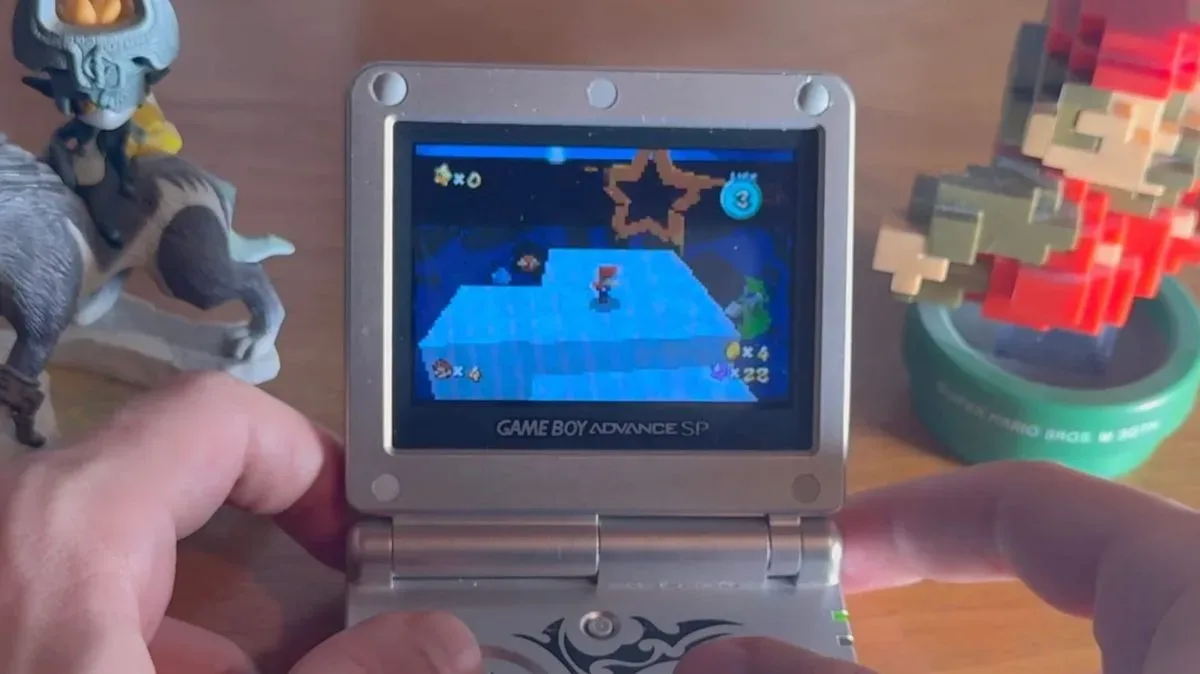
That approach also aligns with Evercade’s continued emphasis on cartridges. The device does not ask players to treat physical games as an afterthought; the cartridges are the ecosystem. For enthusiasts who value owning a shelf-friendly release with a defined catalogue, that remains a legitimate difference rather than nostalgia for nostalgia’s sake. Readers interested in ambitious retro projects that push old hardware in unexpected directions can also see how that enthusiasm extends to a Super Mario Galaxy rebuild for Game Boy Advance.
Who should consider the Evercade Nexus?
The strongest case for Nexus is straightforward: it is the most capable portable for people who already collect Evercade cartridges, or who specifically want a legal, physical-media-focused way to play a growing selection of retro releases. The larger display, early-3D-ready controls, wireless options and compatibility with the existing catalogue substantially expand what Evercade can be.
It is also a notable proof of concept for officially supported enhanced ports. Banjo-Kazooie and Banjo-Tooie at widescreen 60fps are not just familiar games placed on new plastic; they show the advantages of tailoring software to a defined target. If future releases follow that model, Nexus has a clearer identity than a generic device whose main selling point is raw hardware power.
Buyers looking for maximum flexibility should weigh the compromises carefully. There is no HDMI output, no sleep mode, no hall-effect sticks and no guarantee that in-game system controls will be improved. Battery runtime is listed at more than five hours, while one reported usage scenario with Banjo games landed closer to four hours. Bluetooth and Eversync are useful additions, but neither erases the day-to-day shortcomings of the operating system.
In other words, Nexus is not best judged as a direct substitute for every Android or Linux retro handheld. It is a specialized system with its own physical library, software curation and compatibility promises. On those terms, it moves Evercade convincingly into early 3D territory. The next challenge is whether software updates can make the experience as modern in use as its new ports are in performance.