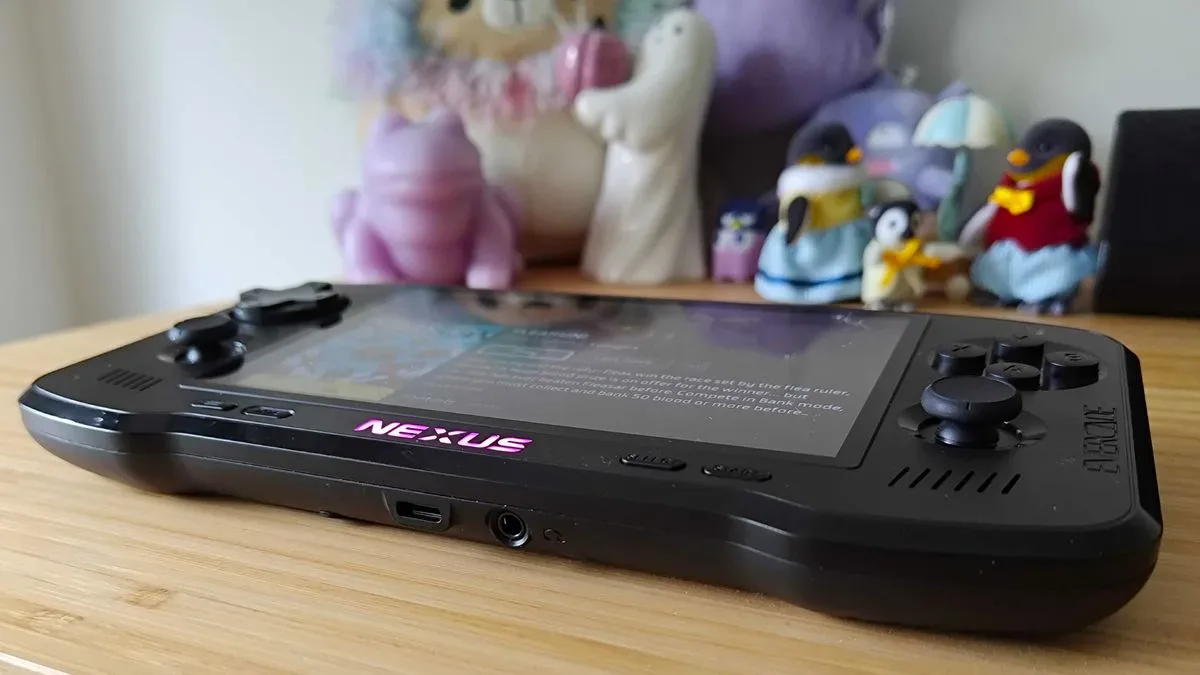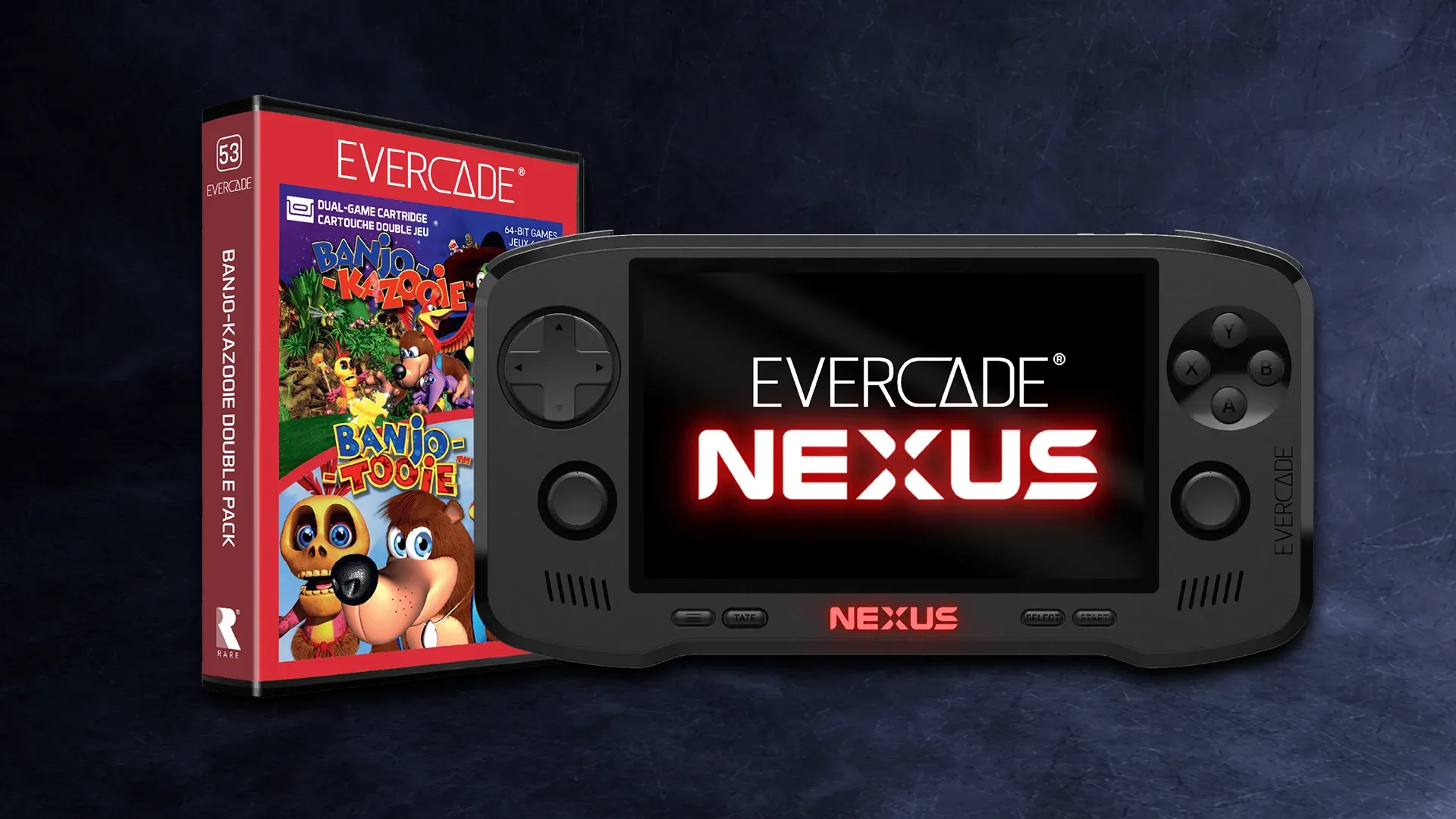
Blaze Entertainment has launched the Evercade Nexus, a new handheld built around the Evercade ecosystem’s defining idea: games on physical cartridges. The system is available in Europe and the US through retailers including Amazon, Funstock, Best Buy and GameStop, and every console includes the BANJO-KAZOOIE Double Pack, containing Banjo-Kazooie and Banjo-Tooie from RARE.
At £169.99, $199.99 or €199.99, the Nexus arrives as a higher-spec handheld route into a library that has grown to more than 80 cartridges and over 700 games since Evercade began in 2020. Its headline additions include a larger 5.89-inch IPS display, two analogue sticks, a customisable RGB logo and EverSync, a console-to-console local wireless multiplayer feature.
For a useful overview of the package and its launch positioning, see this Evercade Nexus launch coverage.
What comes with the Evercade Nexus?
The standard box includes the handheld, the BANJO-KAZOOIE Double Pack cartridge, a USB-C-to-USB-A charging cable and a quick-start guide. A mains adaptor is not included. Blaze is selling an official hard-shell EVA carry case and screen-protector kit separately.
For more context, explore Attack on Titan 3 Opens Nintendo Switch 2 Digital Pre-Orders Ahead of December Release.
The bundled cartridge matters because it makes the Nexus immediately usable in the way Evercade intends. This is not presented as a storefront-first handheld where a buyer must set up an account and download a launch game before playing. Insert the included cartridge and the two included games are available from the physical media in the box.
Banjo-Kazooie and Banjo-Tooie are a particularly fitting pack for a machine with dual analogue sticks. The supplied details do not set out exactly how every control input is assigned, but the second stick expands the hardware’s potential for games that benefit from modern-style camera control. More broadly, the bundle gives the new device a pair of substantial 3D platforming games rather than a short technical demonstration.
A cartridge machine in an increasingly download-led market
The Nexus uses a cartridge slot and requires physical cartridges for games. That is more than a nostalgic styling choice: it is the central practical distinction between this device and a handheld designed chiefly around digital purchases and a continually expanding download library.
Physical cartridges make the game library visible, lendable and easy to organise as individual releases. They also mean that building a Nexus collection involves obtaining cartridges rather than simply adding licences to an online account. For existing Evercade owners, compatibility with the established cartridge library is the important point. The Nexus is an additional way to access that catalogue rather than a separate software platform starting from zero.
There are trade-offs. A cartridge-focused system needs users to carry the games they want to play, and the supplied 4GB of storage should not be confused with a large download drive. However, the stated hardware approach makes that capacity less significant for ordinary game access than it would be on a digital-first portable. The internal storage is part of the system hardware, while the games themselves remain cartridge-based.
Evercade’s physical format also helps explain why the included Double Pack is consequential. The cartridge is a defined part of the product’s library, not merely a code or a preloaded bonus whose ownership is detached from the box.
Screen, size and core hardware
The Nexus has a 5.89-inch 840×512 IPS screen rated at more than 500 nits peak brightness. IPS is a display technology generally associated with wide viewing angles and stable colour presentation, while brightness measured in nits describes how much light the panel can produce. Peak brightness is not a guarantee of identical visibility in every lighting condition, but a 500-plus-nit claim points to a display intended to remain legible beyond dim indoor play.
The 840×512 resolution is an unusual figure compared with the familiar 16:9 resolutions used by many current devices. What matters here is not simply the raw pixel count. Evercade has included display-ratio options, scanline options and custom UI choices, giving players ways to alter presentation for different games and personal preferences.
Scanlines are visual horizontal lines intended to evoke the look associated with older CRT displays. They are a presentation preference rather than a performance feature: some players like the softer, period-inspired image they create, while others will prefer an unfiltered picture. Display-ratio controls are similarly useful because older games were made for more than one screen shape. A choice of ratios can help players decide whether they want to prioritise the intended proportions of an image or a fuller use of the panel.
The device measures 215mm wide, 111mm high and 34mm deep, and weighs 410g. Those figures reinforce Blaze’s description of a larger form factor. Buyers looking for a pocket-sized machine should take note of the dimensions rather than assuming “handheld” means compact. Conversely, the roomier body can accommodate the dual-stick arrangement, a 5.89-inch screen and the 5000mAh battery.
The Nexus uses a quad-core 1.5GHz processor, has 512MB eMMC RAM and offers 4GB of storage. eMMC is embedded flash storage commonly used in compact electronics; in plain terms, it is built-in storage rather than a removable cartridge. The stated specifications identify the platform’s configuration, but do not by themselves establish how every game will perform, look or behave. Cartridge compatibility and the particular game’s design remain more useful guides to what someone will actually play.
EverSync focuses on local shared play
Perhaps the most distinctive new feature is EverSync. It lets two Nexus consoles connect wirelessly to one another without Wi-Fi so that two players can play the same cartridge simultaneously. That wording is important. EverSync is described as local multiplayer between consoles, not internet multiplayer, and it is separate from the Nexus’s Wi-Fi 6 support for console updates.
In practical terms, the feature is aimed at nearby players with their own Nexus hardware. It avoids needing a home router for the connection, which could be useful for travelling, meet-ups or rooms where ordinary Wi-Fi is unavailable. It also potentially reduces the need for each participant to own a separate copy of a multiplayer-capable cartridge, subject to the game supporting multiplayer in the first place.
Not every title in a broad retro catalogue will have a two-player mode, so EverSync should be viewed as a capability that compatible games can use rather than a promise that every cartridge becomes a multiplayer game. The supplied information does not provide a compatibility list or spell out which titles support the feature. That distinction is worth keeping in mind for anyone considering the Nexus chiefly as a two-player machine.
The system also supports wireless headphones. Together with the local wireless feature, that points to a handheld intended to work flexibly away from a television, while its physical software model retains a deliberate separation between game access and online connectivity.
TATE Mode and the value of display options
The Nexus supports TATE Mode. “TATE” refers to a vertically oriented screen presentation, a format associated with games designed for a tall display. Its inclusion is useful for suitable titles because it can present vertically framed action in an orientation closer to the original design.
As with the scanline and ratio settings, TATE Mode is a quality-of-life option rather than a blanket upgrade. It has value when a game was built around vertical play; it is not inherently preferable for every game in the catalogue. Still, it is a notable acknowledgement that a retro-focused library can include games with very different original display conventions.
The customisable RGB light-up logo is a more cosmetic option. RGB refers to red, green and blue light values that can combine to create different colours. It will not affect game compatibility or battery life claims, but it gives owners a way to change the system’s outward look without modifying the hardware.
Battery, charging and update considerations
Blaze lists a 5000mAh battery with a stated runtime of more than five hours. Battery capacity, measured in milliamp-hours, is one indicator of the battery’s size, but playing time will vary with factors such as screen brightness, wireless use and the game being played. The sensible reading is that the Nexus is rated for five-plus hours, not that every setup will produce the identical result.
Charging uses USB-C, with a USB-C-to-USB-A cable included. Since no mains adaptor is in the box, buyers will need to provide a suitable USB power source. Wi-Fi 6 is included for console updates, which gives the hardware a route for system maintenance while leaving the core game format on cartridges.
That split is one of the Nexus’s clearest ideas. The system can receive updates over Wi-Fi, support wireless headphones and connect locally through EverSync, but playing its games still relies on inserting a physical cartridge. For players who want modern convenience without making a digital storefront the centre of their library, that is the proposition.
Who the Nexus is for
The Evercade Nexus is most straightforwardly aimed at existing Evercade cartridge owners and players attracted to an all-in-one handheld entry point. The included Banjo double pack means newcomers have two games immediately, while the wider catalogue gives established users a sizeable selection to bring over.
Its strengths are specific: a bigger IPS screen, dual analogue controls, configurable visual settings, vertical-play support and a local wireless multiplayer concept that does not depend on Wi-Fi. Its limitations are equally clear from the design. Games require physical cartridges, the device is relatively substantial at 410g, and accessories such as the case and screen protectors cost extra.
For the right buyer, those are not contradictions. They are the Nexus’s identity: a contemporary handheld designed to make a cartridge library portable, rather than a general-purpose device that happens to play older games.