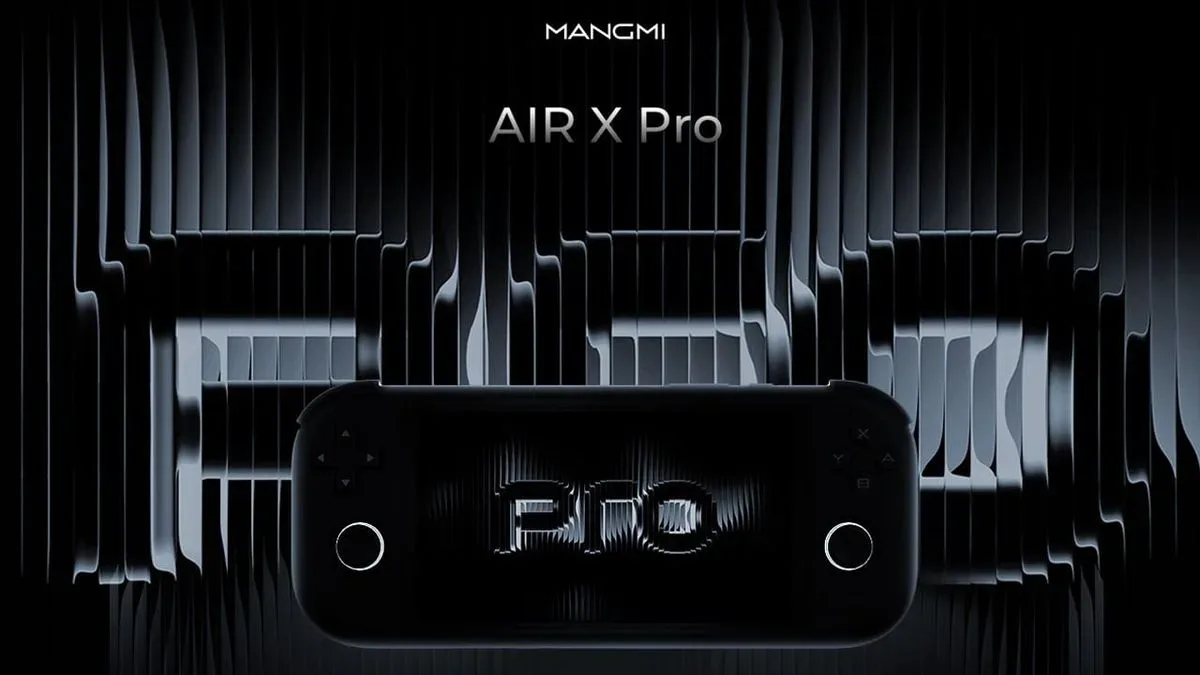
MANGMI has offered an early tease of the Air X Pro, a forthcoming addition to its Android handheld range. The preview provides a look at the device’s general design rather than a specification sheet, so the important buying details remain unresolved: processor, display size, battery capacity, memory configurations, storage, operating system, price and release timing have not been confirmed.
What can be seen points to a horizontal handheld that carries forward the Air X family look in a sleeker, more styled shell. The shoulder-button arrangement also appears similar to the existing Air X. That detail may matter more than it initially sounds. Shoulder buttons are used constantly in many console-era control schemes, so their size, travel and placement can have an outsized effect on comfort in long sessions. An attractive redesign will be welcome, but the eventual hardware and ergonomics will decide whether the “Pro” label represents a substantive step forward.
What the teaser establishes — and what it does not
The Air X Pro is real enough to have been shown by MANGMI on social media, but the teaser should not be read as a full product announcement. It does not establish that the Pro uses a new chip, a larger battery, upgraded controls, a metal chassis or a particular Android version. It also does not confirm a display measurement or resolution.
That distinction is particularly important in the enthusiast handheld space. A product name can suggest a performance upgrade, but “Pro” can just as easily identify a revised form factor, different configuration, improved materials or a broader product tier. Until MANGMI publishes a full spec list, claims of a 6-inch display, a 5,000mAh battery, an unchanged chipset or any specific price should be treated as informed possibilities rather than product facts.
The early image is a design preview, not a benchmark chart in disguise.
For prospective buyers, the sensible response is patience. There is not enough official information to judge value against the existing Air X or the company’s other handhelds, and no reason to assume the teased model will inherit every component from either.
The Air X is the clearest point of reference
The existing MANGMI Air X supplies the most relevant context because it is the horizontal model the Air X Pro appears positioned to follow. It has a 5.5-inch IPS display with a 1,920 by 1,080 resolution and 400-nit brightness, and it runs Android 14. It has also been associated with GameCube and PlayStation 2 emulation capability.
IPS, short for in-plane switching, is a type of LCD panel generally valued for stable viewing angles and color presentation. That label alone does not settle display quality: brightness, contrast, calibration and response behavior all remain relevant. Still, the Air X’s listed 1080p display gives a useful baseline for thinking about a potential Pro model. A larger screen could make interface text and 3D games more comfortable to view, but it could also affect the device’s overall size and power demands.
Related coverage includes MANGMI Teases Air X Pro Handheld as Questions Remain Over Specs.
Emulation is software-based reproduction of another system’s hardware behavior, allowing compatible software to run on different hardware. It is demanding in uneven ways. A handheld may be satisfactory for one platform or game yet need settings changes, encounter issues or deliver different results elsewhere. That is why an Air X Pro’s processor, thermal design and software setup cannot be inferred from its shape alone. A device’s chip is important, but cooling, drivers and the chosen emulator settings can also influence the experience.
Anyone already interested in portable ways to revisit older games may also want to see how a much more constrained project can approach the idea from the opposite direction: a Super Mario Bros. Wonder Game Boy demake is taking shape. The Air X Pro conversation is about an Android handheld with modern components; that project highlights the enduring appeal of playing and adapting games around older hardware limits.
The Air Y Pro shows MANGMI’s current component playbook
MANGMI’s Air Y Pro is a separate, vertical-format handheld with two analogue sticks. It should not be mistaken for a confirmed specification template for the Air X Pro, but its published hardware provides valuable context for the company’s current range.
- Qualcomm Snapdragon 865 processor
- 4GB or 8GB of LPDDR4X RAM
- 64GB of UFS 2.1 or 128GB of UFS 3.1 storage
- Active cooling
- 4.2-inch, 1,280 by 960 IPS display
- Wi-Fi 6 and Bluetooth 5.1
- USB-C, TF card slot and 3.5mm headphone jack
- Dual stereo speakers
- Android 13
- 5,000mAh battery with 18W charging
- Customizable key, volume wheel and six-axis gyroscope
- 144.84 × 94.64 × 23mm dimensions and a 286g weight
Several of those terms deserve unpacking before they become a comparison checklist. LPDDR4X is low-power system memory. More RAM can help Android keep applications and services available, though it does not automatically deliver faster emulation. UFS is a flash-storage standard; its version and capacity may influence loading and file-transfer behavior, but neither reveals an Air X Pro configuration.
Active cooling means the handheld uses a fan or comparable powered cooling approach. The practical goal is to remove heat during sustained work and reduce the likelihood of performance being lowered to control temperature. Its effectiveness depends on implementation, and it can introduce fan noise. Meanwhile, a six-axis gyro combines motion-sensing axes used for tilt and rotation input. Whether that becomes meaningful for a particular player depends on Android games and emulator setups that support motion controls.
The Air Y Pro’s 1,280 by 960 display has a 4:3 aspect ratio, which suits its vertical design and certain older game formats. The Air X’s 16:9 1080p panel serves a different purpose. The teased Air X Pro is expected to be a horizontal device, but its exact screen format is unknown. A proposed 6-inch class display is speculation, not a published MANGMI detail.
Battery figures need context, not guesses
The Air X and Air Y Pro are both associated with a 5,000mAh battery, while the Pocket Max is described with an 8,000mAh battery. Those figures establish that MANGMI already uses different capacities across its lineup, not that the Air X Pro will choose any one of them.
mAh, or milliampere-hours, expresses battery charge capacity. It is useful for broad comparison, but it is not a direct promise of runtime. Display brightness, screen size and resolution, processor load, cooling, wireless use, speaker volume and software efficiency all affect how long a charge lasts. A 5,000mAh pack in a new enclosure could therefore behave differently from one in an existing model.
The Air Y Pro’s stated 18W charging is likewise only a reference point. Faster charging can reduce time connected to a cable, but an eventual Air X Pro rating will need to be assessed alongside battery capacity, included power accessories and charging behavior. None of those details has been announced for the teased handheld.
What to watch for in the full reveal
A meaningful Air X Pro announcement should answer a relatively short list of questions. First is the chipset: retaining existing silicon could prioritize price and software familiarity, whereas a newer platform could target higher performance. Second is the display: size, resolution, panel type, brightness and aspect ratio will determine how the device differs from the 5.5-inch 1080p Air X.
Third are the physical controls. The teaser’s shoulder buttons resemble those of the Air X, but images cannot communicate trigger travel, stiffness, reach or durability. The location and feel of the analogue sticks, D-pad and face buttons are equally important. Fourth is software. The Air X runs Android 14, while the Air Y Pro is listed with Android 13; MANGMI has not said which version the Air X Pro will use.
Finally, price will frame every other specification. A largely cosmetic refresh and a performance-focused successor can both be reasonable products, but they make sense at different price points. For now, MANGMI has shown enough to make the Air X Pro worth watching, but not enough to determine which kind of upgrade it will be.