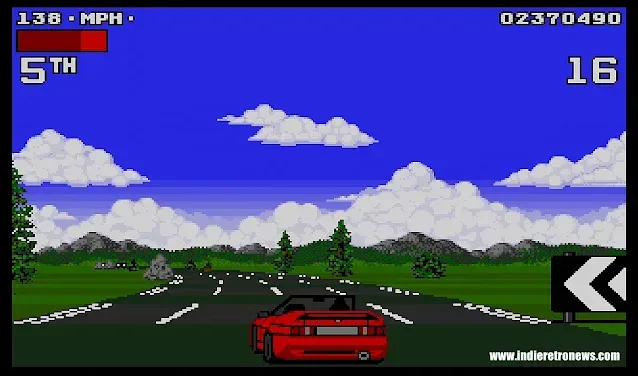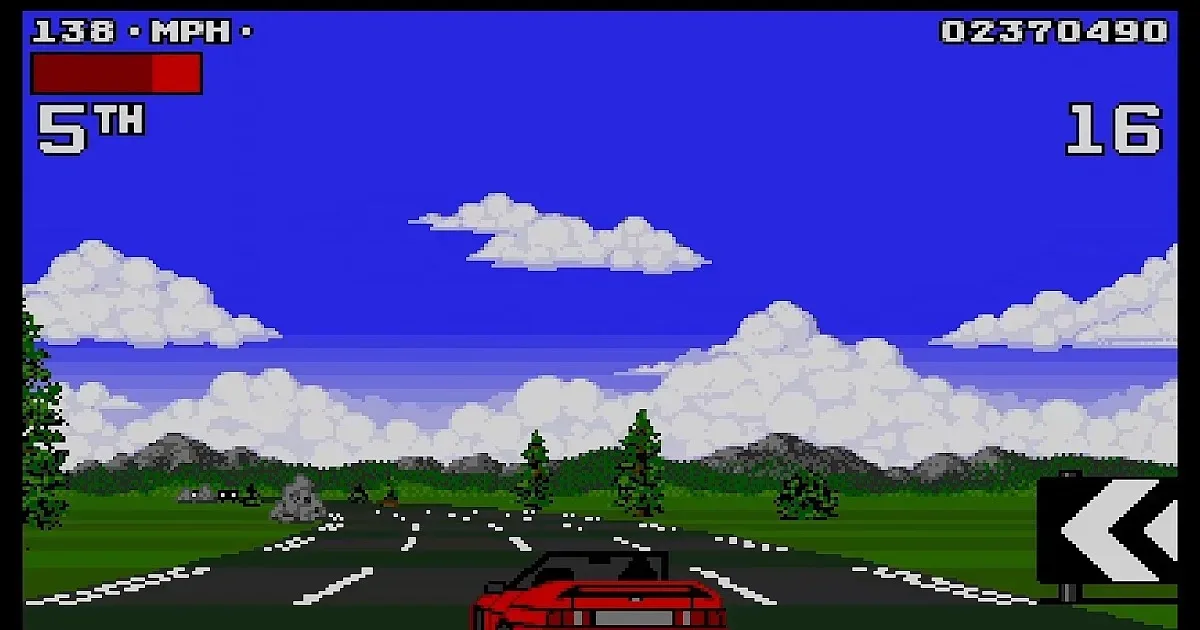
Lotus Turbo Challenge II DX is a fan-made update for the Amiga version of Lotus Turbo Challenge 2, targeting machines with at least 1 MB of Chip RAM. Its central improvement is deceptively simple but especially meaningful for an audio-driven racing game: the update allows the soundtrack and sound effects to play at the same time.
That capability addresses a long-standing compromise in the 1991 original. The new DX version also restores the game’s “Checkpoint” vocal call even when a player has disabled the music, adds a pre-race music selection that covers all eight stage tracks plus the main theme, and gives opponents ten new two-tone paint schemes.
The underlying racer is still the same fast, rear-view checkpoint dash: choose between the Lotus Esprit and the more grip-focused Lotus Elan convertible, then push through a series of circuits that include snowy roads, desert terrain and busy two-way motorways. The objective is not conventional lap racing. Players race a countdown clock, reaching checkpoints before time expires and using speed and time boosts to stay alive.
A technical limitation becomes the point of the upgrade
For modern players, “music and sound effects simultaneously” may sound like a baseline feature rather than headline news. On older hardware, however, games often had to make trade-offs among memory, processing time and audio resources. In practical terms, a game could be forced to prioritize its music or its effects rather than present both as a continuous mix.
That distinction matters in Lotus Turbo Challenge 2. The soundtrack provides much of the game’s momentum, while effects and spoken feedback communicate what is happening during the run. An engine note, passing traffic and an audible checkpoint prompt all support the visual action. Having both layers present at once should make each race feel more complete without changing the rules, routes or cars that define the original.
DX version 13 specifically brings back the authentic checkpoint vocal cue when the soundtrack is switched off. That is a useful quality-of-life detail: players who prefer racing without music should not lose a core piece of event feedback in the process. It also makes the sound setting a genuine preference instead of an all-or-nothing choice between music and a recognizable gameplay prompt.
More control over a celebrated racing soundtrack
The update’s music menu is another small change with a large nostalgic payoff. Before beginning a race, players can select any of the game’s eight stage tracks or its main theme. Rather than tying a particular tune only to its assigned course, DX lets players decide which piece accompanies a run.
This is not a new soundtrack, nor is it a claim that the original stage identity has been redesigned. It is a selection feature that puts the existing music in the player’s hands. For a game remembered in part for its audio, that is an appropriately focused extra. Someone returning to a favorite course can use the song they most associate with the game; someone practicing a difficult route can choose a different track without changing the challenge.
Related coverage includes Lotus Turbo Challenge II DX Updates Amiga Racer With Music and SFX.
The new opponent liveries serve a similar purpose. Ten fresh two-tone paint jobs do not alter the competition’s fundamentals, but they add visible variety to the traffic of rival Lotus cars. It is the sort of enhancement that fits a preservation-minded DX release: new presentation touches around an unchanged classic core.
What remains unchanged: a race against time
Lotus Turbo Challenge 2 uses a behind-the-car perspective and puts pressure on the player immediately. Its checkpoint structure changes the rhythm from a standard circuit racer. The immediate question is not simply whether a rival can be overtaken on a given corner; it is whether the next checkpoint can be reached before the timer drains away.
Speed boosts and time boosts are therefore central to the tension. They are opportunities to keep the run moving, not incidental collectibles. The game’s courses also ask players to cope with changing conditions and hazards, including snow, sand and civilian traffic approaching on two-way roads. A route with oncoming traffic transforms passing into risk management, because a successful drive depends on preserving momentum while avoiding a costly interruption.
The two available cars provide an additional choice. The Lotus Esprit returns, while the Lotus Elan convertible is presented as the grippier option. “Grip” refers to how effectively a car holds the road while turning or responding to changing surfaces. Within the game’s fast checkpoint format, a car with more grip can matter when a route demands control as well as outright pace. The update does not announce mechanical changes to either vehicle, so the appeal is in revisiting those established choices with a stronger audio presentation.
An Amiga-focused revision of a multi-platform racer
The original Lotus Turbo Challenge 2 arrived in 1991, developed by Magnetic Fields and published by Gremlin Graphics. It was an important Amiga release before appearing on the Atari ST, Sega Mega Drive and Acorn Archimedes. DX is specifically positioned around the Amiga edition and requires at least 1 MB of Chip RAM.
Chip RAM is memory accessible to the Amiga’s custom hardware, which is relevant to graphics and audio work. The stated requirement is therefore important for anyone looking at the DX release: it is not described as an update for every possible Amiga configuration. No broader compatibility list, installation process or distribution details are provided here, so prospective players should avoid assuming support beyond that 1 MB Chip RAM baseline.
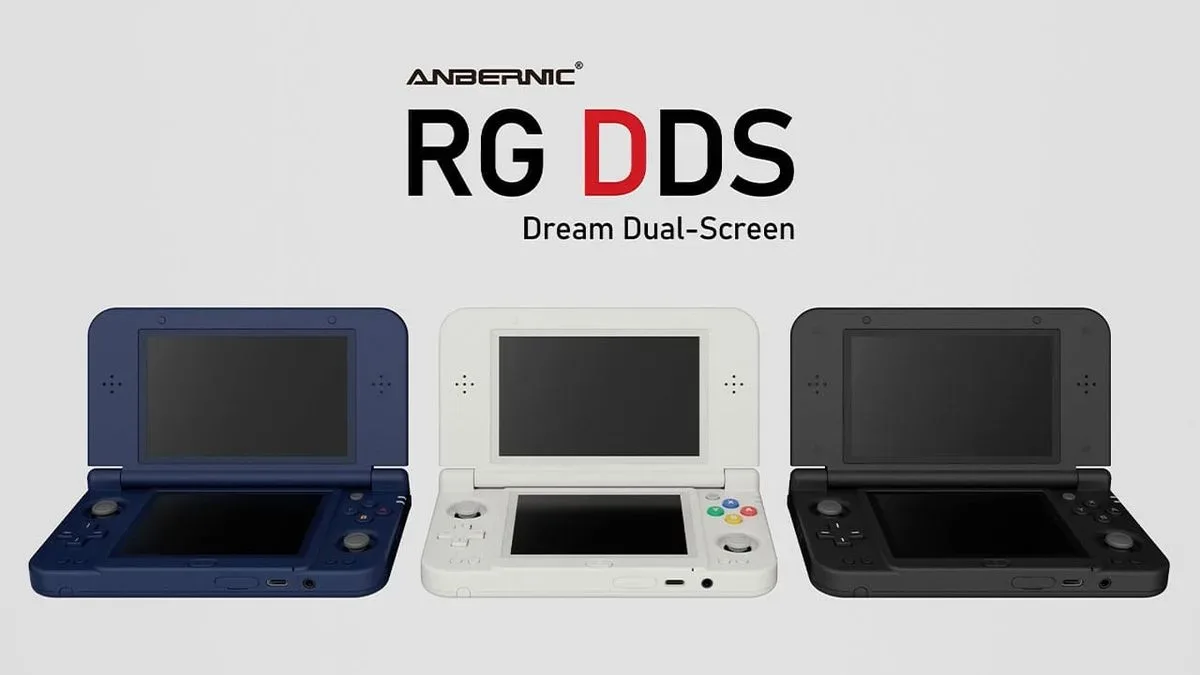
The project arrives at a moment when retro hardware and software continue to attract attention alongside newer ways of revisiting old libraries. For example, the expanding market for purpose-built nostalgic devices is reflected in Anbernic’s RG DDS, a dual-screen handheld aimed at retro-minded players. DX takes a different route: rather than reframing the game for a new device, it focuses on improving an Amiga experience within the hardware context that made the racer notable.
Credits, preservation and the project’s AI disclosure
The original game’s credited team includes programmer Shaun Southern, graphics artist Andrew Morris, composers Barry Leitch and Shaun Southern, and level designer Peter Liggett. Any retrospective of DX should keep the separation clear: the update adds features to an existing work, while the original game’s design, programming, art, music and levels belong to its original creators.
DX is credited to John Boatofcar Shawler, with GPT-Codex also disclosed as part of its creation. That disclosure is worth reporting plainly. It identifies an AI-assisted element in the fan project, but the available information does not specify which tasks GPT-Codex handled or how extensively it was used. It would be inaccurate to infer more than that stated collaboration.
Ultimately, the update’s appeal rests on a targeted philosophy. It does not recast Lotus Turbo Challenge 2 as a modern racing game or replace the elements that players remember. It aims to remove an old audio compromise, preserve a familiar checkpoint call in silent-music play, make the existing songs easier to choose, and add some visual variety to opponents. For Amiga fans, that combination is likely to feel less like a reinvention than the version of a beloved race they had hoped to hear all along.