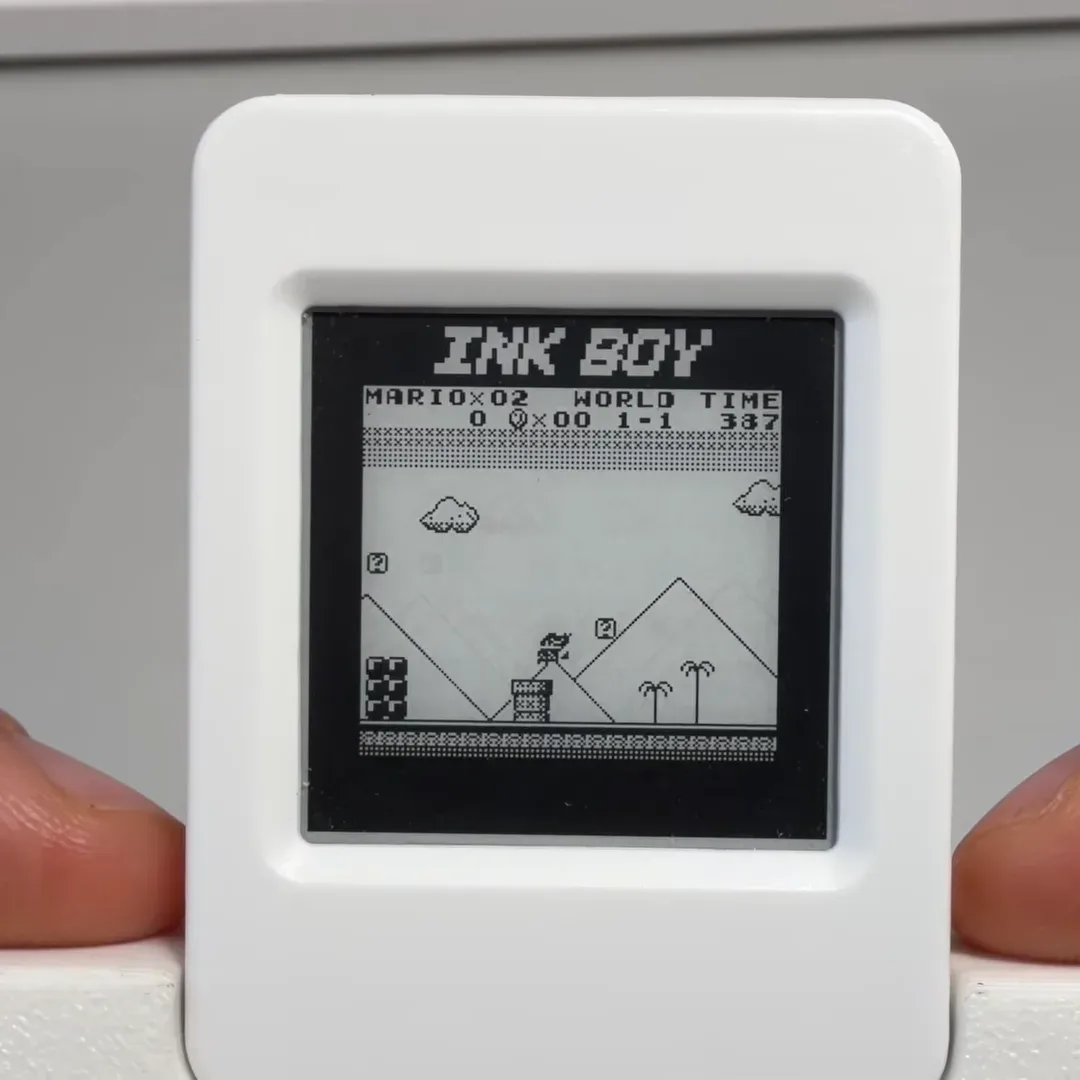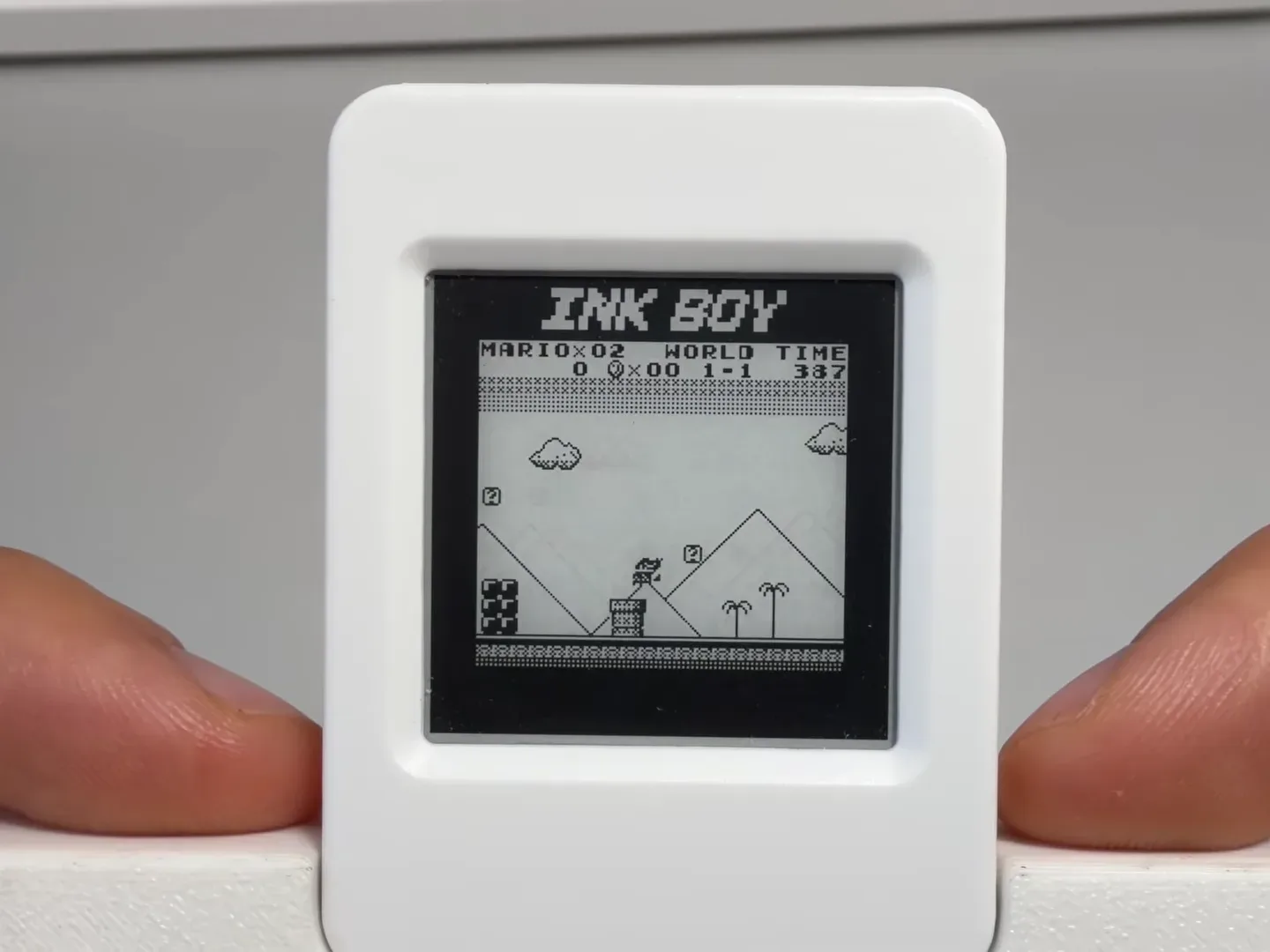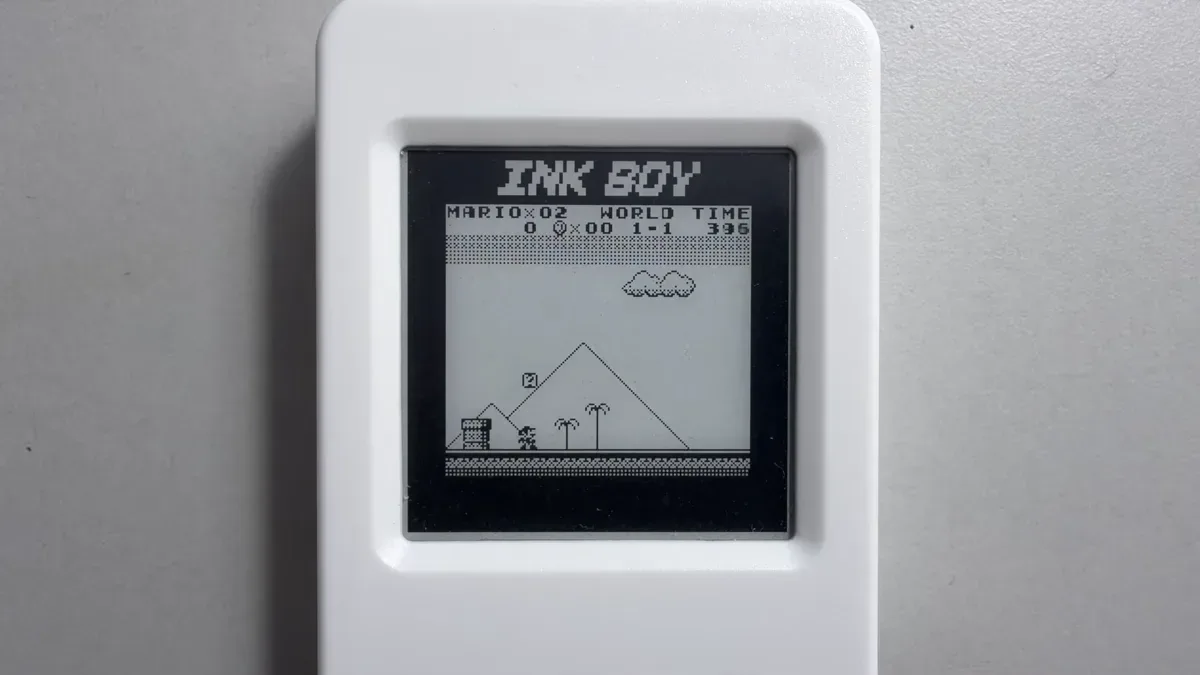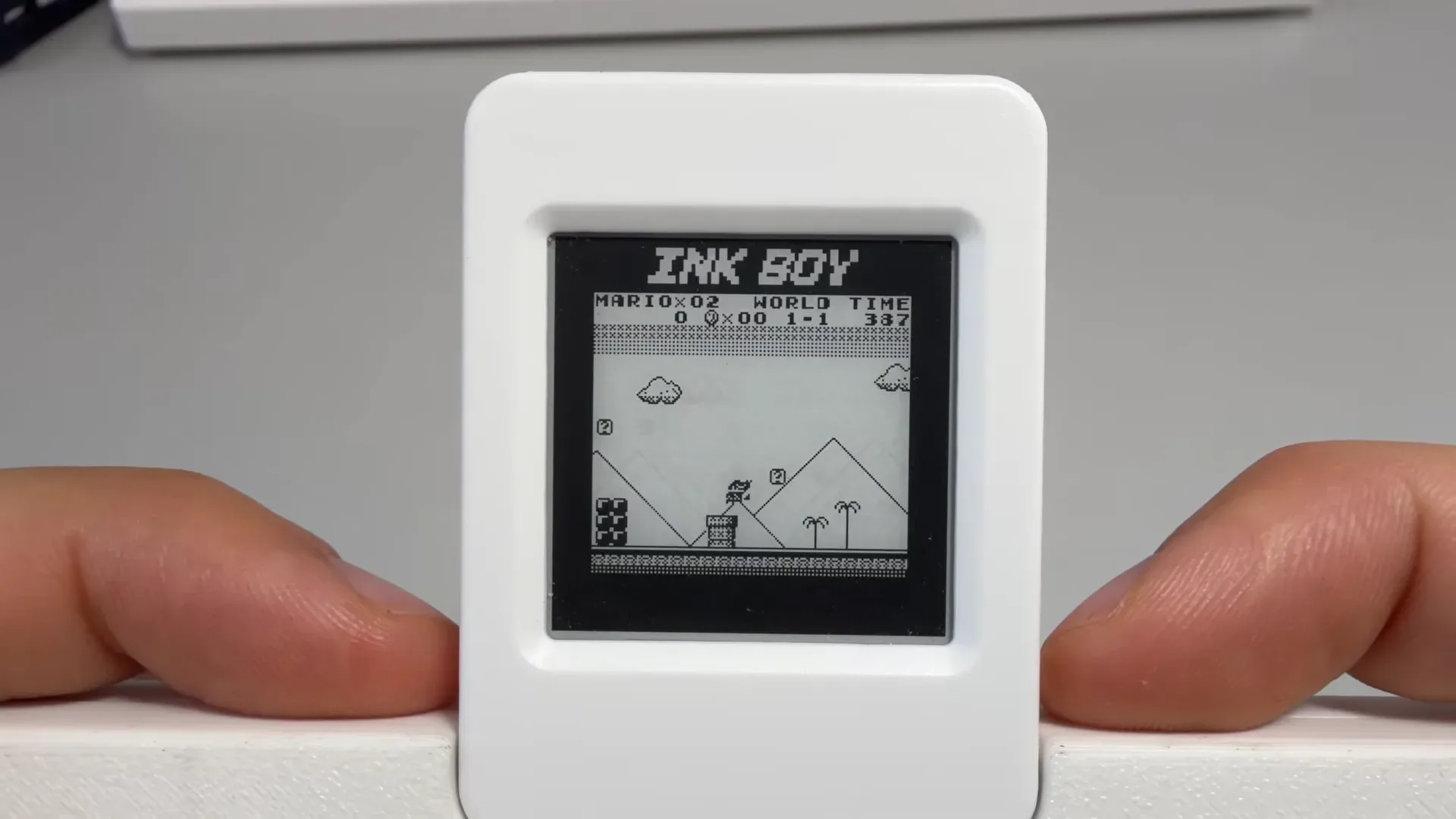
The Ink-Boy is an appealingly odd little retro-handheld project: a Game Boy-inspired machine built around an E-ink display, an ESP32 microcontroller, and a custom display driver designed to make a technology associated with leisurely page turns handle games at 30 frames per second.
That last part is the real story. E-ink, also called electronic paper, is usually a poor match for fast-moving videogame images. A typical panel does not refresh like an LCD, whose pixels can be changed rapidly and continuously. Instead, E-ink’s visible particles must be driven through a sequence of electrical changes to reach the intended light or dark state. That behavior gives e-readers their paper-like look, but it also means full-screen movement can appear slow, dirty, and full of leftovers from the previous image.
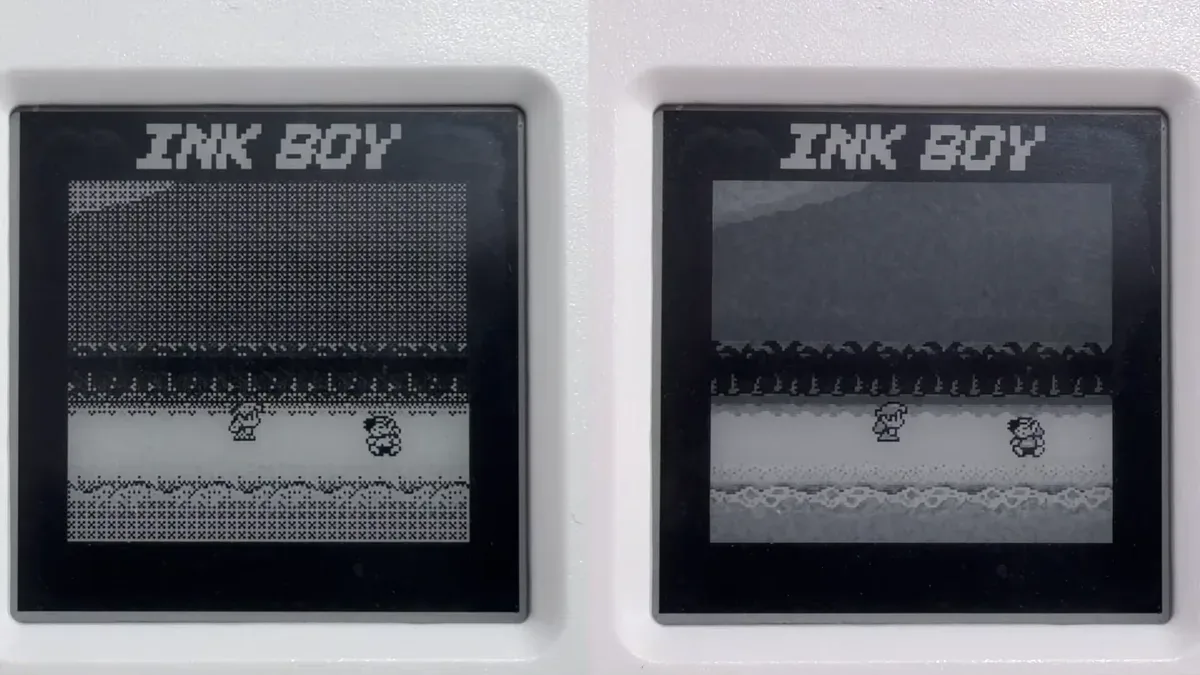
Bo Made It’s Ink-Boy attempts to turn those apparent limitations into a workable Game Boy display. The project runs classic Game Boy software at 30fps rather than the roughly three frames per second one might expect from an unmodified, slow-refresh electronic-paper setup. It does so in a package based on a 1.54-inch Waveshare ESP32-S3 screen with a 200 by 200 pixel resolution. The result is not a conventional handheld trying to outrun modern LCD devices. It is a deliberately specialized device trying to make an unusual screen feel useful for a particular era of games.
Why E-ink needs a different approach
The technical obstacle is refresh behavior. Every electronic-paper panel has a driving process that tells pixels how to move toward black or white. This process is often called a waveform sequence. A full, careful waveform can produce a clean page, but it takes time. For a reader, that delay is largely fine: a page change is an occasional event. For a platform game, where a character and the camera can shift every frame, it creates the dreaded slideshow effect.
The Ink-Boy’s custom driver trims that process down. Rather than using a longer sequence intended to cleanly set every pixel during every refresh, it shortens the black-pixel waveform and drives only the pixels that need changing in each frame. That second choice is especially important. Updating only changed areas reduces the work asked of the display, making it more plausible to show motion frequently enough for games.
This is not merely a matter of chasing a bigger frame-rate number. It is a practical attempt to manage two recognizable E-ink problems: ghosting and messy transitions. Ghosting is the faint persistence of a prior image after the display should have moved on. On a handheld game, it can leave trails or remnants that make sprites and scrolling scenes hard to read. Selective updates and calibrated transitions aim to keep those artifacts under control while preserving a substantially quicker response.
The project’s 30fps target matters because it turns the display from an experimental novelty into something potentially playable for the kinds of games it is meant to run. It is still a compromise, and it should be viewed as one. E-ink is not suddenly interchangeable with a modern high-speed color panel. But the Ink-Boy demonstrates that an electronic-paper screen does not have to be limited to static menus, digital clocks, or one-frame-at-a-time curiosities.
Matching Game Boy’s small screen without wasting the panel
The original Game Boy’s display resolution is 160 by 144 pixels. The Ink-Boy panel is 200 by 200, close enough that the project can preserve the game image at its native dimensions instead of relying on aggressive scaling. The unused area becomes a static black bezel, an aesthetically appropriate solution that also avoids forcing the original picture into a different aspect ratio.
Related coverage includes Ink-Boy E-Ink Game Boy Project Reaches 30fps With a Tiny ESP32-S3 Screen.
Resolution is only one part of the visual challenge. The original Game Boy used 2-bit visuals: four monochrome shades could be represented on screen. The E-ink display used here defaults to two states, so it cannot simply reproduce that four-shade image in the most direct way.
Bo Made It’s workaround takes advantage of the way E-ink pixels naturally transition between states. The Ink-Boy calibrates those transitions to create extra apparent shades, described as 4-bit “color” on demand. In context, that does not mean the tiny display becomes a full-color screen. It means the project uses carefully managed E-ink behavior to spoof additional grayscale-like tones beyond its ordinary black-and-white default.
The distinction is worth making because it identifies what is clever about the build. The Ink-Boy is not pretending the hardware has no constraints. It is actively working around constraints that are central to the screen technology: low refresh speed, ghosting, a two-state baseline, and a compact resolution. For Game Boy material, which was already designed around a restricted monochrome palette and 160 by 144 pixels, that makes much more sense than attempting to turn E-ink into an all-purpose display for every retro platform.
A tiny portable with a strangely sensible controller idea
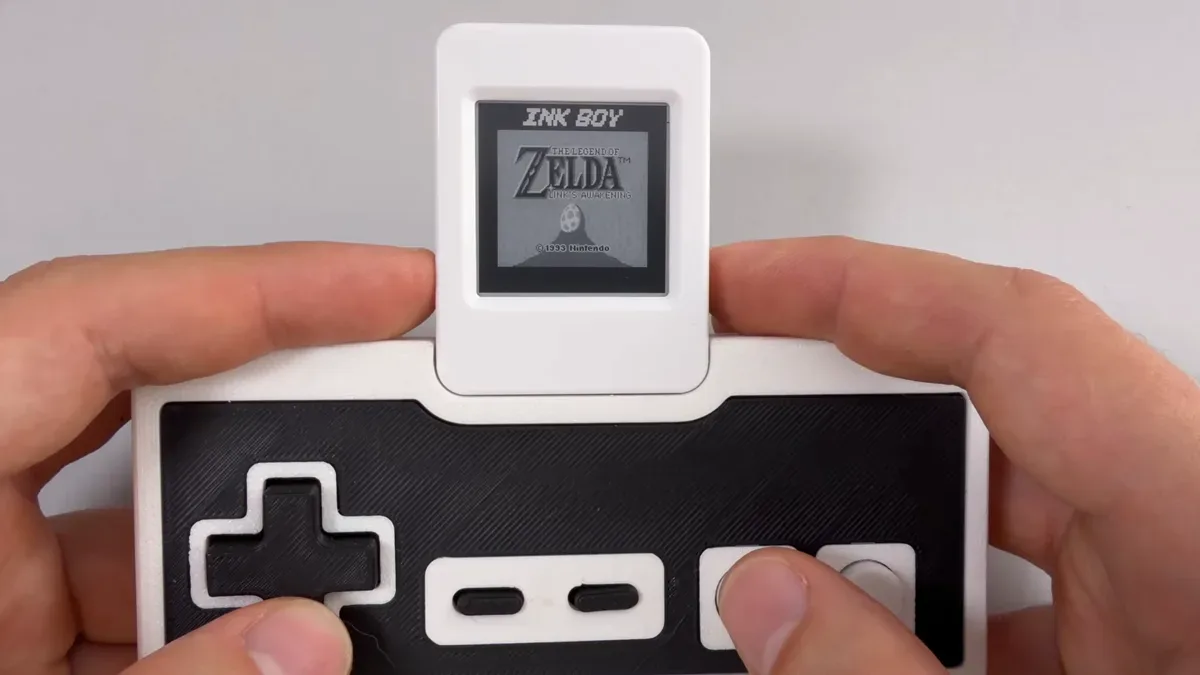
The small panel also changes what a handheld can physically be. At 1.54 inches, the Waveshare ESP32-S3 display leaves space for unconventional enclosures and controls. The Ink-Boy uses that freedom for perhaps its most charming feature: a USB-C NES controller that docks into the bottom of the handheld.
It is a smart fit for a project that embraces miniature scale instead of fighting it. Tiny handheld controls can be difficult to make comfortable, especially when the entire device is built around a very small screen. A dockable controller lets the portable remain compact while providing a more familiar control format when desired. The NES association also makes visual sense alongside a Game Boy-focused machine, even if it is an intentionally cross-generational bit of hardware design.
The Ink-Boy is also said to support Bluetooth, opening the door to wireless controllers. That does not erase the appeal of the docked NES-style pad; the two ideas solve different problems. Bluetooth provides flexibility for an external controller setup, while the bottom-mounted option makes the device feel more self-contained and more toy-like in the best way.
For retro hardware enthusiasts, this modularity may be as significant as the screen-speed work. There are plenty of straightforward ways to emulate older systems on conventional handhelds. An E-ink project earns attention by offering a distinct form factor and behavior, not simply another route to the same software library. The dockable controller helps establish that identity.
What the Ink-Boy suggests for future DIY handhelds
The project was inspired in part by the Paperboy S3, another electronic-paper portable concept. The Ink-Boy’s contribution is not the claim that E-ink gaming has never existed. It is a more focused argument for how a very small E-ink device can be adapted around Game Boy-era limitations through custom display work.
That has practical implications for modders. A compact panel and microcontroller can encourage experiments with unusual cases, recycled shells, detachable control designs, and displays selected for character rather than raw specifications. The source material does not establish a retail product, a kit, or a standard design for others to copy. But it does show a direction: custom portables can be defined by thoughtful limitations instead of solely by increasingly capable hardware.
The broader retro scene has room for both approaches. Modern LCD handhelds remain the obvious choice for players who want broad compatibility, bright backlighting, conventional color, and responsive motion. E-ink asks for different expectations. It can offer a non-backlit, paper-screen aesthetic, but only if software, resolution, palette, and refresh demands are chosen carefully. The Ink-Boy’s Game Boy focus is important precisely because it gives those trade-offs a plausible home.
There is also a useful lesson in the project’s technical priorities. The screen does not need to be treated as a passive component with fixed shortcomings. The driver—the software layer that controls how the hardware updates—can reshape the experience. By shortening the waveform sequence, limiting changes to the pixels required for each frame, and calibrating transitions for extra apparent shades, the build finds more performance in a device many people would write off as too slow for action games.
That is not a universal recipe. A design intended for rapid, highly detailed, full-color games would demand more than the Ink-Boy’s specialized compromises can provide. Yet retro projects frequently become more interesting when their hardware and software goals align. A 200 by 200 display can accommodate a 160 by 144 image. A Game Boy-style palette is a meaningful match for an electronic-paper panel with simulated shades. And a 30fps target is far more achievable when the screen updates only what has changed.
Not a replacement for LCD retro handhelds—and that is the point
It would be easy to frame the Ink-Boy as a rival to inexpensive LCD emulation portables, but that misses its appeal. A standard LCD machine is better suited to players who want a broadly capable device with little interest in display quirks. The Ink-Boy’s attraction is that it makes those quirks part of the object: the paper-like surface, the unusual image transitions, the static bezel, and the tiny dockable control idea all create a different relationship with familiar games.
There is precedent for retro enthusiasts valuing distinctive technical interpretations rather than only pristine reproduction. New projects continue to reinterpret older hardware and software in unconventional forms, including new licensed conversions of Toki for classic systems. The Ink-Boy belongs to that same broad impulse, though its method is hardware experimentation rather than a platform conversion.
For anyone interested in building a handheld rather than simply buying one, the Ink-Boy provides a particularly clear design thesis. Start with a display that seems unsuitable. Pick games whose technical language fits it. Build a driver that attacks the actual bottlenecks. Then make the physical object memorable enough that the limitations feel intentional.
The outcome is a very small Game Boy-like device that does not look like every other retro portable—and, more importantly, does not behave like one. At 30fps, the Ink-Boy makes the case that electronic paper can support motion when a project is willing to meet the technology on its own strange terms.
Shop the products
Check current price, model and availability at the retailer.