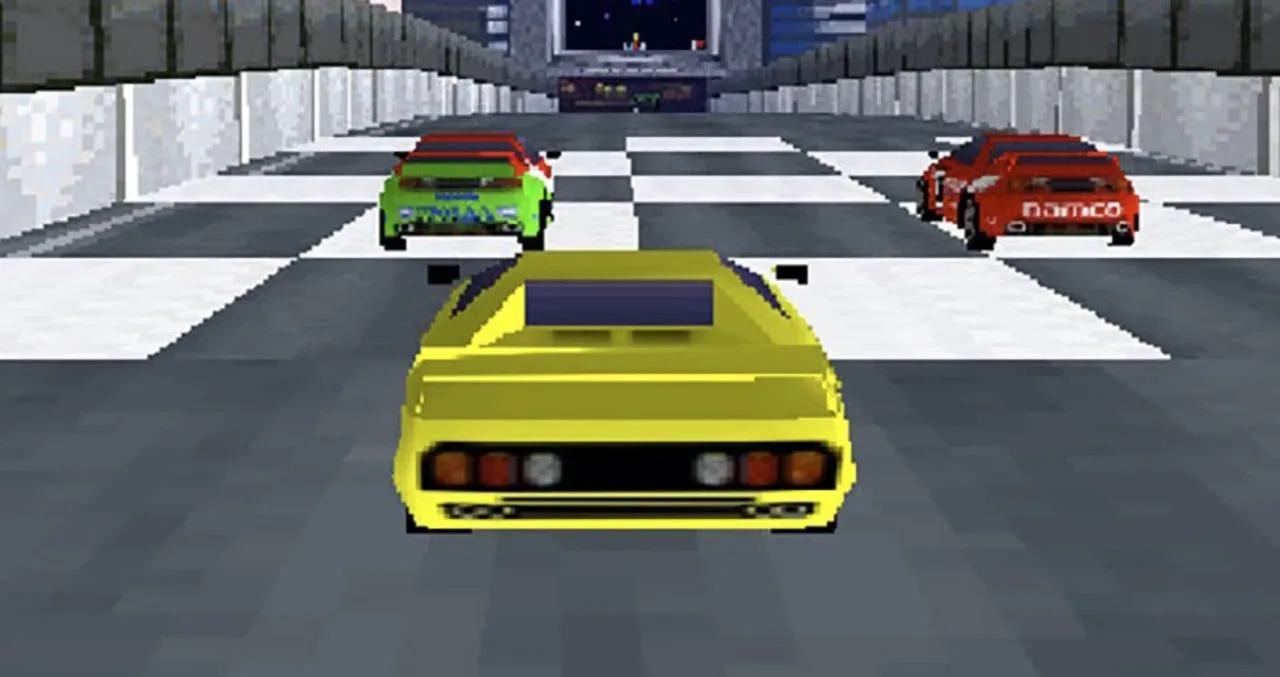
Ridge Racer is preparing to take an unusually narrow route back onto contemporary hardware. G-MODE Archives+ Ridge Racer, a reissue of a Japanese flip phone-era entry in Namco’s racing series, is headed to Nintendo Switch and Steam with the original game’s vertical, portrait-oriented display intact. That means this is not positioned as a newly built arcade conversion, a remake, or a substitute for the famous coin-op original. It is a compact preservation-minded return for a game designed around the shape and screen of pre-smartphone mobile hardware.
The Switch version is set to launch on September 3 through the Japanese eShop for 800 yen. It appears to be a Japan-only Switch release at present. Steam players, meanwhile, are slated to receive a worldwide edition on September 16. The split rollout makes platform and regional details especially important for anyone hoping to add this peculiar Ridge Racer branch to their digital garage.
A Ridge Racer made for a phone held upright
The defining feature is immediately obvious: this Ridge Racer runs in portrait orientation. Modern racing games generally spend every available pixel on a broad view of the road, distant corners, trackside scenery, and rival cars. This one comes from an era when developers had to build around a tall, comparatively restricted mobile display. Rather than erasing that identity to fit a widescreen television or monitor, the Archives+ release retains the vertical framing associated with its original handset version.
That choice should set expectations before the first drift. The game is presented in 3D, but it should not be approached as an arcade-perfect reproduction of the original Ridge Racer. Its technical limits, framing, and design priorities belong to a different platform and a different moment in portable gaming. In exchange, the release offers something that a conventional port could not: a chance to see how a major arcade racing identity was translated for flip phones in Japan.
There is comedy in the image of Ridge Racer attempting its famous powerslides through what is effectively a very tall racing window. But that format is more than a novelty. It is part of the game’s historical character. Mobile adaptations from the pre-smartphone period often had to preserve a recognizable series feel while working within severe display and input constraints. A portrait-screen Ridge Racer is, on its face, an oddity; it is also evidence of the ways developers adapted well-known games to devices that were not built for arcade spectacle.
Small-scale features, recognizably Ridge Racer priorities
Despite its flip phone origins, G-MODE Archives+ Ridge Racer includes a more substantial set of options than its format might suggest. Players can select from three difficulty levels, take on a time trial mode, and choose among four vehicles. Those features establish a basic framework for repeat runs rather than a single, disposable novelty race.
Most importantly, the game is said to retain a reasonably faithful version of the franchise’s drift-centered handling philosophy. Ridge Racer’s arcade appeal has long been tied to dramatic cornering: entering turns with confidence, initiating a slide, and treating the road less like an obstacle course than a stage for controlled exaggeration. The flip phone entry naturally works at a reduced scale compared with a full arcade machine, but its purpose still seems clear. It aims to make the act of sliding through bends feel like Ridge Racer, even within the practical boundaries of early mobile hardware.
That distinction matters because a recognizable logo alone does not make every old mobile tie-in a meaningful archival release. The listed modes and cars point to a game with at least some replay structure, while the emphasis on drifting suggests an effort to carry forward the series’ core mechanical identity. Whether the compressed presentation will feel charming, challenging, or merely curious will depend on each player’s tolerance for the limitations that come with its original format. The available details do not support treating it as a modernized reinvention, but they do describe more than a static curiosity.
Related coverage includes Ridge Racer's Portrait-Mode Flip Phone Port Is Heading to Switch and Steam.
Why the Archives+ treatment fits this release
Phone games from this period have an awkward place in game history. They are frequently remembered in title lists, promotional images, or passing references, yet they can be difficult to revisit because the devices, storefronts, and services that originally carried them have moved on. In many cases, the hardware context is as important as the software itself. Buttons, screen dimensions, and the expectations of someone playing in short sessions all shaped the final product.
Releasing this Ridge Racer entry with its portrait layout preserved acknowledges that context instead of pretending it never existed. There will always be an understandable desire to stretch old games across a modern screen, add widescreen support, or smooth away conspicuous signs of age. Sometimes that is the right route. Here, however, the tall display is not incidental decoration. It is a direct link to the machine category for which the game was created.
That makes the new release particularly interesting for fans who collect the stranger corners of a franchise’s history. Ridge Racer has a widely recognized arcade lineage, but its reach extended beyond the cabinets and home-console versions that tend to dominate retrospectives. A flip phone installment demonstrates the breadth of that reach, including the practical compromises required to put speedy 3D racing on a device that fit in a pocket and closed with a snap.
The broader reissue category has room for both polished classics and artifacts that preserve an era’s unusual constraints. A portrait Ridge Racer falls firmly into the latter camp. It may not deliver the all-consuming visual sweep of a cabinet racer, yet its limitations provide the point. The game offers a record of how 3D racing and brand recognition were negotiated under mobile conditions far removed from today’s touchscreen-first expectations.
Switch and Steam plans are not identical
The release schedule is straightforward, but not uniform. Nintendo Switch receives G-MODE Archives+ Ridge Racer first on September 3, and the stated plan limits that edition to Japan’s eShop. The 800-yen price has been specified for that version. Steam follows on September 16 with a worldwide launch, providing the clearest official route for players outside Japan based on the currently available information.
That regional divide is worth keeping in mind rather than assuming the Switch version and PC version will share the same availability. The Steam release is explicitly worldwide; the Switch release presently appears restricted to the Japanese storefront. Nothing in the available details establishes a wider Switch launch, so prospective buyers should avoid reading one into the announcement.
For PC players watching a busy stream of smaller and unusual releases, the game joins the kind of catalog that makes digital preservation increasingly visible. Our look at an eclectic recent PC game roundup is a reminder that the platform’s appeal is not limited to giant new releases; it can also provide a home for narrowly scoped works and historical curiosities that might otherwise remain difficult to access.
Set expectations for a historical detour, not a definitive conversion
Ridge Racer fans have recently had opportunities to revisit the arcade original and the arcade-only sequel Rave Racer on modern systems. That context could make another Ridge Racer arrival sound like a continuation of the same arcade-revival story. G-MODE Archives+ Ridge Racer is a different proposition. It is not competing to be the best way to play the original, nor does it appear designed to reproduce an arcade cabinet’s audiovisual impact.
Instead, it occupies a more specific lane: an accessible port of a Japanese mobile-era offshoot, complete with the vertical screen arrangement that made sense on its original hardware. The three difficulty settings, four selectable vehicles, and time trial option give it a clear arcade-racing toolkit. The drift emphasis gives it a legitimate connection to the larger series. And the portrait presentation makes it a reminder that game history does not always arrive in the most elegant shape for modern screens.
For some players, that will be exactly the attraction. A Ridge Racer game that looks as if it is trying to escape through a flip phone’s display is inherently memorable, and its preservation on Switch and Steam gives an obscure format a second life without disguising where it came from. Switch owners outside Japan may need to watch for any later regional news, while Steam users can look toward September 16 for the worldwide release. Either way, this is one for anyone who believes the oddest version of a racing series can still be worth taking for a spin.