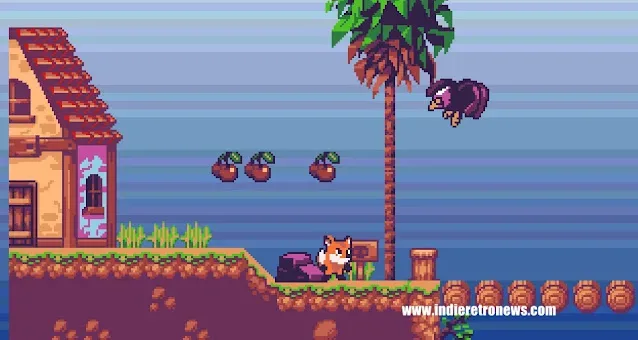
The Commodore Amiga is getting another reason to keep its joystick ports warm. Foxy’s Run, a family-friendly side-scrolling platformer still in development, sends a fox through colourful woodland stages built around an intentionally classic Amiga presentation. The project is listed as being developed by Rairn in the available project details, while its code and music are credited to Adam Templeton.
An early work-in-progress version is available through itch.io, though the game is not yet finished and is expected to remain in development for some time. That distinction matters: Foxy’s Run should be viewed as an early look at a project taking shape, rather than a final release with every feature and balance decision locked in. Still, the outlined feature set already gives retro-platforming fans a clear sense of its intended journey.
The technical target is wonderfully specific. Foxy’s Run uses a PAL 320×256 display mode and a 16-colour palette, choices that place the game firmly in the visual language of the original Amiga era. Better yet for owners of older hardware, the current build is said to require only 1 MB of Chip RAM, with a stock Amiga A1200 also named as a suitable machine. That makes the game’s ambitions less about brute-force modern hardware and more about fitting a complete, attractive platform adventure within familiar Amiga constraints.
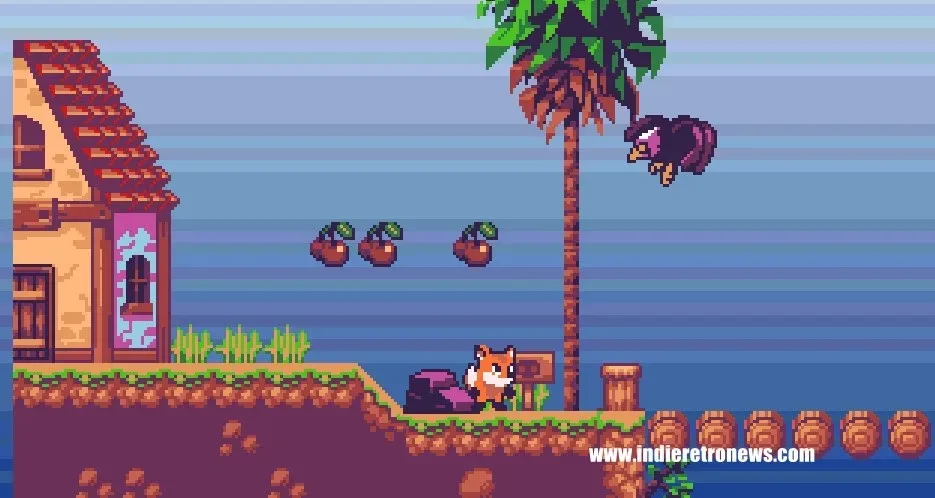
A traditional platforming toolkit, with cherries doing the heavy lifting
Foxy’s Run is designed around the fundamentals players expect from a side-scrolling platformer. The fox can walk, jump, duck, climb ladders and ride moving platforms. Those actions may sound simple, but they establish the building blocks for stages that can shift between ground-level movement, vertical routes and timing-based obstacles.
The protagonist also has a more unusual means of dealing with trouble: collected cherries can be spat at enemies. Rather than presenting the cherries solely as score items or health pickups, the game makes them part of Foxy’s defensive kit. The planned enemy roster includes foes that walk, hop and fly, so the ability to fire cherries should have different tactical implications depending on whether danger is approaching along the ground, bouncing through a lane, or moving overhead.
That approach gives the collectible an immediate gameplay purpose. In a platformer, an item that looks inviting but doubles as ammunition can turn a routine jump sequence into a small decision: save cherries for threats ahead, or spend one now to make a tricky passage safer. The project details do not establish the final limits of carrying or firing cherries, so those specifics remain uncertain, but the basic idea is already a charming fit for the game’s accessible forest setting.
Five maps and a changing seasonal mood
The planned adventure spans five distinct maps. The environments begin in vibrant forest territory, providing a bright, approachable backdrop for the fox’s run. Later, the journey’s colder second half changes the visual theme: enemies are set to receive winter-themed skins as the setting shifts away from its earlier woodland warmth.
That seasonal variation is a neat way to make a compact map count feel broader without abandoning the game’s central identity. It suggests that Foxy’s Run is interested in carrying its initial setting through a visible transition, rather than simply hopping between unrelated biomes. The supplied information does not confirm every location, boss arena or individual stage layout, so it would be premature to treat the five-map structure as a complete level-by-level breakdown. What is clear is that the forest-and-winter contrast is a defining part of the planned visual progression.
For a machine celebrated for its distinctive art and sound, that matters. Amiga platformers often live or die on whether their worlds feel coherent at a glance, and Foxy’s Run is making a deliberate case for a vivid, restricted-colour aesthetic rather than a generic throwback filter. Pixel art is credited to Luis Zuno, also known as Ansimuz and associated with Sunny Land. The art is identified as CC0, with credit not required, although it is explicitly provided for this project.
Hidden gems are the route to the exit
Foxy’s Run’s stage progression is not simply about reaching the far right side of the screen. Players will need to locate hidden gems in order to unlock level exits. This gives exploration a direct role in advancement: a player who can survive the enemies and platform gaps but misses a gem may need to look more closely at the map before moving on.
It is a mechanic with deep roots in classic platform design. Hidden-object requirements can encourage detours, reward curiosity and make ladders, moving platforms and suspicious-looking corners feel more significant than scenery. It also brings a slightly more deliberate rhythm to a genre often associated with continuous forward motion. Foxy’s Run is therefore framing its five maps as spaces to investigate, not just courses to sprint through.
Players begin with three lives, and the overall goal is to reach a final boss after clearing the stages. The project information does not specify the boss’s design, attack patterns, or whether the cherry-spitting mechanic will be central to that encounter. Nor does it detail checkpoints, continues, difficulty settings or other systems that can substantially shape a platformer’s challenge. Those are all sensible areas to watch as development continues.
What has been outlined, however, is a recognisable arcade-era arc: preserve limited lives, uncover what is needed to open each exit, navigate increasingly varied hazards and eventually confront a climactic opponent. That structure should be immediately legible to players who appreciate straightforward objectives with a little secret-hunting folded in.
Built with Amiga-specific audio and display character in mind
The game’s retro identity goes beyond its palette and resolution. Foxy’s Run is set to use a hardware-sprite HUD, an Amiga-specific presentation detail that keeps the interface tied to the machine’s capabilities. Its sound effects are described as authentic Paula audio, a reference to the Amiga’s famous sound hardware, while the music is being made in ProTracker.
Those choices are more meaningful than merely checking off a nostalgia list. ProTracker music and Paula sound are central to how many people remember the Amiga: punchy sampled effects, energetic modules and a character that differs from console chiptunes or later CD-driven game audio. With Templeton handling both code and music, Foxy’s Run has a single credited contributor across two important parts of its mechanical and audiovisual identity.
Technically, the game uses ACE (Amiga C Engine), released under the MPL-2.0 licence. Its development setup also names bartman amiga-debug and AmigaCMakeCrossToolchains as part of the toolchain. These are useful details for anyone following contemporary Amiga homebrew development, where modern cross-development workflows can coexist with software deliberately tailored for period hardware.
A promising early run for Amiga homebrew fans
Foxy’s Run is not being positioned as a finished product yet, and its remaining development time means the early version should not be mistaken for a final statement on its content or polish. But its direction is unusually well defined: low-memory Amiga compatibility, five planned maps, ladder climbing, moving platforms, cherry ammunition, secret gems, seasonal enemy art, a final boss, Paula effects and ProTracker music all point toward a cohesive old-school platformer rather than a vague proof of concept.
It is also a reminder that retro game development does not have to chase modern scale to be interesting. A compact adventure tailored to a 16-colour PAL display can create its own kind of appeal when its movement, secrets and audiovisual personality work in concert. Readers in the mood for another reflection on why old control schemes and hardware quirks still matter may enjoy this look at how an N64 button could be part of a game’s personality.
For now, Foxy’s Run is one to follow for Amiga owners, homebrew collectors and fans of approachable platformers with a tangible connection to the hardware they celebrate. Its fox has cherries, hidden gems and a winterward trip ahead; the rest of the trail will become clearer as the project advances.
Credited development details
- Code and music: Adam Templeton
- Pixel art: Luis Zuno (Ansimuz / Sunny Land)
- Engine: ACE (Amiga C Engine), MPL-2.0
- Toolchain: bartman amiga-debug and AmigaCMakeCrossToolchains