One of Japanese PC gaming’s stranger surviving mysteries has acquired a very specific new clue: people who mailed in registration cards for Cookie’s Bustle: Mysterious Bombo World in 1999 were reportedly invited to a private event in Tokyo more than two decades later.
The event itself appears to have happened, with posts describing live performances of music from the game, character-themed cookies, merchandise and a person dressed as Cookie. What remains unresolved is the part that matters most to players who have spent years trying to trace this unusual point-and-click adventure: why now, who is behind the renewed activity, and whether it leads to an actual return for the game.
For the moment, there is no confirmed rerelease, remaster, sequel or new platform version. The invitations and the party suggest renewed attention, not a product announcement. That distinction is essential when dealing with a game whose history has already been shaped by scarce copies, incomplete documentation and contested online ownership claims.
The invitation points to a possible return, not a confirmed game launch
An invitation attributed to an “Official Cookie’s Bustle Team” thanked recipients for their adventure with Cookie, stated that the game was discontinued in 2001, and said Cookie and Gray the rabbit had entered a long hibernation. Its central tease was that, as that sleep nears its end, these early customers would be the first to receive the news.
“And as the end of that deep slumber approaches, you, our most valued customer, will be the first to receive the news.”
That wording is deliberately forward-looking, but it does not say what the news is. It could indicate any number of things, including an archival initiative, a reunion-style project or a commercial revival. None can be treated as established from the invitation alone.
The reported selection method is arguably the most remarkable detail. A registration card was once a familiar piece of physical software-era administration: buyers filled in and mailed a card to a publisher or related business, often for customer records, warranty information, promotions or future correspondence. If the invitations genuinely reached people through those cards, someone involved with the gathering had access to records tied to the game’s original customer base.
That does not, by itself, identify a rights holder or prove a development plan. It does underline the unusual degree of continuity implied by the event. For a title that disappeared from ordinary circulation after its discontinuation, contacting registrants from 1999 is a far more deliberate gesture than simply posting a social-media anniversary message.
Related coverage includes Cookie's Bustle Mystery Deepens as 1999 Registrants Receive Secret Event Invitations.
A Tokyo gathering with a confusing anniversary label
The Tokyo function was reportedly held by QualityTime Consulting, a Japanese technology firm established in 2006. Its precise relationship to Cookie’s Bustle is not clear from the available information. Reports from attendees and material tied to the event used labels including “25th secret event” and “time capsule event.”
There is an evident chronological wrinkle: Cookie’s Bustle: Mysterious Bombo World was released in 1999, while the reported event occurred in 2026. That is 27 years later, not 25. The “25th” language should therefore be understood as event branding or a delayed anniversary observance, rather than a precise calculation of the game’s release anniversary, unless further clarification emerges.
The lack of photographs also adds to the uncertainty. Attendees were apparently told not to take pictures, yet details still circulated publicly. Those details paint a celebratory, fan-oriented scene rather than a formal reveal presentation: musicians performed music associated with the game; exclusive items were present; Cookie appeared in costume; and Cookie-shaped baked goods made the character’s bear-like silhouette literal dessert.
That atmosphere is meaningful in one limited sense. It shows that the game’s unusual world, music and character identity remain important enough to stage physically for a small community. It does not establish that new software is imminent.
Why Cookie’s Bustle remains such an oddity
Released in 1999, Cookie’s Bustle: Mysterious Bombo World is described as a surreal point-and-click adventure. In practical genre terms, a point-and-click adventure centers on selecting objects, places or characters in an environment to explore spaces, solve puzzles and advance a narrative, rather than relying primarily on reflex-driven combat or action controls.
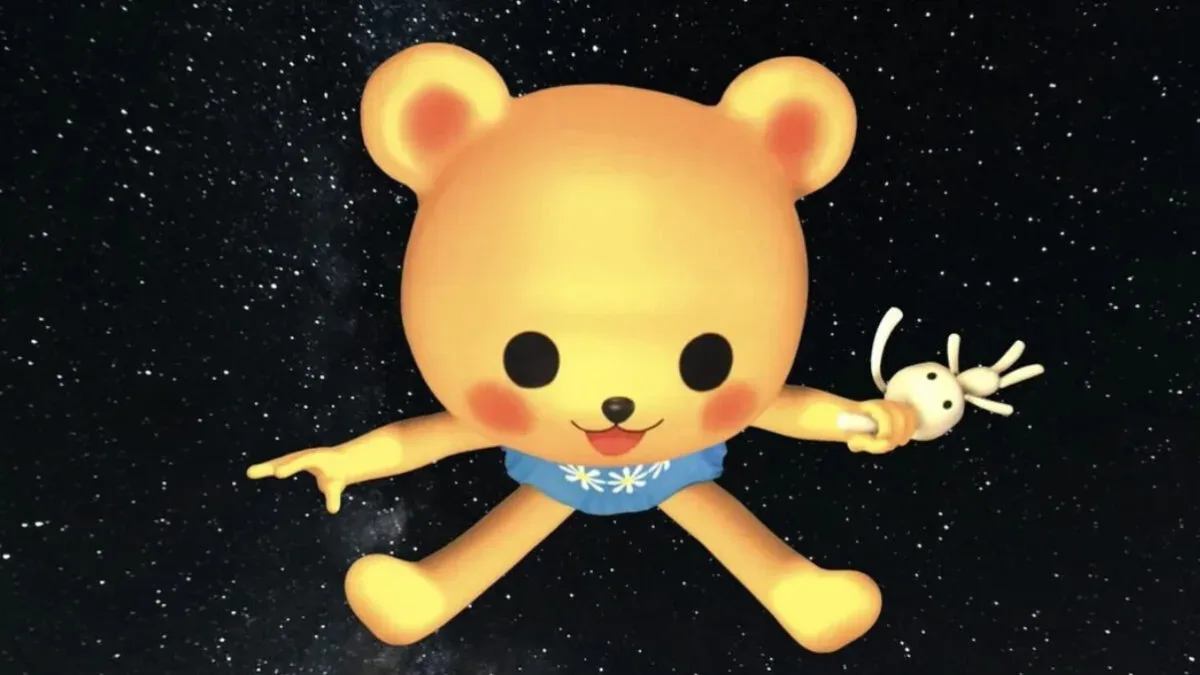
Its premise is about as resistant to a tidy elevator pitch as its later history. Cookie is a girl from New Jersey who believes she is a bear and looks the part. She travels to an isolated island nation founded by aliens from space in order to compete in athletic games, only to become entangled in a violent revolution presented with a disarmingly cute edge. Gray the rabbit, named in the invitation, is part of the game’s character world as well.
That collision of cheerful design, dreamlike logic, sport, alien history and political upheaval helps explain why the game earned dedicated admirers despite its obscurity. It is not merely an old game that is hard to find; it is a work with an unusually singular premise and an incomplete public record. The very act of describing it can sound fictional, which has likely amplified curiosity among preservation-minded players.
Its situation also fits a broader preservation challenge around older Japanese computer games. Japan had PC players and PC developers in the 1990s, but that scene was smaller than the country’s console market. Games distributed into a narrow market can become difficult to locate when physical media, manuals, registration material and company records disperse. The result is that a game’s cultural footprint may outlast its practical accessibility.
Other surreal Japanese PC titles have cultivated devoted audiences over time, including Garage: Bad Dream Adventure, Zeddas and Cosmology of Kyoto. The shared thread is not that these games are identical, but that unusual works from limited and aging PC ecosystems can become exceptionally difficult to study, play and document. Preservation news in that space can be as consequential as conventional release news. For a different example of retro computing’s continued creative life, see this look at a new first-person dungeon crawler for an unexpanded Commodore 64.
The digital-history dispute makes the revival hints more complicated
Cookie’s Bustle has attracted attention not only because of its content, but because material documenting it was reportedly removed from the internet. Videos began disappearing from ClassicsOfGame’s detailed YouTube page covering the title. Fans connected the takedowns to an individual identified as Brandon White, who was accused of using copyright claims in an attempt to remove the game’s online footprint.
A DMCA takedown is a request made under the U.S. Digital Millennium Copyright Act asking an online service to remove allegedly infringing content. The procedure is intended to give copyright owners a way to protect their work, but it can create serious difficulties when ownership is disputed or when the targeted material is archival documentation. A takedown notice is not, on its own, a final legal determination of who owns the underlying work.
Attempts to contact creator Keisuke Harigai reportedly did not succeed. The Video Game History Foundation later used legal action that, by March, had ended the challenge attributed to White and allowed the ClassicsOfGame page to be restored. That restoration matters because gameplay footage, itemized records and other documentation can be vital when a game itself is rare. When old software is inaccessible, reliable video and cataloguing are often how future players, researchers and fans can establish what existed.
This is why the latest event cannot be viewed only as an eccentric birthday party. It arrives after a fight over whether the game’s public digital record could remain visible at all. If an authentic revival effort is forming, clear communication around rights and preservation would be more valuable than cryptic promotion. A proper rerelease would need to answer basic questions about authorization and access; an archival project would need to make its custodianship and goals understandable.
What players should and should not infer
The strongest supported takeaway is modest: a private Cookie’s Bustle gathering reportedly took place, some original registrants were apparently invited, and its messaging suggested that Cookie’s long dormancy may be nearing an end.
Several attractive conclusions remain unconfirmed:
- A remaster has not been announced.
- A modern rerelease has not been announced.
- A sequel has not been announced.
- QualityTime Consulting’s role in the property is not established.
- The exact nature of the coming “news” has not been disclosed.
For fans, restraint is warranted, but so is cautious interest. The event’s use of legacy registration information, its game-specific musical and visual touches, and its hibernation language collectively make this more substantial than a passing online reference. At the same time, Cookie’s Bustle has always been a game surrounded by gaps. Until someone responsible states what is next, the sensible reading is that its story has reopened—not that its next chapter has already been published.