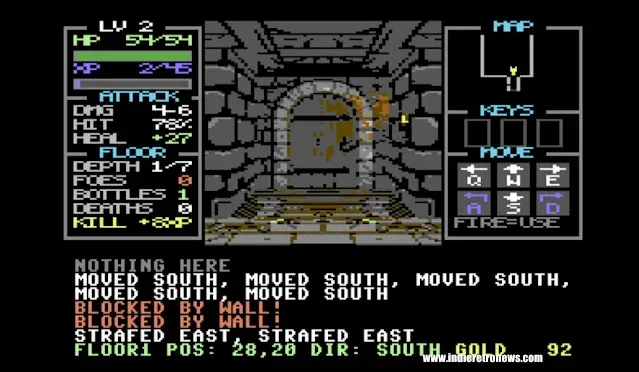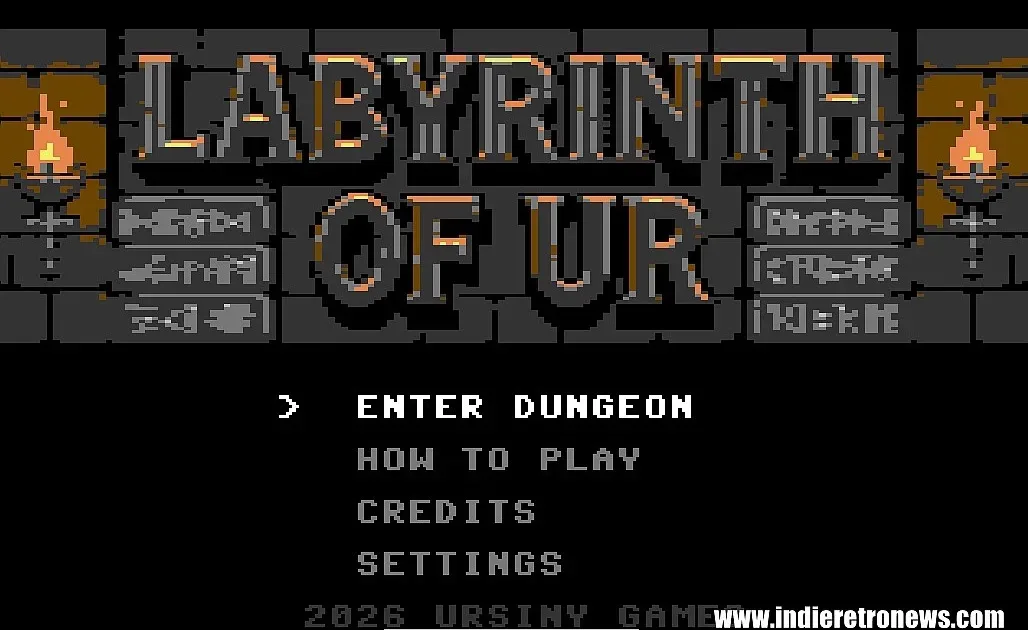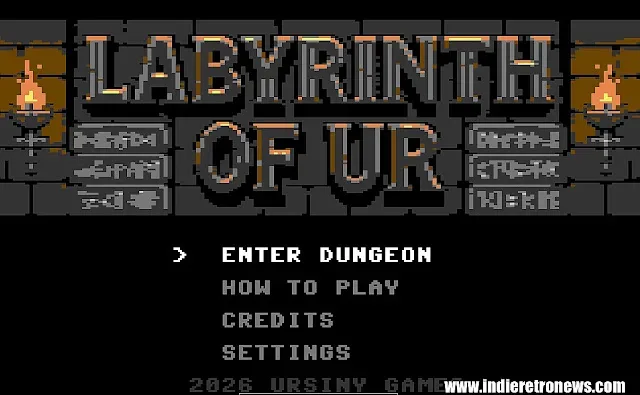
Labyrinth of Ur is a new first-person, 3D dungeon crawler from developer Ursimon, built for the Commodore 64. Its premise is pleasingly direct: play as a lone warrior named Lance, descend into a dangerous labyrinth, survive its threats, unlock the route onward and emerge with as much gold as possible.
The technical angle is as notable as the fantasy setup. Labyrinth of Ur was built from scratch in C for unexpanded PAL Commodore 64 machines, with AI used as part of its development. That means the game is intended for a standard PAL-spec C64 configuration rather than relying on added memory hardware. For a genre associated with more powerful computers and comparatively lavish 3D presentation, that target makes the project an especially interesting retro release.
Seven shifting floors beneath the labyrinth
Lance’s journey covers seven procedurally generated dungeon floors. Procedural generation means that the game creates its layouts through rules and systems rather than presenting one fixed, manually authored map every time. In practical terms, players should expect the route through the dungeon to vary, rather than learning a single permanent floor plan by heart.
The floors range from tight, maze-like rooms to large halls. That distinction matters in a first-person crawler because room scale changes how navigation feels. Confined sections can make it more difficult to maintain bearings or anticipate what lies beyond a turn. Bigger spaces, by contrast, can make the dungeon feel more exposed and may place more emphasis on surveying the area before committing to a direction.
The supplied game details do not specify enemy types, combat systems beyond the sword, or the exact rules governing each generated floor. What is clear is the central loop: navigate, fight, locate keys, open guarded doors, recover health through potions and collect gold on the way toward the victory screen.
Keys, doors and limited recovery
Labyrinth of Ur gives Lance a sword and places colored keys at the center of progression. Those keys open heavily guarded doors, creating a familiar dungeon-crawler rhythm: a blocked route establishes a short-term objective, exploration turns up the required item, and the newly accessible door reveals the next part of the floor.
Color coding is useful design shorthand in a maze game. It lets a player connect an obstacle with a particular tool without requiring lengthy text explanations. When the layouts themselves are procedural, that kind of immediately readable goal can be especially important. A player may not know the map, but they can understand the task: find the key that matches the way forward.
Healing potions are another essential resource. Their presence suggests that damage management is a significant part of a successful descent, not merely a cosmetic concern between sword fights. Since the game’s stated objectives include scavenging for those potions, players will need to weigh movement and exploration against the need to preserve health. The available details do not establish whether potions are scarce, how they are used, or whether there are other recovery methods, so those particulars remain unknown.
Related coverage includes Labyrinth of Ur Takes First-Person Dungeon Crawling to Commodore 64.
Gold has a purpose beyond the immediate run
Gold hoards are not described as a simple collectible for its own sake. The treasure contributes to the player’s final rank on the victory screen. That makes gold a performance measure: completing the descent may be the basic goal, but completing it efficiently and thoroughly could affect how the run is remembered by the game.
It is a straightforward but effective incentive in a procedural dungeon. A player who only seeks the critical key-and-door path may reach the end, while someone hunting for additional gold accepts more of the labyrinth’s risk in pursuit of a stronger final result. The source material does not define the ranks, scoring thresholds or whether gold can be spent, so it should not be assumed that it functions as an in-game currency.
That emphasis on a victory-screen ranking also gives repeat attempts a clear point. Randomized floors can make subsequent descents different, while the gold total provides an obvious benchmark for a better run. It is not necessarily a sprawling role-playing progression system; based on the available description, it is a focused survival-and-score structure.
A C64 take on a PC dungeon-crawling tradition
Labyrinth of Ur is inspired by Dungeon Master and Eye of the Beholder, two landmark first-person dungeon crawler references. The comparison identifies the intended genre language: the player looks into the dungeon from a first-person viewpoint, advances through enclosed spaces, encounters dangers directly in the maze and solves progress barriers through exploration.
“3D” here should be understood in the genre’s visual and navigational sense: the dungeon is presented from Lance’s first-person perspective, so corridors and rooms have depth rather than being shown as a top-down map. It does not automatically tell us the rendering technique, frame rate, control scheme or degree of movement freedom. Those details have not been provided.
Still, putting that style of crawler on a stock PAL C64 is the story. The system remains a fertile platform for new projects precisely because developers continue to explore what can be done inside its fixed limitations. Labyrinth of Ur approaches that challenge through original C code and a design built around procedural layouts, tangible keys, guarded thresholds, healing resources and score-minded treasure hunting.
Retro hardware projects also sit within a broader culture of finding new uses for established machines. The C64 is not alone in that respect; later hardware has likewise been adapted in unexpected ways, as shown by this look at how the Game Boy Player turned the GameCube into a handheld gaming hub.
What AI-assisted development does—and does not—tell us
Ursimon developed Labyrinth of Ur with AI assistance, but that phrase needs a little care. It confirms that AI helped during development; it does not, by itself, identify which tasks involved AI, how extensively it was used, or what role it played in coding, design, artwork, testing or other work. Without those details, it would be inaccurate to describe the game as wholly AI-made or to assign specific work to an AI system.
The confirmed facts are more concrete: the game was built from scratch in C and is made for unexpanded PAL Commodore 64 systems. C is a programming language, and using it for a machine with the C64’s constraints points to a development effort centered on fitting a first-person dungeon experience into a platform with tightly bounded resources. The supplied information does not provide performance metrics or implementation details, so any deeper claims about memory use or technical methods would be speculation.
What prospective players can expect
- A Commodore 64 first-person 3D dungeon crawler developed by Ursimon.
- A lone protagonist, Lance, armed with a sword.
- Seven procedurally generated floors to descend.
- Dungeon spaces spanning cramped maze-like areas and larger halls.
- Colored keys used to open heavily guarded doors.
- Healing potions to scavenge during the descent.
- Gold hoards that affect the final victory-screen rank.
- A game built in C for unexpanded PAL C64 machines, with AI assistance used in development.
For players drawn to old-school dungeon delving, the appeal is easy to read. Labyrinth of Ur concentrates on core crawler decisions: where to go, which locked route to pursue, when to press onward after taking damage and how much treasure is worth risking a detour for. Its procedural structure should keep that familiar formula from becoming a memorization exercise, while its C64 target gives the project a distinct technical identity.
There are still open questions around distribution, controls, enemies, audio, difficulty and the precise behavior of its random generation. But the disclosed design is already coherent: descend through seven changing floors, keep Lance alive, find the means to move deeper, and leave with enough gold to make the victory rank count.