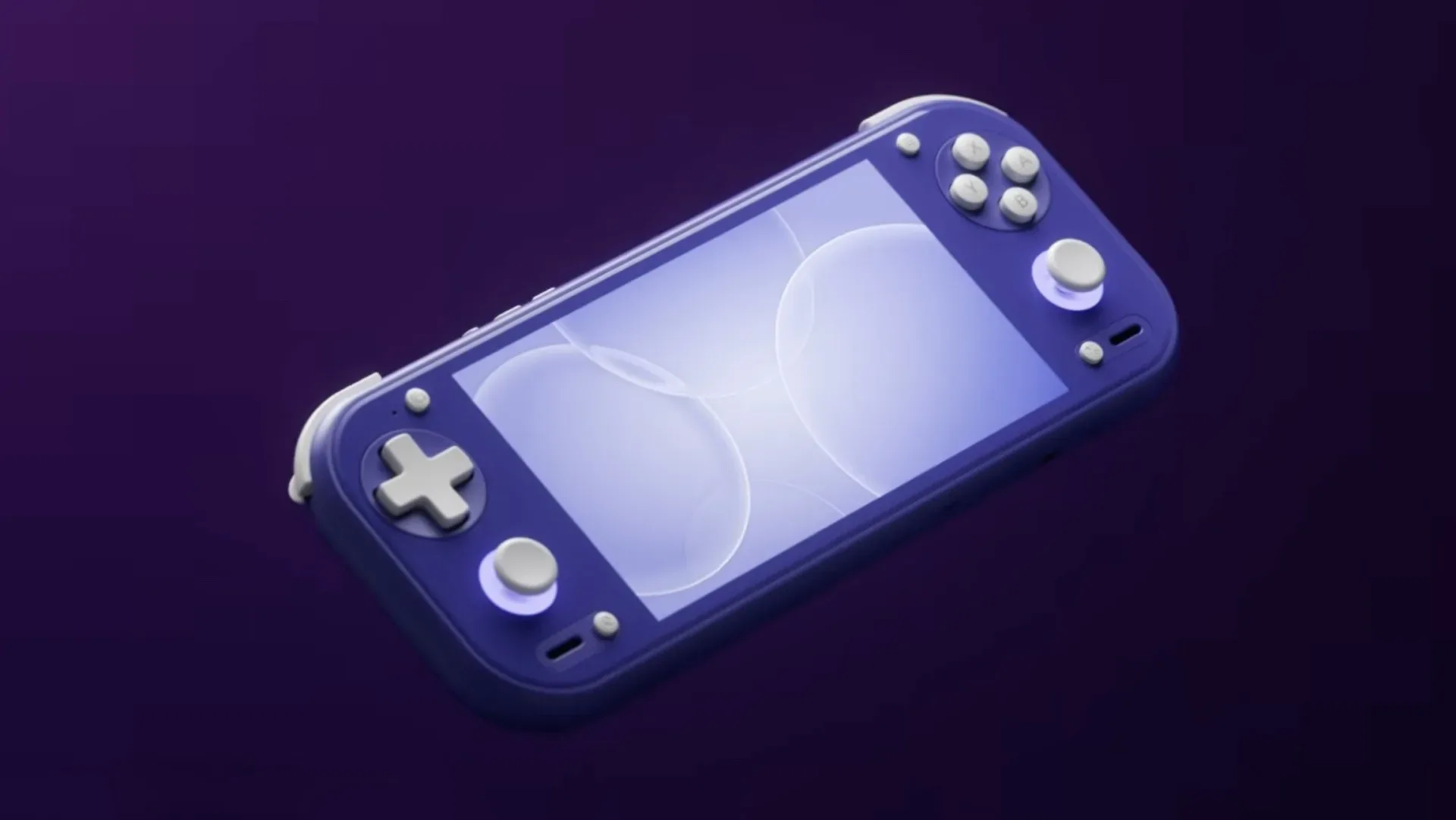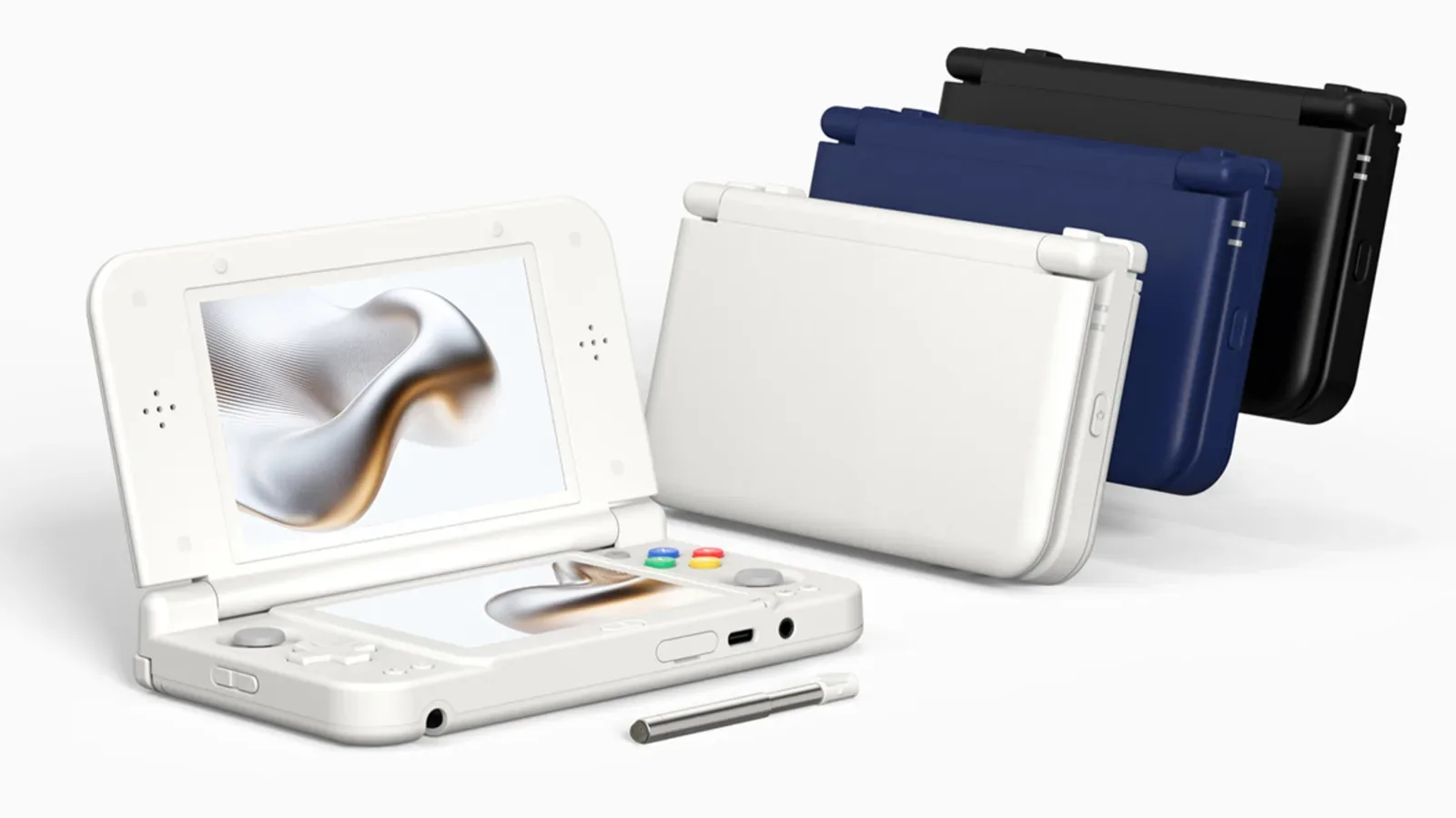
Anbernic’s 55G1 has moved from intriguing lookalike to released Android handheld. The compact system, whose silhouette immediately calls Nintendo’s Switch Lite to mind, is now officially available with a Qualcomm Snapdragon G1 Gen 2 processor and Qualcomm Adreno A12 graphics. That hardware pairing also gives the 55G1 a notable place in Anbernic’s catalogue: it is the company’s first device powered by Qualcomm Snapdragon technology.
It is a substantial update to the early picture of the machine. When the 55G1 first surfaced in June, its processor had not been confirmed, though Snapdragon-based hardware had been suggested in reports. Anbernic has now supplied the key specifications, including its Android 14 operating system, display resolution, battery capacity, storage configurations and starting prices. The headline is no longer merely that this handheld looks very familiar; it is that the feature list is finally concrete.
A Switch Lite-shaped Android handheld, with its own spec sheet
The 55G1 does not make much effort to hide the visual inspiration behind its design. Its broad, one-piece portable form and control layout create a strong resemblance to Nintendo’s handheld-only Switch Lite. That resemblance is likely to be the first thing many people notice, especially in the Black, Retro Grey and Indigo finishes currently offered.
But the 55G1 is not a Switch accessory or a Nintendo product. It is an Android 14 handheld from Anbernic, a company long associated with portable devices designed around emulation and retro-game use. Its previous hardware has often taken visual cues from established systems, including the Game Boy Advance, Nintendo DS and PlayStation Vita. The 55G1 continues that design tendency while targeting a more modern, higher-resolution handheld format.
At the centre is a 5.5-inch Incell IPS screen with a 1920×1080 resolution. Earlier details had pointed to a 5.5-inch panel beneath 2.5D glass, and the official specification now establishes both the screen size and Full HD resolution. On paper, that gives the device a sharp display for Android applications and compatible game software, while keeping the physical dimensions closer to a small dedicated portable than to a large tablet-like gaming device.
The system also includes dual front-facing speakers, a 3.5mm headphone jack, USB-C and MicroSD card support. Wi-Fi and Bluetooth are listed, while active cooling is included to help manage the heat generated by the chipset during more demanding use. There is no need to read too much into that fan by itself, but its inclusion distinguishes the 55G1 from simpler low-power retro portables that can operate without active cooling.
Snapdragon arrives in Anbernic hardware
The confirmed Qualcomm Snapdragon G1 Gen 2 CPU and Qualcomm Adreno A12 GPU are the major newly clarified elements. For Anbernic, the chipset brand matters as much as the individual component names: the 55G1 is described as its first Snapdragon-powered handheld.
That does not automatically answer every performance question. Processor and graphics branding alone cannot establish how each Android game, emulator, operating-system update or user configuration will behave. Nor do the listed specifications identify a complete supported software library. Still, confirmation is preferable to the initial uncertainty, and it gives prospective buyers a far clearer starting point than the early rumours did.
The device is offered in two memory and storage versions:
- 4GB RAM with 64GB storage, starting at $139.99.
- 8GB RAM with 128GB storage, starting at $164.99.
MicroSD support is especially relevant to the second half of that equation. Built-in storage capacity is one consideration, but expandable storage provides flexibility for users managing media, Android apps and their own legally obtained game files. It is worth separating that practical storage feature from any assumptions about bundled content: the available specification details do not establish what software, if any, is preloaded on the 55G1.
Controls lean into modern anti-drift hardware
Anbernic has equipped the 55G1 with 3D Hall-effect joysticks and Hall-effect triggers. Earlier information also described the two sticks as symmetrical and noted RGB lighting around them. Hall-effect controls use magnetic sensing rather than relying on the same physical contact approach used by conventional analog assemblies, a design increasingly promoted in gaming hardware for its potential durability advantages.
In layout terms, the handheld places the D-pad above the left analog stick. That is an arrangement with an obvious retro-console lineage, and it may be particularly appealing to players who give digital directional input a prominent role in platformers, fighting games and older software. The symmetry of the two sticks, meanwhile, preserves the familiar portable-console profile that the exterior is clearly chasing.
None of this makes the 55G1 a direct replacement for every portable device. A physical layout can be comfortable for one person and awkward for another, and the official details do not settle matters such as button feel, trigger travel, fan volume, display brightness or real-world battery duration. Those are all meaningful considerations that cannot be inferred solely from a launch specification sheet.
Battery, cooling and connectivity are part of the pitch
Anbernic lists a 6,000mAh battery for the 55G1. Capacity is an important number, but it should not be mistaken for a promised number of hours. Battery life varies considerably with screen brightness, wireless use, processing load, cooling activity and the software being run. The supplied details confirm the capacity, not a universal endurance figure.
The combination of a 1080p display, active cooling, Wi-Fi, Bluetooth and a Snapdragon platform paints the 55G1 as a more ambitious Android handheld than a basic throwback device. At the same time, familiar conveniences remain: wired audio through the 3.5mm jack, USB-C connectivity, front-facing speakers and MicroSD expansion all make sense on a portable designed for a variety of uses.
Anyone building a wider retro setup should also remember that connectors and display standards matter as much as an attractive handheld shell. For a useful primer on assessing older systems before attaching them to modern screens, see this guide to mapping retro console connections before buying an HDMI adapter. The 55G1 itself lists USB-C, but the published specifications referenced here do not establish HDMI output support, so it would be unwise to assume a television-output feature that has not been listed.
What has changed since the first 55G1 details
The 55G1 was initially presented as an upcoming unit with a strong Switch Lite resemblance, a rumoured 5.5-inch screen, dual front speakers, an internal fan, a headphone port, USB-C, MicroSD support and Hall-effect controls. Its processor was the unresolved question. Reports at the time indicated that Snapdragon hardware was possible, but no official chip had been named.
As of the August 31 update, that uncertainty has been replaced by a formal list: Android 14; Snapdragon G1 Gen 2 CPU; Adreno A12 GPU; 5.5-inch 1920×1080 Incell IPS screen; 6,000mAh battery; Wi-Fi and Bluetooth; active cooling; Hall-effect triggers and joysticks; and the two RAM-and-storage options. It is now available in Black, Retro Grey and Indigo, beginning at $139.99 for the 4GB/64GB configuration and $164.99 for the 8GB/128GB version.
For the retro-handheld audience, the pitch is straightforward. The 55G1 packages a deliberately recognizable compact-console look around modern Android software, an officially identified Snapdragon platform, a Full HD display and a control set built around Hall-effect components. The final judgement will depend on factors not demonstrated by a component list, but the device’s basic proposition is no longer a mystery.