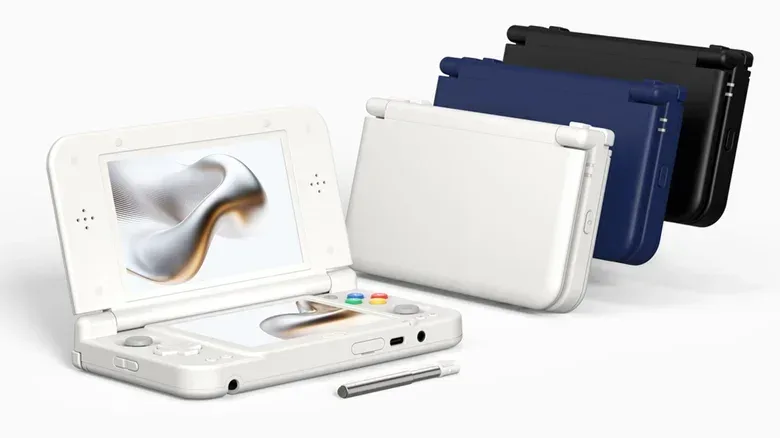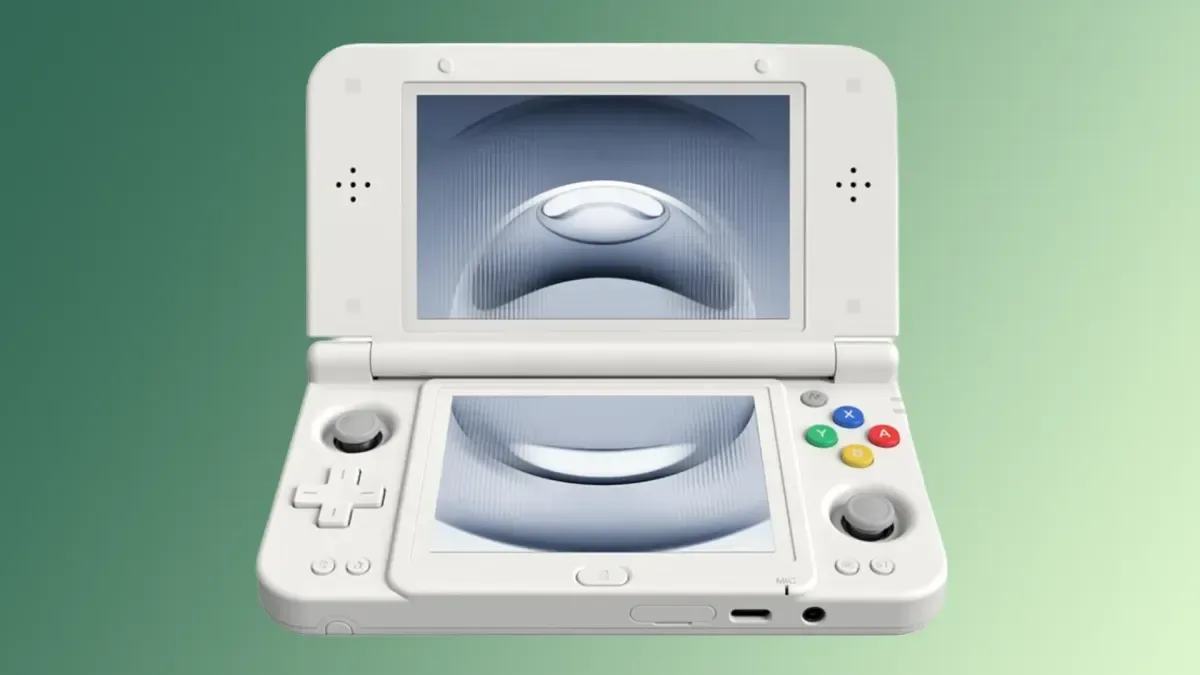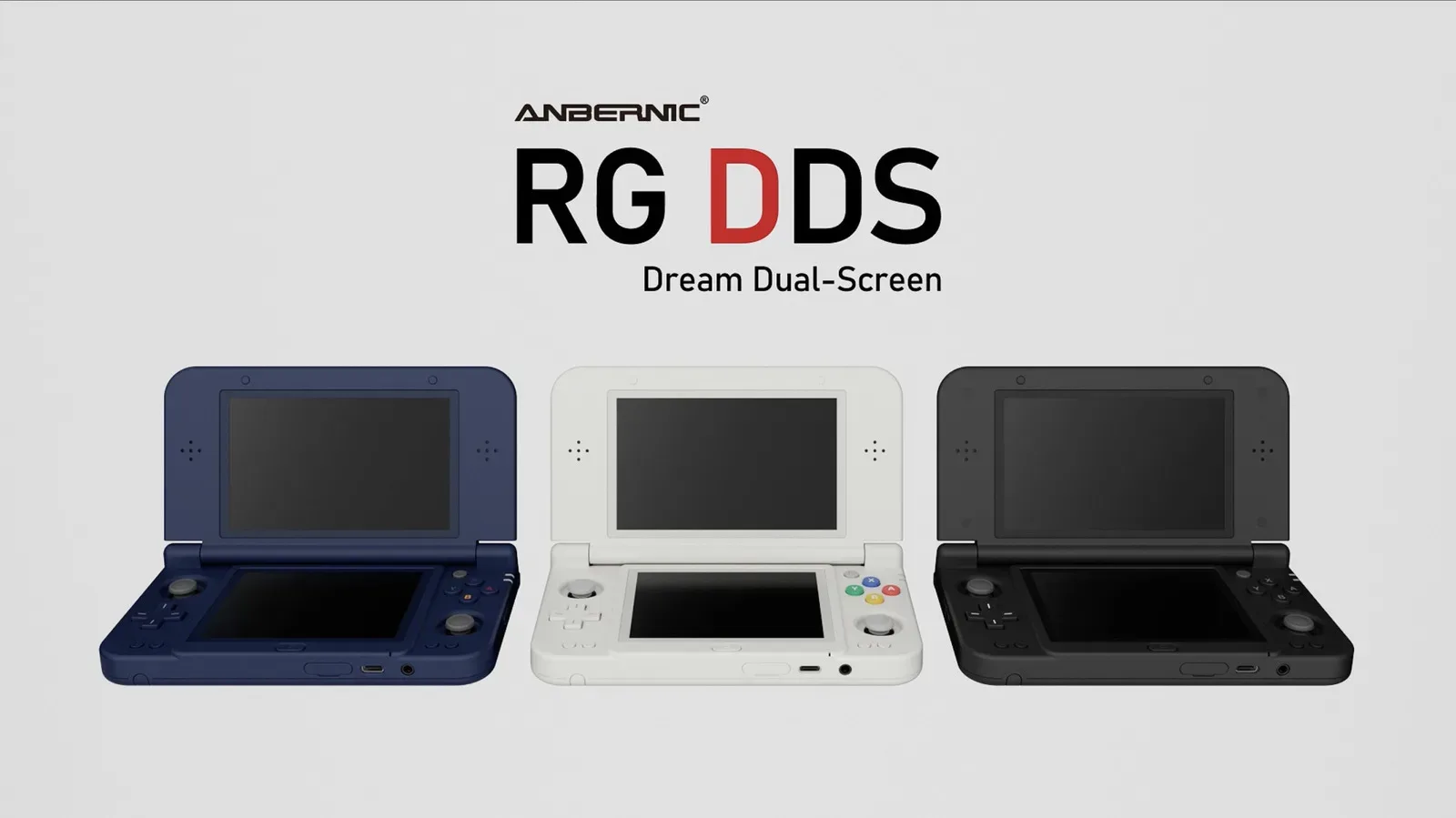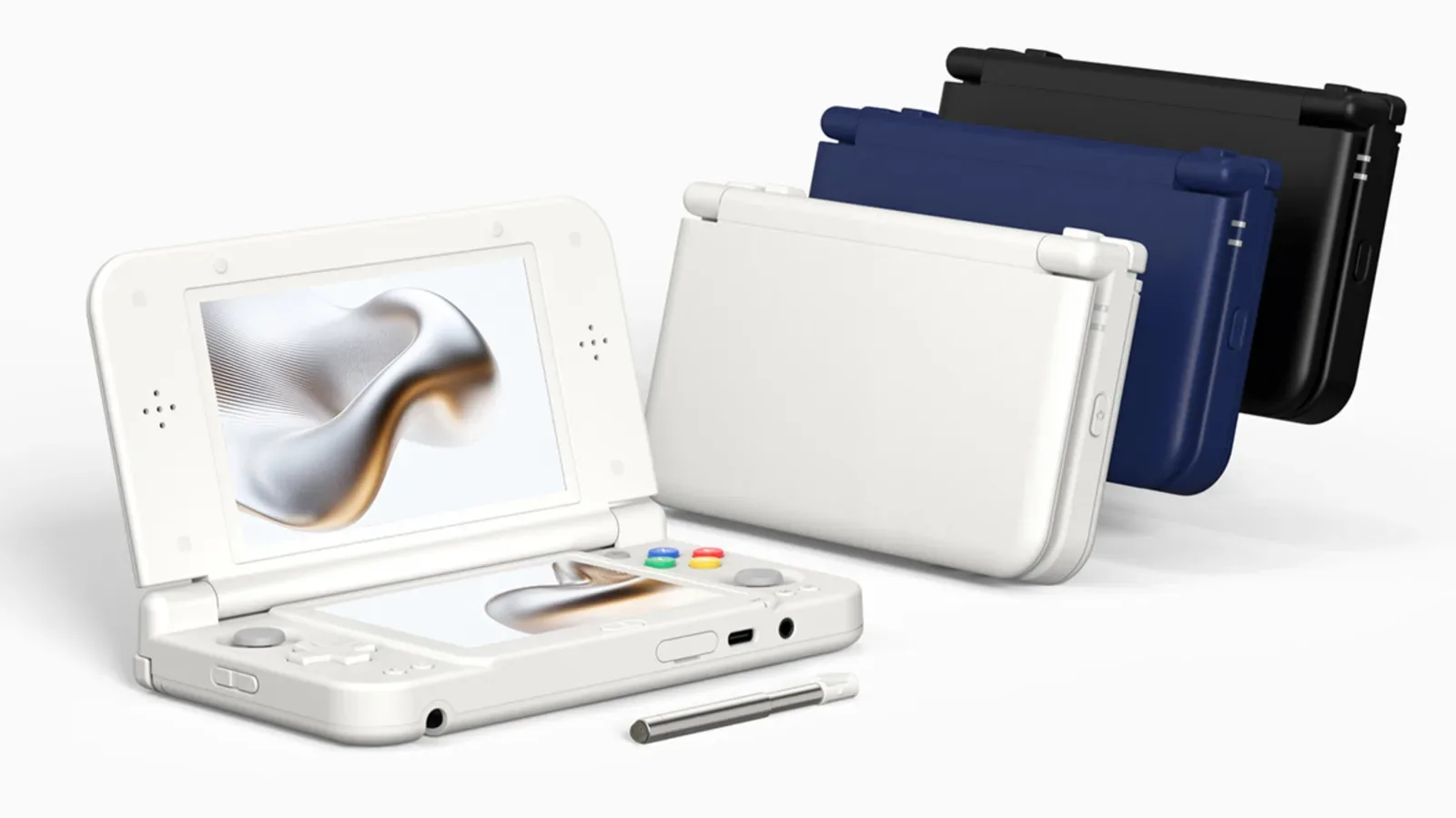
Anbernic is taking a notably more premium route with the RG DDS, a dual-screen clamshell handheld that recalls the basic shape and intent of Nintendo’s 3DS family while aiming for a far broader Android-based feature set. The device is priced at $299.99, with a temporary preorder price of $284.99, and Anbernic says shipping will begin gradually on December 10, 2026.
That price is a meaningful departure for a company associated with budget-minded handhelds. The RG DDS is not being positioned simply as an inexpensive nostalgia machine with two screens. Its listed specification sheet includes a Snapdragon G2 Gen 2 processor, Android 16, two memory and storage configurations, Wi-Fi 6, Bluetooth 5.4, 1080p display output, a six-axis gyroscope, and a dedicated AI button. The result is a device whose appeal will depend less on a single legacy platform and more on whether buyers value a compact, dual-display Android handheld with unusually broad connectivity and expansion options.
What Anbernic has confirmed for the RG DDS
The RG DDS will be offered in two configurations:
- 8GB of memory and 128GB of storage
- 12GB of memory and 256GB of storage
Both versions include a microSD card slot supporting up to 2TB of additional storage. That matters because Android handheld use can involve a mixture of installed applications, local media, game files and system data. Built-in capacity determines how much can live on the device from the start, while microSD expansion gives owners flexibility to add space later rather than treating the internal storage figure as a permanent ceiling.
Anbernic is using Qualcomm’s Snapdragon G2 Gen 2 platform, which it presents as capable of supporting emulation beyond 3DS titles. “Emulation” in this context means software recreating the behavior of another hardware platform so compatible software can run on the host device. Processor capability is important to that task, but it is not the only consideration: individual applications, software optimization, control mapping, screen behavior and operating-system support can all shape the eventual experience. The confirmed specification establishes the RG DDS as substantially more ambitious than a device built around a narrowly defined retro target, but it does not by itself answer how every application or title will perform.
The operating system is Android 16. This is a practical distinction rather than a cosmetic bullet point. Android opens the door to the ecosystem of available emulator applications and other apps, instead of tying the handheld to a single closed-purpose interface. For prospective buyers, that can mean more choice, but also more setup decisions. Different applications may offer different layouts, controller support, display options and feature sets. A dual-screen physical design can be especially interesting when software benefits from placing different information on separate displays, although the usefulness will depend on how each app handles the hardware.
A 3DS-inspired design without the glasses-free 3D
The RG DDS is clearly drawing attention because it is a clamshell with two screens, a configuration closely associated with the Nintendo DS and 3DS lines. But there is one major feature it will not reproduce: glasses-free 3D. Anbernic has confirmed that the RG DDS does not include the stereoscopic display technology found in the original Nintendo 3DS.
That absence helps clarify what kind of homage this is. The RG DDS is borrowing the dual-display, folding-handheld concept, not attempting a one-to-one recreation of every defining feature of Nintendo’s hardware. Instead, Anbernic points to its higher-resolution displays as part of the tradeoff. Higher resolution refers to a display’s number of pixels, which can allow a sharper image when software and display scaling make good use of that resolution. It is a different benefit from stereoscopic 3D: extra pixels do not create depth, and depth effects do not inherently make an image sharper.
The distinction is worth keeping in mind for anyone reading the RG DDS as a direct replacement for a 3DS. It is not one. The lack of glasses-free 3D is a firm hardware difference, while the Android operating system, Snapdragon platform, storage expansion and modern wireless support give it a very different functional identity. The more accurate expectation is a contemporary Android handheld in a dual-screen clamshell format, rather than a modernized replica of Nintendo’s older device.
Why the second screen is only part of the proposition
Two displays are the visual headline, but the remaining hardware indicates that Anbernic wants the RG DDS to work beyond its folded form factor. The system supports 1080p display output, allowing video output at 1080p resolution to a compatible external display. That can be useful for owners who want the option of moving from portable use to a larger screen, though the confirmed details do not specify the connection method, accessories, dock behavior, refresh rates or how individual Android apps will behave when output externally.
It also includes Wi-Fi 6 and Bluetooth 5.4. Wi-Fi 6 is a wireless-network standard, while Bluetooth is commonly used for short-range connections to accessories and other devices. Their inclusion gives the RG DDS current-generation connectivity on paper, but buyers should separate the standard names from guarantees about their own network or accessory performance. Real-world results can depend on routers, paired devices, software and the surrounding wireless environment.
A six-axis gyroscope sensor is also listed. In broad terms, motion-sensing hardware can track movement and orientation, potentially allowing apps that support motion controls to use physical movement as an input. The specification does not establish which software will take advantage of it, or how motion features will be mapped across apps. Still, its presence adds another input option to a handheld already defined by a more elaborate physical layout than a typical slab-shaped Android device.
For audio, Anbernic includes a 3.5mm audio jack. In a device with Bluetooth 5.4, the wired jack provides an alternative to wireless audio accessories. It is a small listing detail, but it preserves a straightforward connection for compatible headphones and speakers without making wireless pairing the only path.
The AI button is the least defined part of the package
Among the RG DDS’s more curious design choices is its dedicated AI button. Anbernic says the button will provide game guides and strategies, real-time translation during gameplay, and other unspecified “fun AI features.” Those promises point toward a contextual assistance tool: something intended to surface help or translate content while a user is playing rather than requiring a separate device or a manual search.
However, the details that would determine the feature’s day-to-day value have not been specified. There is no confirmed explanation of which games, languages or applications will be supported; whether an internet connection will be required; how information will be sourced; what the interface will look like; or what the unspecified extra features are. Game-guide assistance and real-time translation are therefore confirmed aims, not fully described finished workflows.
That uncertainty is especially relevant because AI labels cover a wide range of functions. A button assigned to an assistant can be convenient if it reliably delivers useful information in the moment. It can also become a minor novelty if the results are slow, shallow or inconsistent. Buyers interested chiefly in the AI controls should wait for details about the actual implementation instead of treating the button alone as a complete feature specification. Broader questions around AI-enabled software are also becoming more important across app ecosystems, as seen in recent App Store policy changes involving AI features, though no comparable policy claim has been made here about the RG DDS.
Price, configurations and the practical buying question
At $299.99, or $284.99 during the temporary preorder discount, the RG DDS asks buyers to evaluate more than its resemblance to older dual-screen hardware. The central question is whether its particular combination of components matches the intended use. Someone who only wants a low-cost handheld for a narrowly limited purpose may not need Android 16, 1080p output, Wi-Fi 6, Bluetooth 5.4, a gyroscope or an expandable storage ceiling of 2TB. Someone looking specifically for a dual-screen Android device with a newer processor and a broad app ecosystem may see the package differently.
The two memory and storage variants make that decision more granular. More built-in memory and storage are straightforward advantages on a spec sheet, but the importance of either depends on how the handheld will be used. Since both models offer microSD expansion up to 2TB, the storage difference is not the same as being unable to add space later. Conversely, expansion does not make the differences in internal configuration meaningless: applications and system data still use internal storage, and the source material does not specify the price difference between versions.
Prospective owners should also distinguish confirmed features from reasonable hopes. The following are confirmed: the Snapdragon G2 Gen 2, Android 16, the two listed memory and storage combinations, microSD support up to 2TB, Wi-Fi 6, Bluetooth 5.4, 1080p output, a six-axis gyroscope, a 3.5mm jack, no glasses-free 3D, and the three color options. Not confirmed here are battery capacity, dimensions, weight, display size, port details, the pricing of each configuration, and exact behavior for the AI functions. Those unknowns may matter as much as processor choice for a premium portable device.
Release timing and colors
Anbernic says the RG DDS will begin shipping gradually starting December 10, 2026. “Gradually” is an important qualifier: it indicates a rolling start rather than a promise that every order will arrive on the same day.
The handheld will come in three colors: Glacier White, Basalt Black and Phantom Blue. These are the confirmed color names, following an earlier tease of the clamshell design.
The RG DDS ultimately stands out because it joins an old-school physical concept to a modern Android specification list. Its lack of glasses-free 3D means it is not a full recreation of Nintendo’s 3DS formula, but the Snapdragon hardware, Android 16, substantial storage expansion and contemporary connectivity make clear that imitation is not the whole point. The premium price places extra pressure on execution, especially around the dual-screen software experience and the still-vague AI button. For now, the clearest picture is of a feature-rich clamshell whose specifications are more complete than its unanswered practical details.