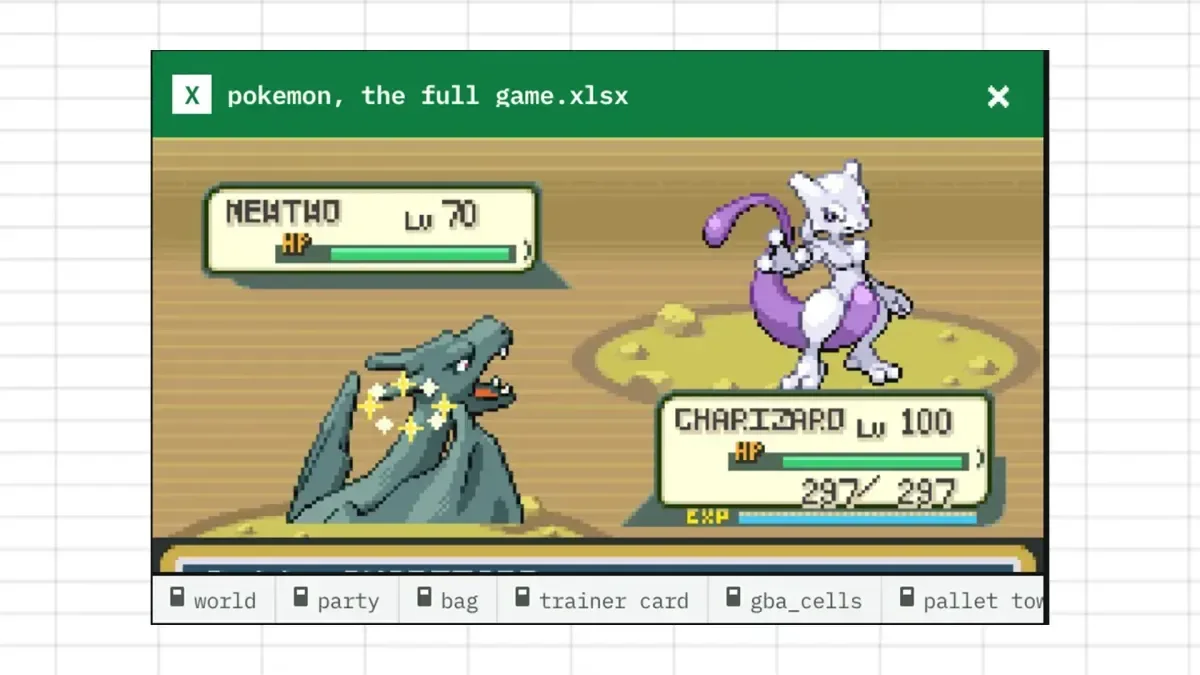
Microsoft Excel is built for budgets, formulas and the occasional chart that somehow becomes the most dramatic part of a meeting. It is not, by any reasonable description, a Game Boy Advance. Yet a project attributed to creator justaspreadsheet is attempting to place Pokémon FireRed inside the familiar grid of a spreadsheet, rendering the game’s visuals through coloured cells.
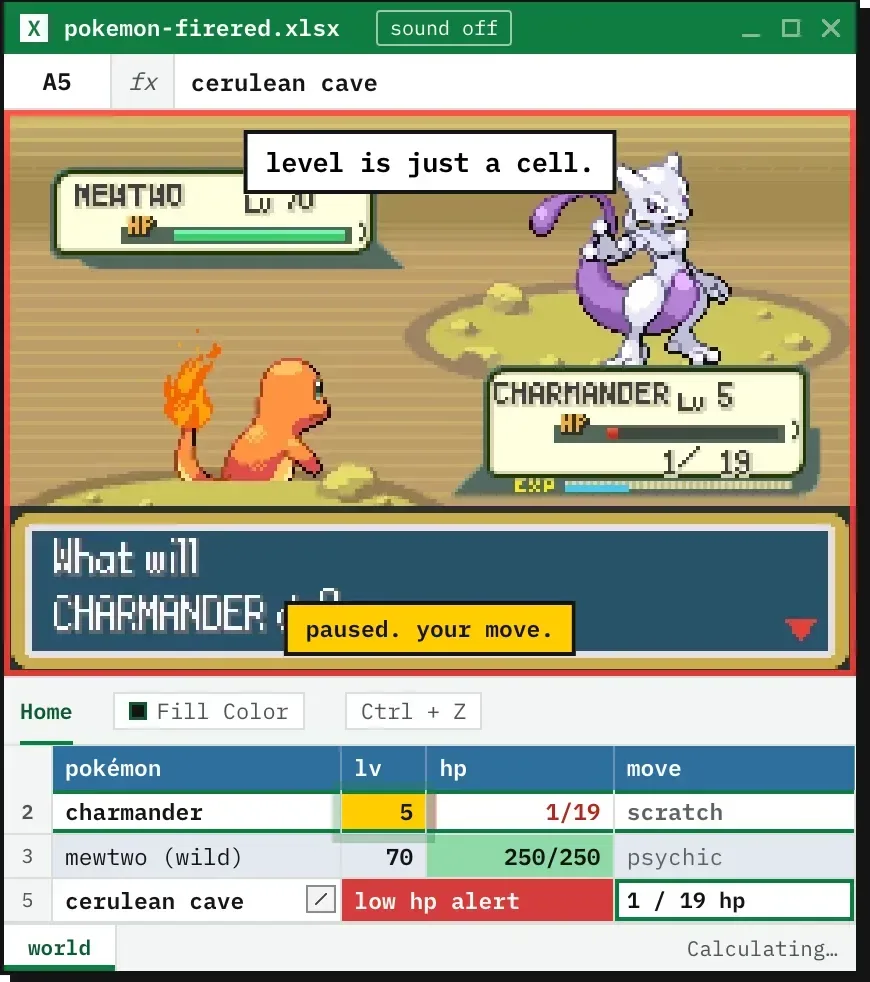
The result is a striking example of software being used far outside its intended purpose. Rather than presenting a conventional game window, the spreadsheet itself becomes the display: individual cells are coloured to represent the image on screen at a given moment. The project is described as matching a 24-by-160 grid, with every cell serving as a pixel-like unit, and more than 38,000 cells coloured during play.
It is an immediately understandable technical gag—Pokémon, but your screen looks ready to calculate quarterly expenses—yet the idea is more interesting than a simple novelty. A spreadsheet grid is not designed for rapid game rendering, character movement or world simulation. Getting an adventure game to appear and respond inside that environment means treating Excel’s basic visual building blocks as a tiny, highly unconventional display surface.
What “running in Excel” means here
In this context, a cell is being used as the smallest visible piece of the picture. Normally, a worksheet cell holds text, a number or a formula. Here, its colour is the important part. When a game image changes, the relevant cells must change colour to form the next frame or scene.
That distinction matters. The appeal is not that Excel has quietly become a normal handheld-game platform. It is that the spreadsheet interface is being repurposed into one. The rows and columns that usually organize data become a mosaic, collectively representing locations, characters and menus from the Pokémon world.
The project reportedly uses substantial AI assistance in its development. That description alone does not establish precisely what tasks the tools handled, whether that was code generation, troubleshooting, image handling or another workflow. What is clear is that the implementation depends on making a spreadsheet repeatedly update a large field of coloured cells in a way that resembles a game display.
Excel projects have long inspired this sort of technical mischief because the application is both restrictive and unexpectedly flexible. Its grid provides a ready-made canvas, while its customization options invite people to bend office software toward games, animations and other experiments. In this case, the limitation is the whole point: it turns a polished handheld-era visual language into an enormous arrangement of rectangular cells.
Places, edits and spreadsheet-specific twists
The available material indicates that the project includes a limited selection of areas rather than the complete original adventure. Pallet Town and Cerulean Cave are among the locations named. That is enough to demonstrate the core concept, but players should not mistake the experiment for confirmation of a full, faithful replacement for an official release.
Related coverage includes Pokémon FireRed Has Been Recreated Inside Microsoft Excel, One Cell at a Time.
One of the more unusual features is the ability to press Escape to freeze the game display, then edit cells and colours as in an ordinary spreadsheet. This is where the project stops merely imitating a game screen and begins exploiting the fact that it is housed in a workbook. The player can interrupt the illusion and directly alter its visual material.
Reported customization options go further, including cheats, changing Pokémon into shiny versions, setting levels, spawning Mewtwo and surfacing Mew under the franchise’s famous truck rumor. These are spreadsheet-powered alterations, not details that should be confused with the original game’s intended progression. The point is less authenticity than the odd pleasure of using office-document controls to meddle with a Pokémon save-state fantasy.
That Mew reference is especially revealing. The truck has long been tied to playground mythology around the original Pokémon games, and the Excel version’s use of it plays into that shared memory. It is not presented as evidence of a newly uncovered canonical secret. It is a customization flourish built around one of the series’ most durable in-jokes.
Compatibility is narrow
Anyone curious about the project should note the stated platform limits before expecting a universal spreadsheet download. The full version is said to require the desktop edition of Excel on Windows 10 or Windows 11. It is not described as working on Mac, and it does not work in Google Sheets.
Those restrictions make sense at a high level: spreadsheet programs may look alike, but they do not necessarily offer the same features or behave identically when handling automation and formatting. A workbook designed around particular desktop Excel behavior cannot simply be assumed to function in a browser-based alternative or on another operating system.
There is also a free demo for people who want to see the concept, while a paid version is reportedly offered. The project is described as a small segment rather than the entirety of Pokémon FireRed, despite claims around a “full game” version. Potential users should be particularly careful about those descriptions and check what is actually being offered.
The copyright question is bigger than the gimmick
The cleverness of the Excel presentation does not remove the intellectual-property issue. Pokémon FireRed, its characters and its game content are protected material. A third party charging money for a recreation or distribution based on that material creates obvious legal and ethical concerns, especially when there is no indication of authorization from the rights holders.
That does not mean every technical experiment inspired by an older game is identical in legal terms; details such as what assets and code are included can matter. But a paid product using a recognizable commercial game’s content is a different proposition from discussing the concept, recreating a visual effect independently, or making a tool that does not distribute protected game material.
The practical takeaway is straightforward: treat this as an interesting software experiment, not a substitute for an official copy of the game. A free demonstration may let curious users understand how the workbook effect looks without endorsing a paid, unauthorized-looking release. Be cautious with downloads that request personal information, too; the demo is said to require an email address.
Why projects like this still attract attention
There is a lasting appeal to seeing a familiar game forced through an unfamiliar machine. The strange venue makes people reconsider both halves of the equation: how little a display needs in order to convey a game world, and how much capability sits inside an everyday productivity program.
It also lands at a moment when AI-assisted development is becoming part of the conversation around hobby projects. In this case, the claimed assistance is part of the story, but it should not eclipse the more concrete observation: the creator has built a system that uses spreadsheet formatting as its visual language. The AI label describes part of the reported process, not a shortcut that explains every design and technical decision by itself.
For retro-game fans, the project’s strongest draw may be its collision of two very different kinds of nostalgia. FireRed evokes the Game Boy Advance era; Excel evokes classrooms, offices and the dead-eyed realization that someone has added a second tab called “Final_FINAL_v7.” Combining them is absurd, but it is a carefully targeted absurdity.
The same urge to revisit older games through new technical contexts also continues to shape retro experimentation, as seen in an AI-enhanced 16-bit reimagining of The Hobbit for Amiga AGA. The common thread is not official preservation or replacement hardware. It is curiosity about what familiar game ideas look like when rebuilt around different constraints.
Excel Pokémon therefore works best as a spectacle of constraint. It is a colourful grid that asks an office program to cosplay as a handheld console, lets users pause the illusion to repaint it, and reminds everyone that the most inventive-looking fan projects can still carry serious rights concerns. The spreadsheet may be full of monsters, but anyone considering the paid offering should keep one eye on the cells and the other on the legal fine print.