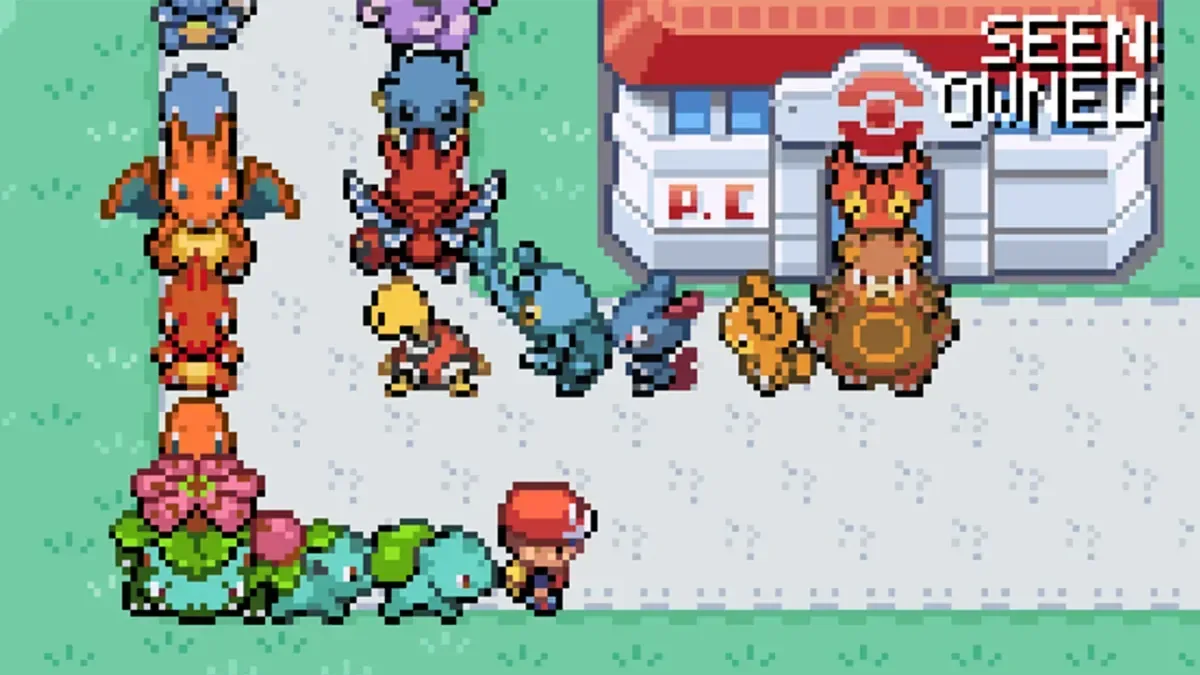
A small Pokémon FireRed ROM hack is taking a decidedly different route from the sprawling fan projects that build new regions, stories and systems. Pokémon Snake, a beta project from developer ranbpa0, uses FireRed’s world for a compact arcade-style challenge: walk between Pallet Town and Viridian City while an ever-growing chain of Pokémon sprites follows behind the player.
The premise takes its cue from Snake, the classic game built around steering a growing tail for as long as possible. Here, the “tail” is not a line or a series of blocks. It is made of Pokémon sprites. Each step adds another creature to the procession, turning a familiar stretch of Kanto into a test of how many followers the game, emulator, or device can keep on screen and moving.
It is an intentionally simple concept, but one with a clear novelty: FireRed’s sprite work becomes the centerpiece rather than the backdrop for a conventional Pokémon adventure. The objective is a high score, and the escalating spectacle comes from seeing a huge collection of individual Pokémon sprites strung out behind the player.
From technical stress test to tiny arcade game
Pokémon Snake began as an experiment for a different hack. ranbpa0 was testing what would happen when large numbers of Pokémon were made to follow the player character, initially trying to push the emulator toward its limits. That stress test produced the central idea: if accumulating followers could overload or visually disrupt the game, it could also form the basis of a score-chasing mini-game.
That origin matters because the project is as much about a technical oddity as a traditional gameplay loop. A ROM hack is a fan-made modification of a game’s original data or code. In this case, the modification changes the behavior of the FireRed experience so the player can build an unusually large party-like trail of sprites rather than simply having one conventional follower.
The result is not presented as a replacement for FireRed or as a deep new role-playing campaign. It is a focused challenge built on one question: how far can the chain grow before the player’s run ends or performance becomes the limiting factor?
That makes the project a close cousin to an arcade score attack. Score attacks strip an experience down to repeatable play and measurable performance, encouraging players to improve an individual run rather than progress through a long narrative. Pokémon Snake applies that structure to a Game Boy Advance-era Pokémon setting, where every movement is also a new addition to the sprite train.
The route is familiar; the goal is not
The playable challenge is set on the area between Viridian City and Pallet Town. For longtime FireRed players, that is a recognizable slice of Kanto. Pokémon Snake changes the significance of the journey, however. The route is not being used to deliver an early-game quest, capture Pokémon, or advance a Gym-focused adventure. It is the board on which the run plays out.
Related coverage includes Pokémon Snake Turns FireRed Into a Growing Sprite-Chain Challenge.
Every step increases the number of sprites following the player. Hundreds can potentially accumulate, provided the hardware or emulation setup can manage them. The visual hook is immediate: a game known for displaying Pokémon in predictable encounters instead becomes a moving mass of character art.
The design also makes a practical constraint part of the challenge. More followers mean more activity for the software to manage. On a project conceived while attempting to break an emulator, instability is not merely an abstract development issue—it is close to the game’s premise. Players may be chasing a personal score, but they are also discovering the limits of their chosen setup.
What “sprites” means in this context
A sprite is a two-dimensional visual graphic used to represent a character, object, or other moving element in a game. Pokémon Snake’s signature is that the player’s growing tail is composed of those Pokémon graphics. Rather than asking players to imagine a numerical total, the hack gives the total a visible form.
That visual approach is why the idea has more personality than a standard counter. A long run is a dense, chaotic line of Pokémon sprites, and the growing display lets players see the score build in real time. It also makes visual errors more noticeable once the crowd becomes large.
Beta status means bugs are part of the picture
Pokémon Snake remains in beta and is open for testing through ranbpa0’s Discord channel. That status should be taken literally: the project is still being worked on, and it has known rough edges. Reports from testing note that, deep into a run with hundreds of followers spawned, sprites may not always display correctly.
There is no confirmed single cause for those issues. The problem could relate to the particular emulator or device being used, the unusually high number of active sprites, or unfinished elements of the hack itself. AI-assisted development has been raised as a possible factor, but that is speculation rather than a confirmed technical diagnosis. The developer is attempting to address the bugs.
For players, the useful expectation is straightforward: a huge chain is the point, but it may also be where the game becomes least predictable. A smooth early run does not guarantee that the same configuration will behave identically once the on-screen procession is much larger.
That is not necessarily a strike against the idea. Experimental ROM hacks often reveal their personality at the edges of what the base game was expected to do. Still, anyone approaching Pokémon Snake should treat it as a work in progress rather than assume the reliability of a finished commercial release.
Music controls offer a small but smart quality-of-life option
ranbpa0 has included a way to change the music during play. On Game Boy Advance hardware, the shoulder buttons handle the change; on an emulator, the equivalent controls are L and R. It is a minor feature, yet one that suits a repeatable score-chasing game particularly well.
Arcade-style runs can involve replaying the same activity many times, and audio repetition can become more noticeable when the underlying structure is deliberately narrow. Allowing music changes gives the player some control over that repetition without complicating the core mechanic.
It also illustrates the project’s priorities. Pokémon Snake does not need layers of menu systems or a large quest log to communicate what it is. Its main interaction is movement and accumulation. The music option supports that loop without distracting from it.
Compatibility is likely to be part of the experiment
Because the hack’s core gimmick can create hundreds of followers, players should expect performance to vary between emulators and devices. The available account of testing used AfterPlay on a Mac without an apparent system-level problem, but that is only one configuration, not a guarantee for all players or platforms.
In practical terms, players interested in the beta may want to keep their expectations modest when pushing a run to extremes. If sprite behavior starts to look wrong late in a chain, that does not by itself establish whether the issue comes from the hack, the emulator, or the amount of activity being demanded from the setup. Testing different environments may be useful, but it should be approached carefully and only with files obtained from places a player trusts.
Downloading ROM-related files from Discord servers or other third-party locations carries risks. Players should use their own judgment, inspect what they download, and avoid treating a community download as automatically safe. The beta’s experimental nature makes caution especially sensible.
Why the idea stands out
Fan-made Pokémon projects are often discussed in terms of scale: new maps, rewritten stories, altered battle systems, or large collections of additional content. Pokémon Snake goes in the opposite direction. It takes one surprising behavior—lots of Pokémon following the player—and commits to it.
That narrowness is a strength. The concept is easy to explain, easy to watch, and potentially difficult to master once the chain becomes enormous. It turns a technical challenge into the whole show, while retaining the instantly recognizable look of FireRed.
There is also a broader appeal in seeing older game technology used for playful experiments rather than only preservation. Another recent example of revisiting classic game systems can be seen in this playable recreation of early GTA-style driving physics. Pokémon Snake operates on a much smaller scale, but it shares that interest in exposing and reshaping the behavior of familiar games.
For now, Pokémon Snake is best viewed as a beta curiosity with a strong visual hook: a FireRed route, a growing score, and a trail that can become a crowd of Pokémon sprites. Whether a particular setup can comfortably handle that crowd is part of the challenge—and, fittingly, part of the experiment that created it.